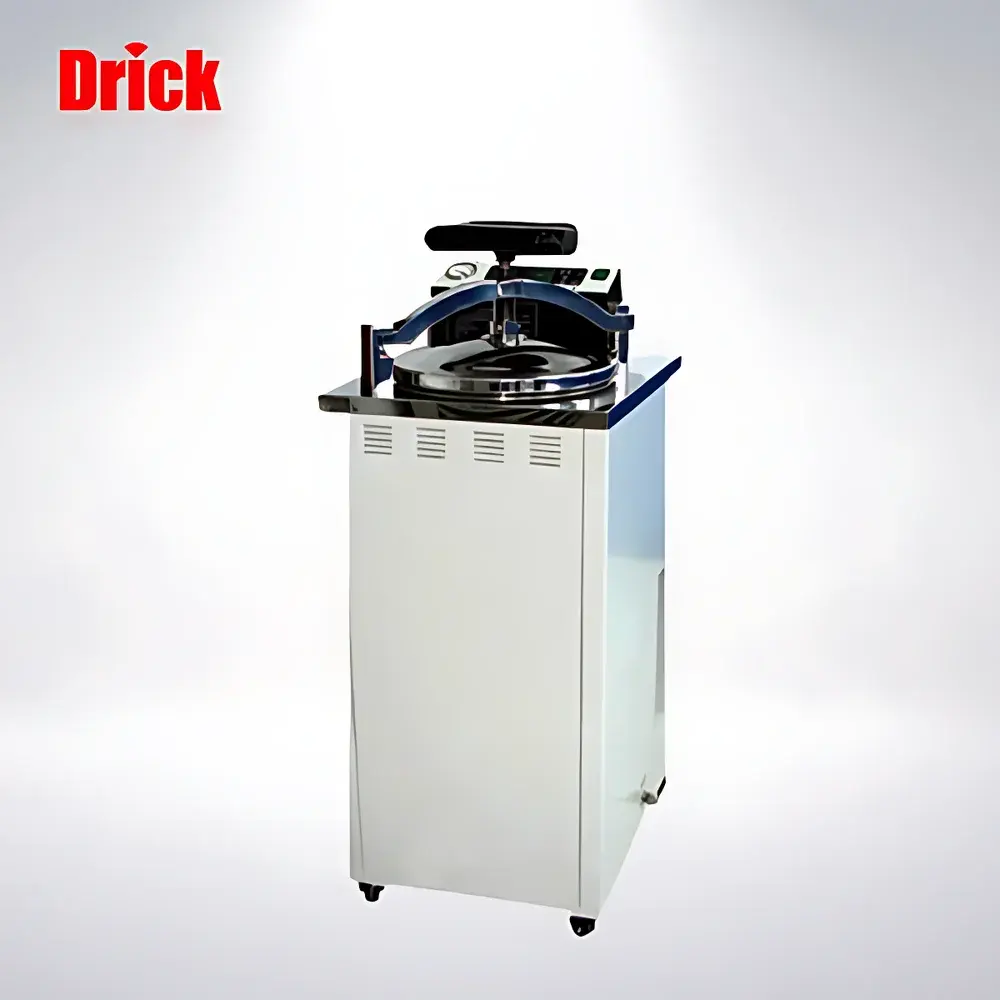
Drick DRK137 Reverse-Pressure High-Temperature Retort Cooker (30 L / 50 L / 70 L Configurable Capacity)
| Brand | Drick |
|---|---|
| Origin | Shandong, China |
| Manufacturer Type | Direct Manufacturer |
| Country of Origin | China |
| Model | DRK137 |
| Power Supply | AC 220 V, 50 Hz (Grounding Required) |
| Operating Temperature Range | 101–135 °C (Steam Mode), ≤100 °C (Water-Boiling Mode) |
| Retort Chamber Volume | 50 L (Standard |
| Steam Pressure Limit | 0.25 MPa (Auto-Relief at Threshold) |
| Cooling Method | Compressed Air + Water Quench (≤3 min to 30–40 °C) |
| Water Supply Pressure | 0.15–0.25 MPa |
| Air Supply Pressure | 0.25 MPa (Stable) |
| Timer Range | 0–99 min |
| Relative Humidity Limit | ≤80 % RH |
| Safety Features | Dual Safety Valves, Overtemperature Cutoff at 140 °C, Overpressure Relief, Low-Water Level Detection, Leakage Protection, Heater Overload Protection, Audible End-of-Cycle Alert |
Overview
The Drick DRK137 Reverse-Pressure High-Temperature Retort Cooker is an engineered laboratory-scale retort system designed for accelerated thermal stability evaluation of flexible packaging materials and related components under controlled pressurized steam conditions. It operates on the principle of saturated steam sterilization and thermal aging—leveraging precise pressure–temperature coupling to replicate industrial autoclave and retort processing environments. Unlike ambient-pressure boiling units, the DRK137 maintains a dynamically balanced reverse-pressure profile during cooling, preventing package deformation, delamination, or seal failure caused by rapid internal vapor condensation and vacuum collapse. This capability is essential for validating the integrity of laminated pouches, metallized films, adhesive bonds, and printed inks subjected to high-temperature food packaging processes per global regulatory expectations.
Key Features
- Microprocessor-based PID temperature and pressure control with real-time digital display and programmable cycle parameters
- Dual-mode operation: saturated steam retorting (101–135 °C) and atmospheric water-boiling (≤100 °C)
- Integrated reverse-pressure quench system using regulated compressed air and auxiliary water injection—achieving uniform cooling from peak temperature to 30–40 °C within ≤3 minutes
- Redundant mechanical safety architecture: two independent spring-loaded safety valves calibrated to open automatically at 0.25 MPa; overtemperature cutoff at 140 °C; low-water-level sensor; earth-leakage circuit interrupter (ELCI); and heater overload protection
- Stainless steel retort chamber with removable dual-tier perforated trays (275 × 190 × 20 mm each) for optimized steam circulation and sample accessibility
- Audible end-of-cycle alarm and automatic power disengagement upon completion
Sample Compatibility & Compliance
The DRK137 accommodates standard flexible packaging formats—including stand-up pouches, flat-bottom bags, sachets, and laminated film strips—up to 50 L chamber capacity (configurable to 30 L or 70 L). Its design supports standardized test specimen mounting without compression or constraint, ensuring representative thermal exposure. The system complies with key national standards governing packaging performance testing, including GB/T 10004–2008 (Flexible Composite Packaging Materials for Food), GB/T 21302–2007 (General Technical Requirements for Flexible Packaging), and aligns with functional requirements referenced in ASTM F2054 (Standard Test Method for Measuring Package and Seal Integrity Using Internal Pressurization) and ISO 11607-2 (Packaging for terminally sterilized medical devices — Part 2: Validation requirements for forming, sealing and assembly processes). All operational parameters are traceable and repeatable under GLP-aligned lab conditions.
Software & Data Management
While the DRK137 operates via embedded firmware without external PC connectivity, its control interface logs critical process variables—including setpoint temperature, actual chamber temperature, elapsed time, and safety event triggers (e.g., valve activation, overtemperature cut-off)—into non-volatile memory. Cycle records can be manually transcribed for audit trails. For laboratories requiring electronic data capture and 21 CFR Part 11 compliance, optional RS-485 or analog 4–20 mA output modules (available as add-on accessories) enable integration with validated SCADA or LIMS platforms. All safety-critical interlocks remain fully functional independent of external systems.
Applications
- Thermal resistance validation of heat-seal strength and peel adhesion in multilayer food pouches
- Evaluation of ink fade, pigment migration, and print adhesion stability after retort exposure
- Accelerated aging studies of pressure-sensitive adhesives used in labeling and lamination
- Process qualification for aseptic and extended-shelf-life (ESL) packaging development
- Research into polymer chain relaxation, crystallinity shifts, and interfacial degradation mechanisms under combined thermal–mechanical stress
- Pre-validation testing prior to full-scale commercial retort trials
FAQ
What is the purpose of reverse-pressure cooling in retort testing?
Reverse-pressure cooling applies regulated compressed air to maintain internal chamber pressure while introducing cooling water—preventing negative pressure differentials that cause pouch collapse, seal rupture, or delamination during rapid cooldown.
Does the DRK137 meet international food contact material regulations?
The unit itself is not a food contact material but serves as a test apparatus. Its stainless steel chamber and plumbing conform to GB 4806.9–2016 (Food Contact Metal Materials) and support protocols required by FDA 21 CFR §177.1390 (for polyolefin laminates) and EU Regulation (EC) No. 1935/2004.
Can the DRK137 be used for microbiological sterility validation?
No—it is a physical performance tester, not a sterilizer. It does not provide biological indicators, F0 calculation, or validation-grade temperature mapping per ISO 17665 or EN 285. Its role is mechanical and thermal integrity assessment only.
Is external compressed air supply mandatory?
Yes. A stable 0.25 MPa clean, dry, oil-free air source is required for reverse-pressure quenching. Failure to meet this specification compromises cooling uniformity and voids test validity.
How often should safety valves be certified?
Per GB/T 12243–2021, safety valves must undergo annual calibration and functional verification by an accredited metrology institution—documented in the lab’s equipment maintenance log.