
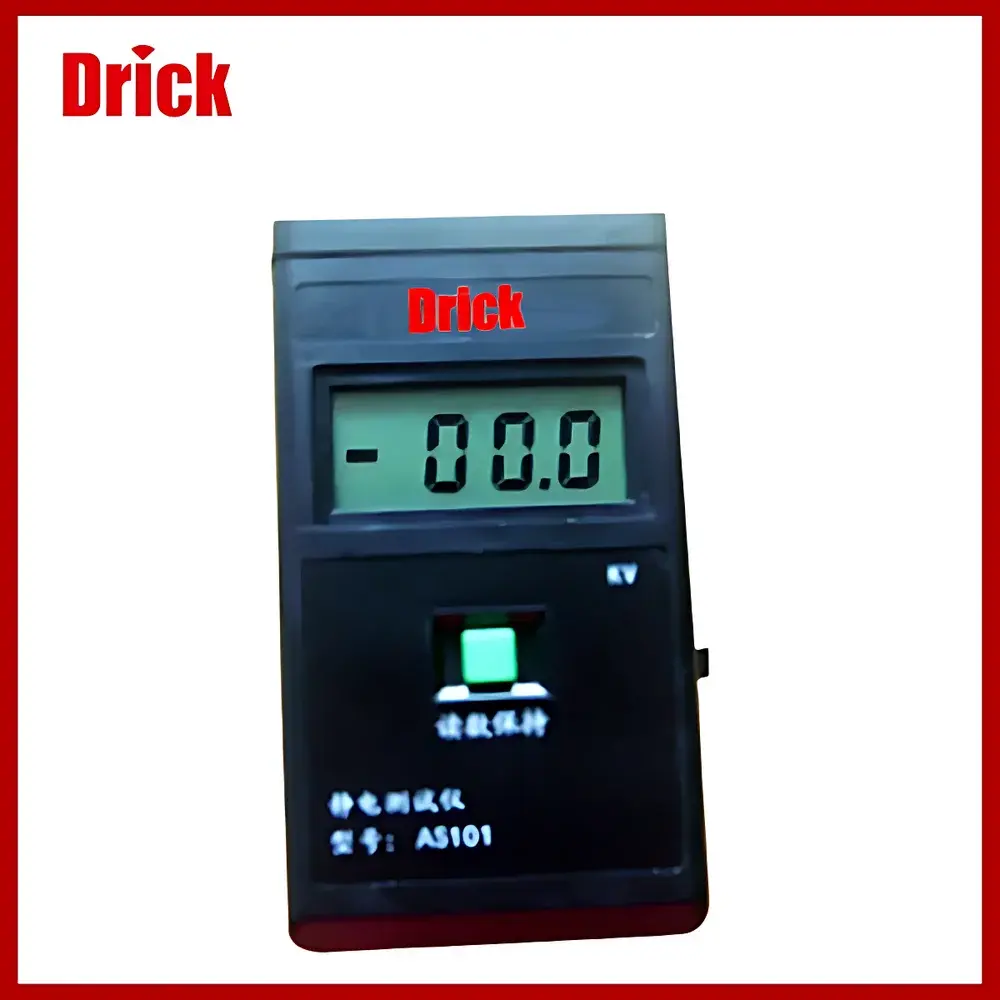
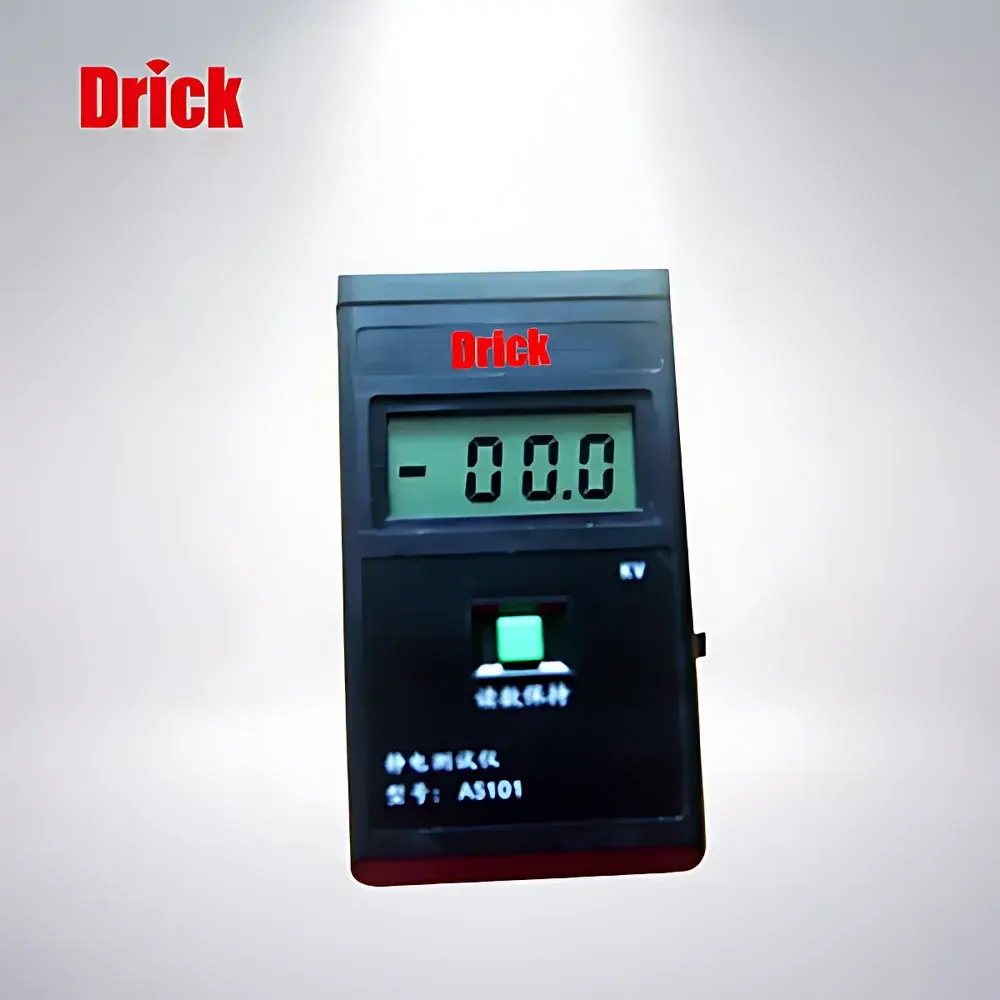
Drick DRK151 Electrostatic Voltmeter
| Brand | Drick |
|---|---|
| Model | DRK151 |
| Measurement Principle | Non-contact electrostatic field induction |
| Display | 3.5-digit LCD with polarity indication |
| Range (at 1″) | 0–20,000 V (100 V resolution) |
| Range (at 0.1″) | 0–2,000 V (10 V resolution) |
| Extended Ranges | ±40 kV (×2 at 4″), ±60 kV (×3 at 6.5″), ±80 kV (×4 at 8.5″) |
| Accuracy | ±10% of reading |
| Input Impedance | >10¹⁴ Ω |
| Probe Distance Calibration | Fixed 25.4 mm (1″) reference scale |
| Polarity Detection | Automatic positive/negative sign display |
| Battery | 9 V alkaline (IEC 6LR61), with low-battery indicator (“BAT”) |
| Sample Hold Function | Manual trigger for stable reading capture |
| Housing Material | Static-dissipative polymer with integrated grounding path |
| Dimensions | 107 × 61 × 23 mm |
| Weight | 142 g (5 oz) |
| Calibration | NIST-traceable certificate included |
| Warranty | 12 months (voided upon housing breach) |
| Compliance | Meets ANSI/ESD S20.20 recommended practices for field instrumentation |
| Operating Environment | 10–35 °C, <80% RH non-condensing |
Overview
The Drick DRK151 Electrostatic Voltmeter is a handheld, non-contact instrument engineered for quantitative measurement of surface electrostatic potential on conductive, dissipative, and insulating materials—without physical contact or charge disturbance. It operates on the principle of capacitive field coupling: an internal sensing electrode detects the electric field generated by surface charge, converting it into a proportional voltage signal via high-impedance (>10¹⁴ Ω) charge amplification. The device is calibrated to report electrostatic potential (in volts) referenced to earth ground, with automatic polarity identification critical for root-cause analysis in ESD-sensitive environments. Designed for field use in industrial hygiene, process safety, and quality assurance workflows, the DRK151 delivers repeatable measurements under variable humidity and ambient temperature conditions typical of production floors, laboratories, and storage facilities.
Key Features
- Non-contact measurement eliminates surface charge perturbation and ensures operator safety during high-voltage assessments.
- Fixed 25.4 mm (1 inch) reference distance scale enables consistent probe positioning for inter-laboratory reproducibility.
- Multi-range configuration supports flexible deployment: standard 0–20 kV range at 1″, extended ±40 kV (×2), ±60 kV (×3), and ±80 kV (×4) modes for elevated potentials at greater standoff distances.
- Real-time polarity detection displays “+” or “−” prefix automatically—essential for identifying triboelectric charging mechanisms and verifying grounding efficacy.
- Manual sample hold function freezes displayed value for documentation or comparison without requiring continuous stabilization.
- Integrated static-dissipative housing provides a controlled discharge path to ground when held properly, reducing measurement drift from operator-induced fields.
- NIST-traceable calibration certificate supplied with each unit ensures metrological traceability per ISO/IEC 17025 requirements for accredited testing laboratories.
Sample Compatibility & Compliance
The DRK151 measures electrostatic potential on solid surfaces (e.g., polymer sheets, painted metal panels, PCB substrates), liquid interfaces (e.g., hydrocarbon surfaces in tanks or pipelines), and human skin—provided the target remains within defined standoff limits and environmental constraints. It complies with ANSI/ESD S20.20 Annex B guidelines for field meter verification and supports compliance verification for IEC 61340-5-1, MIL-STD-1686, and NFPA 77. While not intrinsically safe, its battery-powered operation and absence of spark-prone circuitry make it suitable for Zone 2 classified areas when used per manufacturer-specified handling protocols. No ATEX or IECEx certification is claimed; users must assess suitability against local hazardous area regulations.
Software & Data Management
The DRK151 is a standalone analog-digital hybrid instrument with no embedded memory or USB/Bluetooth interface. All data acquisition is manual: operators record values alongside contextual metadata (distance, material type, ambient RH/T, grounding status). For audit readiness, users are advised to log readings in paper-based or electronic notebooks compliant with 21 CFR Part 11 (if using validated LIMS or ELN platforms). The included NIST certificate documents as-received accuracy against primary standards; annual recalibration is recommended to maintain measurement integrity in GLP/GMP-regulated settings.
Applications
- Petrochemical operations: Monitoring charge accumulation on tank walls, filters, and transfer hoses during hydrocarbon loading/unloading to mitigate ignition risk.
- Electronics manufacturing: Verifying static dissipation performance of work surfaces, wrist straps, footwear, and packaging materials per ESD Association standards.
- Pharmaceutical processing: Assessing electrostatic hazards in powder blending, tablet coating, and dry granulation where charged particles may affect content uniformity or pose explosion risk.
- Printing & converting: Diagnosing static-related web misregistration, dust attraction, and ink misting on press lines.
- Aerospace composites handling: Validating charge decay behavior of carbon-fiber prepregs and tooling surfaces prior to layup.
- Academic research: Supporting triboelectric series studies, material resistivity mapping, and corona discharge characterization experiments.
FAQ
What is the minimum measurable distance between the probe and the surface?
The calibrated reference distance is fixed at 25.4 mm (1 inch); measurements taken at other distances require multiplication factors (×2, ×3, or ×4) as specified in the operating manual.
Does the DRK151 require periodic recalibration?
Yes—annual recalibration against NIST-traceable references is recommended to maintain stated ±10% accuracy, especially after mechanical shock or exposure to extreme humidity.
Can the instrument measure charge on moving webs or rotating drums?
It can provide spot measurements on stationary targets; for dynamic applications, users must ensure consistent standoff geometry and account for motion-induced field distortion.
Is the DRK151 suitable for Class I, Division 1 hazardous locations?
No—it lacks intrinsic safety certification and is intended for general-purpose use in non-classified or Zone 2 environments only.
How does humidity affect measurement stability?
Relative humidity below 30% may increase surface resistivity and prolong charge retention, potentially elevating readings; above 60%, rapid charge leakage may reduce observed potentials—ambient RH should be logged with each measurement.



