
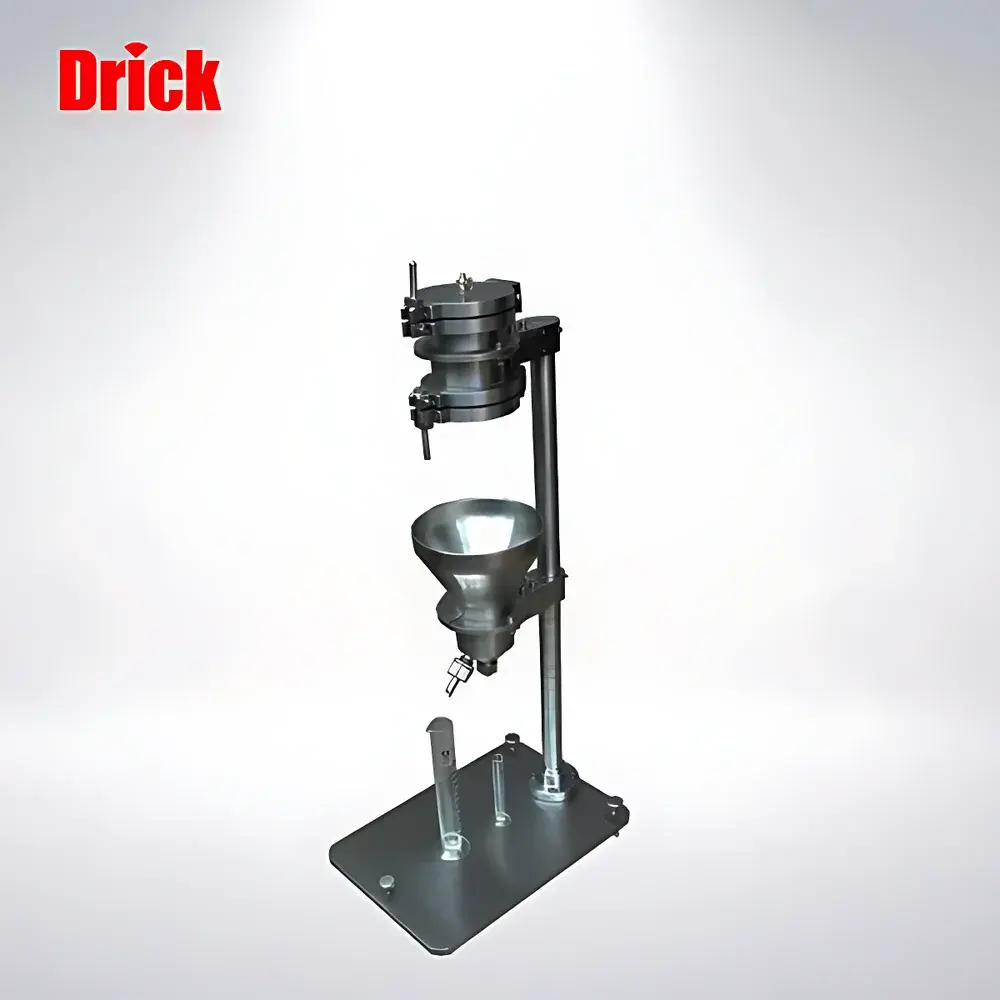
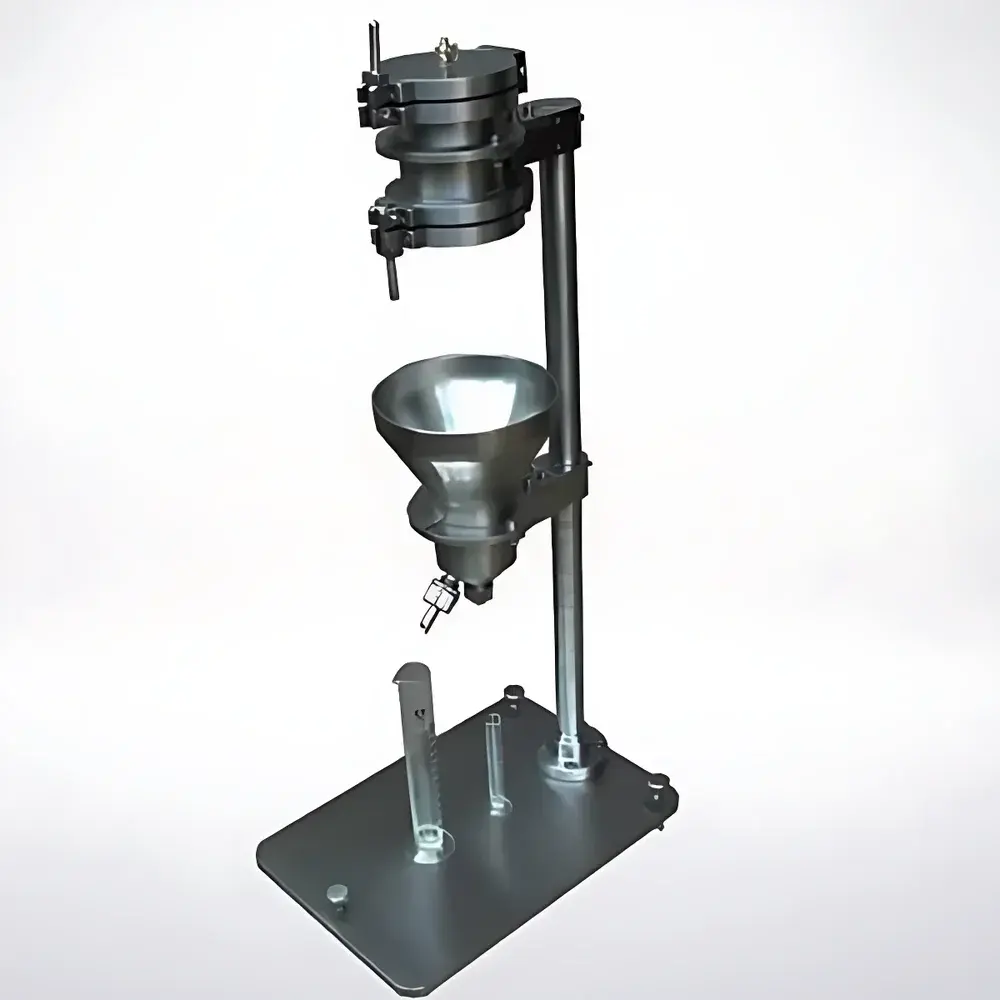
Drick DRK261 Canadian Standard Freeness Tester
| Brand | Drick |
|---|---|
| Origin | Shandong, China |
| Manufacturer Type | Manufacturer |
| Country of Origin | China |
| Model | DRK261 |
| Price | USD 7,000 (FOB Qingdao) |
Overview
The Drick DRK261 Canadian Standard Freeness Tester is a precision laboratory instrument engineered for quantitative assessment of the dewatering rate of pulp suspensions—expressed as Canadian Standard Freeness (CSF), measured in milliliters (mL). It operates on the principle of gravity-driven filtration through a standardized perforated plate under controlled geometric and hydrodynamic conditions, in strict accordance with TAPPI T227 “Standard Test Method for Canadian Standard Freeness of Pulp”. The CSF value serves as a critical process indicator in pulp and paper manufacturing, correlating directly with fiber fibrillation, cutting, and refining intensity. A higher CSF value indicates faster drainage and lower fiber development (e.g., mechanical pulps or lightly refined chemical pulps), while lower values reflect greater fiber entanglement and swelling—key parameters influencing sheet formation, strength development, and press performance on the paper machine.
Key Features
- Two-tier chamber design: Separates outer jacket and inner cylinder to facilitate rapid, residue-free removal and cleaning of the pulp chamber after each test.
- Removable 304 stainless steel filtration plate conforming precisely to TAPPI T227 dimensional and tolerance specifications (diameter: 101.6 mm; thickness: 1.02 mm; 128 holes of 0.38 mm diameter arranged in concentric rings).
- Adjustable side-outlet tube with calibrated orifice (inner diameter: 10.0 ± 0.1 mm), enabling precise volumetric collection of filtrate over the standard 5-minute test duration and supporting periodic recalibration traceable to NIST-referenced flow standards.
- Robust cast-aluminum base and anodized aluminum structural components ensure long-term dimensional stability and resistance to aqueous corrosion during routine operation.
- Optional wall-mounted configuration available for laboratories with constrained bench space—includes reinforced mounting bracket and alignment guide for vertical plumb installation per ASTM D646 standard setup requirements.
Sample Compatibility & Compliance
The DRK261 accepts pulp suspensions within the concentration range of 0.15–0.30% (w/w), prepared according to TAPPI T205 “Preparation of Laboratory Samples of Pulp” and diluted to target consistency using deaerated, temperature-controlled (20.0 ± 0.5 °C) distilled water per TAPPI T211. It is validated for use with hardwood, softwood, and non-wood pulps—including kraft, sulfite, mechanical, and recycled grades—as well as blended suspensions containing fillers or retention aids. All wetted parts comply with FDA 21 CFR §177.2420 for indirect food-contact suitability where applicable. Instrument documentation includes full traceability to TAPPI T227, ISO 5267-1:2019, and SCAN-CM 27:2016, supporting GLP-compliant testing environments and internal audit readiness.
Software & Data Management
While the DRK261 is a manually operated gravimetric/volumetric tester requiring operator timing and volume reading, it integrates seamlessly into digital QA/QC workflows via optional companion software (DRK-DataLink v2.1, sold separately). This Windows-based application supports manual entry or USB-connected digital burette input, auto-calculates CSF using the standard formula (CSF = 1000 − 10 × V, where V = mL filtrate collected in 5 min), applies temperature correction per TAPPI T227 Annex A, and exports timestamped CSV reports compliant with ISO/IEC 17025 record-keeping requirements. Audit trails, user access levels, and electronic signatures align with FDA 21 CFR Part 11 readiness when deployed with validated IT infrastructure.
Applications
- Refining optimization: Correlating CSF trends with specific energy input (kWh/ton) to establish refining endpoints for bleached kraft pulp production.
- Batch consistency monitoring: Detecting deviations in pulp furnish from different digesters or recycling lines prior to blending.
- Quality control of recycled fiber: Assessing hornification effects after drying and repulping cycles.
- R&D screening: Evaluating enzymatic treatment efficacy or novel refining technologies (e.g., PFI磨, high-consistency refining) via comparative CSF shifts.
- Supplier qualification: Verifying incoming pulp specifications against contractual CSF tolerances (e.g., ±15 mL CSF for market hardwood kraft).
FAQ
What is the required sample preparation procedure before running a CSF test?
Samples must be disintegrated per TAPPI T205, diluted to 0.25% ± 0.01% consistency, and tempered to 20.0 ± 0.5 °C in a water bath for ≥10 minutes prior to pouring into the chamber.
Can the DRK261 be used for handsheets or formed paper testing?
No—the DRK261 is designed exclusively for dilute pulp suspensions; it does not measure drainage of formed sheets or consolidated mats.
How often should the side-outlet tube be recalibrated?
TAPPI recommends annual calibration verification using a certified volumetric flask and stopwatch; more frequent checks are advised if the tube is physically disturbed or cleaned with abrasive tools.
Is the filtration plate compatible with ISO 5267-1 testing?
Yes—the 304 stainless steel plate meets both TAPPI T227 and ISO 5267-1 dimensional and material specifications, enabling cross-standard comparability without hardware modification.
Does the instrument include certification documentation for metrological traceability?
Each unit ships with a factory calibration certificate referencing NIST-traceable flow standards and dimensional verification reports for the plate and outlet tube.





