
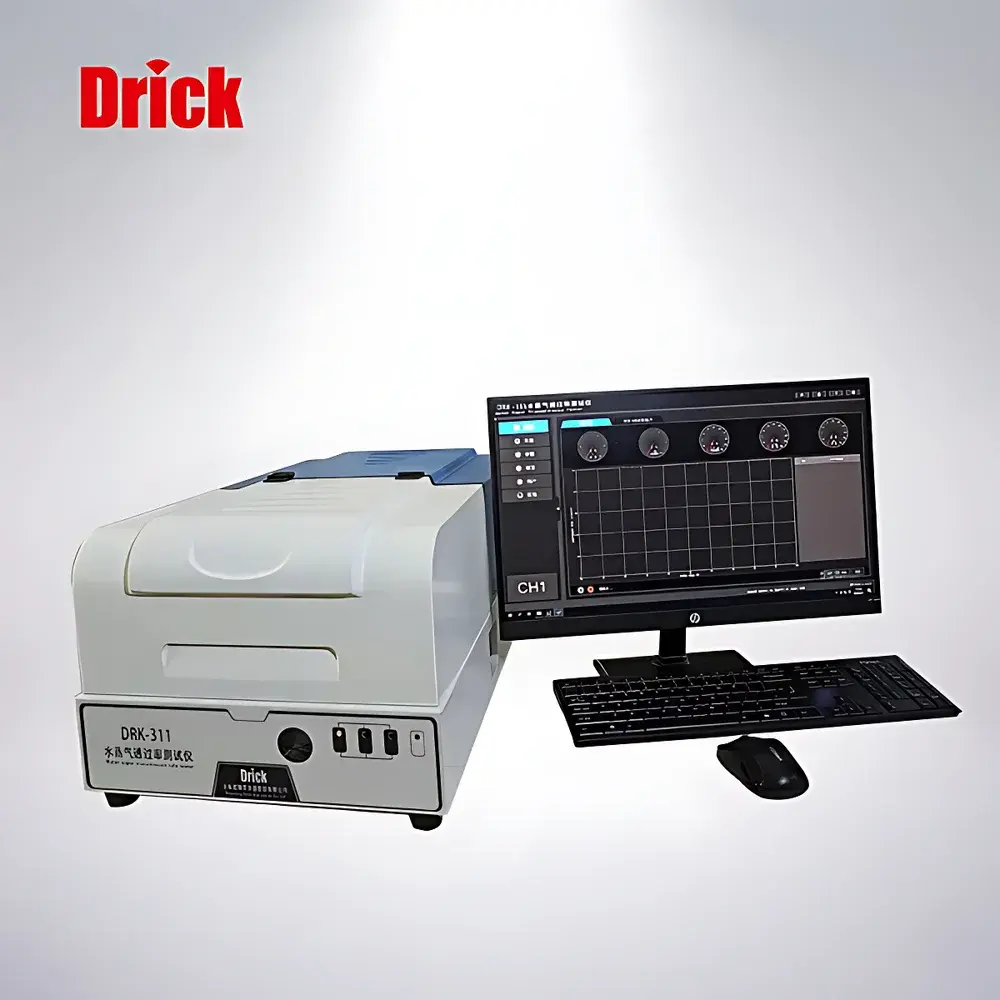


Drick DRK311 Triple-Chamber Electrolytic Water Vapor Transmission Rate (WVTR) Tester for Plastic Packaging Materials
| Brand | Drick |
|---|---|
| Origin | Shandong, China |
| Manufacturer Type | Direct Manufacturer |
| Country of Origin | China |
| Model | DRK-311 |
| Test Range | 0.01–40 g/(m²·24h) |
| Resolution | 0.01 g/(m²·24h) |
| Sample Capacity | 3 independent chambers |
| Sample Size | 100 mm × 110 mm |
| Effective Test Area | 50 cm² |
| Max Sample Thickness | ≤3 mm |
| Temperature Control Range | 15–55 °C |
| Temp. Accuracy | ±0.1 °C |
| Humidity Control Range | 50–90 %RH |
| RH Accuracy | ±2 %RH |
| Carrier Gas Flow Rate | 100 mL/min |
| Carrier Gas | 99.999% high-purity nitrogen |
| Dimensions (W×D×H) | 680 × 380 × 300 mm |
| Power Supply | AC 220 V, 50 Hz |
| Net Weight | 72 kg |
Overview
The Drick DRK311 Triple-Chamber Electrolytic Water Vapor Transmission Rate (WVTR) Tester is a precision instrument engineered for the quantitative determination of water vapor permeation through flexible packaging materials—including plastic films, laminated structures, coated papers, and pharmaceutical blister foils—under controlled temperature and humidity conditions. It operates on the principle of coulometric electrolytic detection, in accordance with ASTM F1249 and ISO 15106-3 standards. In this method, water vapor diffusing through the test specimen is carried by a dry, high-purity nitrogen stream into an electrolytic sensor chamber, where moisture is quantitatively decomposed into hydrogen and oxygen via a solid polymer electrolyte (SPE) membrane. The resulting current is directly proportional to the mass flow rate of water vapor, enabling trace-level, high-reproducibility WVTR measurement down to 0.01 g/(m²·24h). Unlike gravimetric or infrared-based systems, the electrolytic detection architecture delivers superior long-term stability, minimal baseline drift, and immunity to ambient humidity fluctuations—critical attributes for QC laboratories operating under GLP or GMP-compliant environments.
Key Features
- Three fully independent test chambers enable concurrent evaluation of up to three identical or dissimilar specimens—significantly improving throughput without cross-contamination or thermal/hygrometric interference.
- Precision dual-zone environmental control system maintains stable temperature (15–55 °C, ±0.1 °C) and relative humidity (50–90 %RH, ±2 %RH) across all chambers, ensuring compliance with standardized test conditions per ASTM D1653 and ISO 2528.
- Integrated coulometric sensor utilizes a Nafion®-based solid polymer electrolyte membrane, delivering linear response over the full 0.01–40 g/(m²·24h) dynamic range with <0.5% repeatability (RSD).
- Automated computer-controlled operation includes real-time data acquisition, automatic endpoint detection, and built-in calibration verification routines using certified reference films.
- Modular hardware design supports optional upgrades including automated sample loading, expanded RH range (10–95 %RH), or integration with LIMS via OPC UA or CSV export protocols.
Sample Compatibility & Compliance
The DRK311 accommodates flat, non-porous, and semi-crystalline polymeric substrates up to 3 mm thick, including PET, OPP, PE, PP, EVOH, PVDC-coated films, aluminum-laminated composites, and barrier-coated paperboard. Specimen dimensions are standardized at 100 mm × 110 mm with a defined test area of 50 cm²—aligned with ISO 15106-3 and ASTM F1249 requirements. All operational parameters—including gas flow rate (100 mL/min ±1%), carrier gas purity (≥99.999% N₂), and sensor zeroing intervals—are programmable and logged with timestamped metadata. The system conforms to FDA 21 CFR Part 11 for electronic records and signatures, supporting audit-ready data integrity through role-based user authentication, immutable audit trails, and electronic signature capture for test initiation and report approval.
Software & Data Management
The proprietary Windows-based software platform implements a tiered permission model compliant with EU Annex 11 and USP analytical instrument qualification guidelines. Administrators, analysts, and reviewers are assigned distinct access levels governing method editing, test execution, and report generation. Every action—including parameter modification, calibration event, and result export—is time-stamped, user-identified, and archived in an encrypted SQLite database. Raw sensor output, environmental logs, and calculated WVTR values are stored in vendor-neutral CSV format; PDF reports include embedded digital signatures, instrument ID, calibration certificate references, and uncertainty statements per GUM (JCGM 100:2008). Data backup and remote monitoring are supported via USB 2.0 interface and optional Ethernet module.
Applications
This instrument serves critical quality assurance functions across multiple regulated sectors: food packaging R&D teams use it to validate shelf-life predictions for snack pouches and retort bags; pharmaceutical manufacturers rely on it for moisture barrier verification of cold-form blisters and sachets containing hygroscopic APIs; medical device packaging engineers apply it to assess sterility maintenance in Tyvek®/PET laminates; and academic researchers employ it in polymer science studies evaluating nanocomposite barrier enhancement mechanisms. Its triple-chamber architecture is especially valuable for comparative studies—e.g., assessing coating uniformity across production rolls, validating accelerated aging protocols, or benchmarking supplier material batches against internal specifications.
FAQ
What standards does the DRK311 comply with?
It supports ASTM F1249, ISO 15106-3, ASTM E96 (desiccant method reference), and GB/T 21529–2008.
Can the system operate without a nitrogen supply?
No—high-purity nitrogen (99.999%) is mandatory as the carrier gas to prevent sensor contamination and ensure electrochemical accuracy.
Is calibration traceable to national metrology institutes?
Yes—certified reference films with NIST-traceable WVTR values are available for routine performance verification.
How is data integrity maintained during power interruption?
The system features non-volatile memory that retains active test state and environmental logs; resumed tests preserve original timestamps and continuity flags.
Does the software support multi-language interfaces?
English and Simplified Chinese UIs are included; additional language packs may be deployed upon request for international deployment.



