
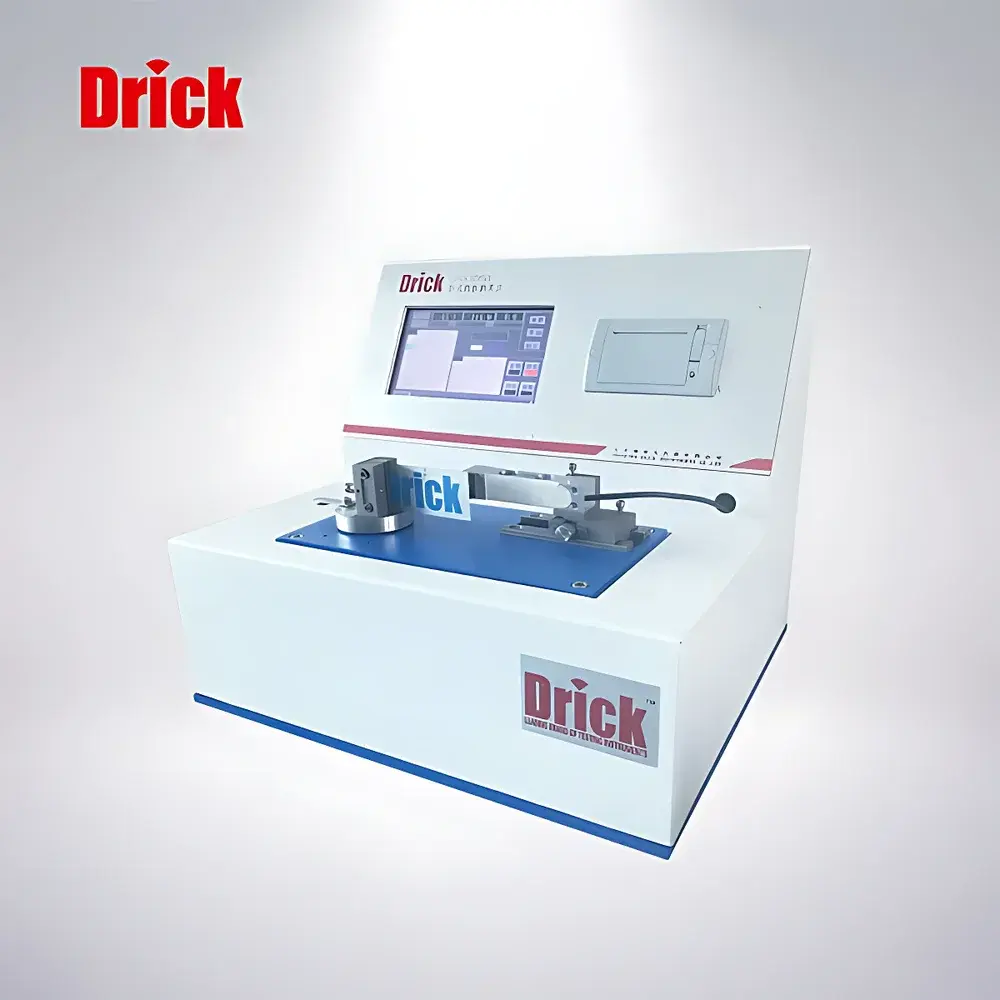
Drick DRK106 Horizontal Touchscreen Paperboard Stiffness Tester
| Brand | Drick |
|---|---|
| Origin | Shandong, China |
| Manufacturer Type | Direct Manufacturer |
| Country of Origin | China |
| Model | DRK 106 |
| Measurement Range | 15–300 mN (bending force) |
| Resolution | 0.1 mN |
| Accuracy | ±0.6 mN for readings <50 mN |
| Repeatability | ≤1% |
| Bend Length Options | 50.0±0.1 mm, 25.0±0.1 mm, 10.0±0.1 mm |
| Bend Angle Options | 15.0°±0.3°, 7.5°±0.3° |
| Bend Rate | 200°±20°/min (adjustable) |
| Operating Temperature | 20°C±10°C |
| Power Supply | AC 220 V±5%, 50 Hz, grounded |
Overview
The Drick DRK106 Horizontal Touchscreen Paperboard Stiffness Tester is a precision-engineered instrument designed to quantify the static bending stiffness of paper, paperboard, and other low-strength sheet-like nonmetallic materials. It operates on the principle of controlled angular deflection under defined bending moment conditions, in strict accordance with ISO 5628 (“Paper and board — Determination of static bending stiffness — General principles”) and GB/T 2679.3 (“Determination of stiffness of paper and paperboard”). The instrument also complies with ISO 2493 (“Paper and board — Determination of stiffness”), ensuring global methodological consistency for quality control laboratories engaged in packaging material evaluation. Its horizontal configuration enables stable specimen positioning and minimizes gravitational interference during measurement, delivering high reproducibility across routine QC testing cycles.
Key Features
- Intuitive 7-inch capacitive touchscreen interface with multilingual UI support (English, Chinese, Spanish), enabling rapid parameter setup and real-time curve visualization.
- Motor-driven bending arm with closed-loop position feedback ensures precise angular displacement control at 7.5° or 15° bend angles, with tolerance maintained within ±0.3°.
- Three selectable bend lengths (10.0, 25.0, and 50.0 mm) accommodate diverse sample geometries and stiffness ranges—from lightweight linerboard to rigid corrugated medium.
- Adjustable bend rate (200°±20°/min) allows method optimization for materials exhibiting viscoelastic response, supporting both standard compliance and internal R&D protocols.
- High-resolution load cell (0.1 mN resolution) coupled with temperature-compensated signal conditioning delivers traceable force measurement across the full 15–300 mN range.
- Robust aluminum alloy frame with vibration-damping base minimizes environmental influence, meeting ISO 2493’s requirement for mechanical stability during test execution.
Sample Compatibility & Compliance
The DRK106 accommodates specimens up to 300 mm in length and 50 mm in width, with thicknesses ranging from 0.1 mm to 5.0 mm. It supports standard test strips cut per ISO 2493 (typically 38 mm × 70 mm) as well as custom dimensions required by internal specifications. All test procedures align with internationally recognized standards including ISO 2493, ISO 5628, GB/T 2679.3, and TAPPI T 543. The instrument’s mechanical design and calibration protocol are fully compatible with GLP-compliant environments, and its measurement uncertainty budget is documented per ISO/IEC 17025 requirements for accredited testing laboratories.
Software & Data Management
Embedded firmware includes built-in data logging with timestamped storage of up to 1,000 test records. Export functionality supports CSV and PDF report generation via USB flash drive. Optional PC software (DRK-Stiffness Suite v3.2) provides advanced statistical analysis—mean, SD, CV%, trend charts, and SPC control charts—and supports audit trail logging compliant with FDA 21 CFR Part 11 when configured with user authentication and electronic signature modules. Raw force-angle data is exportable for third-party regression modeling or integration into LIMS platforms via RS-232 or optional Ethernet interface.
Applications
This tester is routinely deployed in packaging R&D labs, pulp and paper mills, and contract testing facilities for evaluating folding endurance, crease resistance, and structural integrity of carton board, solid bleached sulfate (SBS), recycled fiberboard, and laminated composites. It supports critical quality gates such as incoming raw material inspection, in-process monitoring of calendering or coating lines, and final product release testing against customer-specified stiffness thresholds (e.g., 20–10,000 mN force equivalent, corresponding to 2–1000 mN·m bending moment). Its adaptability to varying bend geometries also makes it suitable for comparative studies of fiber orientation effects and moisture-induced stiffness degradation.
FAQ
What standards does the DRK106 comply with?
It conforms to ISO 2493, ISO 5628, GB/T 2679.3, and TAPPI T 543 for static bending stiffness determination.
Can the instrument measure samples thicker than 5 mm?
No—the maximum supported thickness is 5.0 mm due to mechanical clearance and clamping geometry constraints.
Is external calibration certification available?
Yes—traceable calibration certificates issued by CNAS-accredited laboratories (ISO/IEC 17025) are available upon request, including uncertainty statements for force and angle measurements.
Does the DRK106 support automated batch reporting?
When paired with DRK-Stiffness Suite software, it enables customizable batch templates, automatic pass/fail flagging, and scheduled report exports to network folders or email.
How often should the bending arm be recalibrated?
Annual verification is recommended; however, daily zero-point checks and quarterly performance verification using certified reference specimens are advised under GLP/GMP regimes.





