
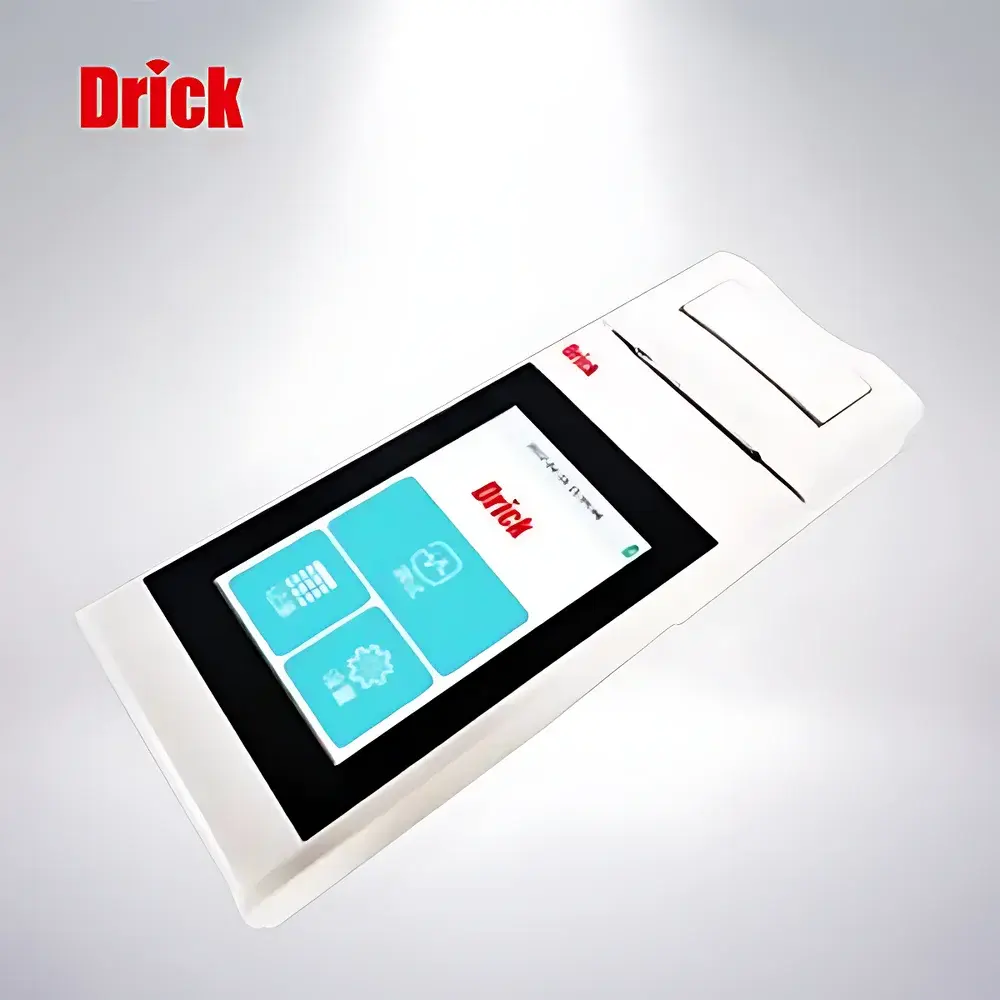
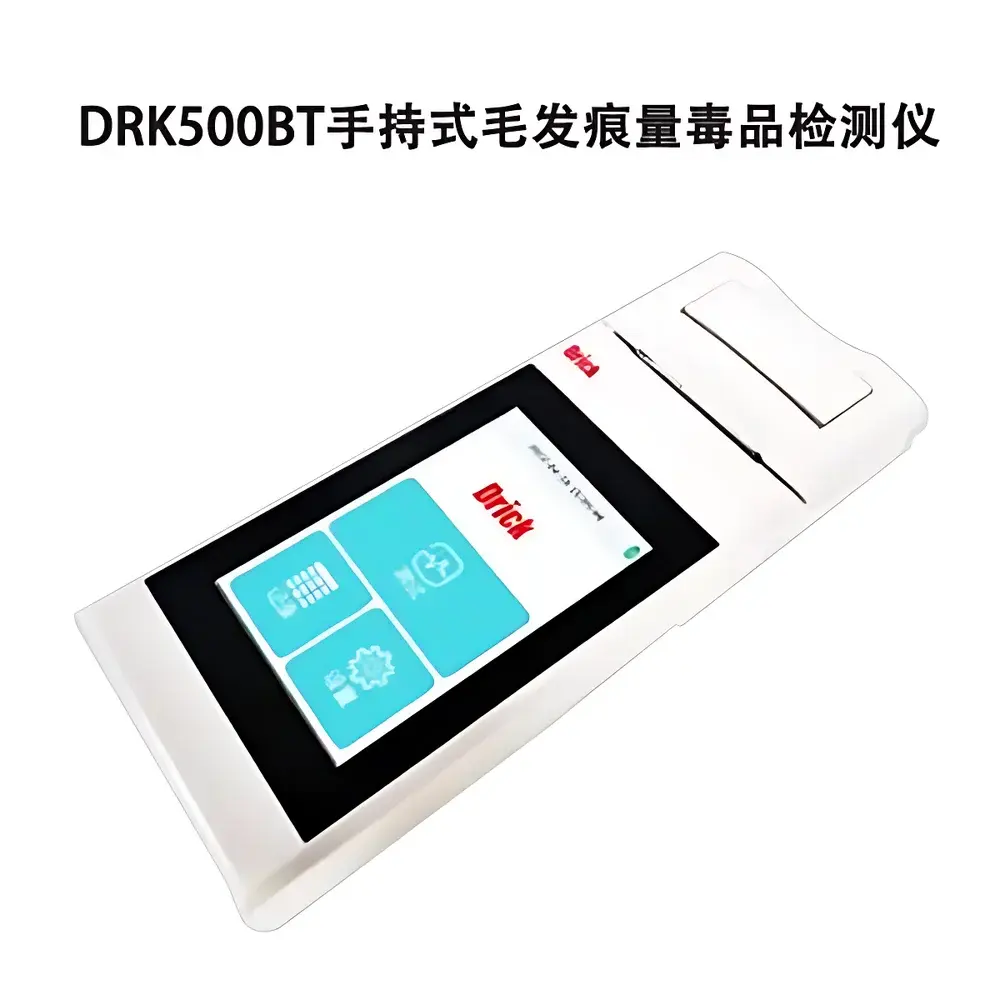
Drick DRK500BT Handheld Time-Resolved Fluorescence Immunoassay Analyzer for Trace Drug Detection in Hair
| Brand | Drick |
|---|---|
| Model | DRK500BT |
| Detection Principle | Time-Resolved Fluorescence Immunoassay (TRFIA) |
| Target Analytes | Morphine, Methamphetamine, Ketamine, MDMA, Cocaine, Mephedrone, and others |
| Sensitivity | 0.2 ng/mg |
| Sample Volume | 5 mg hair |
| Assay Time | ≤10 min |
| Power | Rechargeable 4000 mAh Li-ion battery (1–2 h charge, ≥200 tests per full charge) |
| Display | 5.5-inch TFT LCD |
| Weight | 1.2 kg |
| Data Output | Thermal printer, USB, LIS interface, 4G SIM slot |
| Regulatory Compliance | Designed to meet China’s MPS “Specifications for Hair Sample Testing of Suspected Drug Users” (2021), compatible with GLP-aligned workflows |
Overview
The Drick DRK500BT is a field-deployable, handheld time-resolved fluorescence immunoassay (TRFIA) analyzer engineered for quantitative detection of trace-level drug metabolites in human hair samples. Unlike conventional immunoassays relying on short-lived fluorophores, the DRK500BT leverages lanthanide chelate labels—primarily europium (Eu³⁺)—which exhibit microsecond-to-millisecond fluorescence lifetimes. This enables temporal gating: excitation light is pulsed and then extinguished before signal acquisition, effectively eliminating background autofluorescence and scattered excitation light. As a result, the system achieves high signal-to-noise ratios critical for reliable quantification at sub-nanogram-per-milligram concentrations. The instrument operates exclusively with proprietary dry-reagent lateral-flow immunofluorescence test cards, each pre-coated with capture antibodies and Eu³⁺-labeled detection antibodies. Upon capillary migration of the extracted hair digest, target analytes form sandwich immune complexes immobilized at test and control lines. A pulsed UV LED excites the Eu³⁺ chelates, and emitted fluorescence at 615 nm is measured via calibrated photodiode detection. Signal intensity correlates linearly with analyte concentration across validated dynamic ranges, supporting both qualitative screening and semi-quantitative reporting compliant with forensic toxicology requirements.
Key Features
- Time-resolved fluorescence detection with europium-labeled immunoassay cards, delivering enhanced specificity and reduced matrix interference
- Quantitative analysis capability with demonstrated sensitivity down to 0.2 ng/mg for morphine, methamphetamine, ketamine, MDMA, cocaine, mephedrone, and 13 additional controlled substances
- Integrated thermal printer for immediate, tamper-evident result documentation—essential for chain-of-custody integrity in law enforcement applications
- Dual-mode connectivity: USB port for firmware updates and data export; LIS interface for laboratory information system integration; embedded 4G module (SIM slot) for real-time result transmission where network infrastructure permits
- Onboard identity verification module supporting ID card optical character recognition (OCR) and facial image capture—designed for field deployment by public security personnel under MPS Directive No. GA/T 1857–2021
- Battery-powered operation (4000 mAh Li-ion) enabling ≥200 consecutive assays per charge; full recharge in ≤2 hours; operational temperature range: 10–35 °C
- Pre-programmed calibration routines and built-in QC monitoring using reference signal cards, ensuring assay reproducibility (CV ≤8% with reagent kits)
Sample Compatibility & Compliance
The DRK500BT is validated for use with human scalp hair specimens collected according to standardized protocols outlined in the Ministry of Public Security’s Specifications for Hair Sample Testing of Suspected Drug Users. Hair samples require minimal processing: 5 mg is mechanically homogenized, followed by alkaline hydrolysis and organic solvent extraction to liberate bound drug metabolites. No centrifugation or refrigerated storage is required—samples remain stable at ambient temperature for up to 30 days prior to analysis. The platform supports multi-analyte detection through interchangeable single-plex and tri-plex test cards, all manufactured under ISO 13485-certified conditions. While not FDA-cleared or CE-IVD marked, the system’s analytical performance aligns with internationally recognized validation criteria for forensic immunoassays, including linearity (r ≥0.98), accuracy (bias ≤±15%), and stability (≤±8% drift over 8 h). Its design facilitates audit readiness for GLP-compliant laboratories conducting research or method development related to chronic drug exposure assessment.
Software & Data Management
The DRK500BT runs embedded firmware v3.2+ with role-based access control and full audit trail functionality—including user login timestamps, test initiation records, result modifications, and printer output logs. All measurement data are stored locally in encrypted SQLite databases with optional cloud synchronization via HTTPS. Raw fluorescence intensity values, calculated concentrations, and pass/fail thresholds are exported in CSV format compatible with LIMS platforms. Firmware updates are delivered via signed USB packages to prevent unauthorized modification. For regulatory environments requiring electronic record integrity, the system supports 21 CFR Part 11–compatible configurations when deployed with external authentication servers and digital certificate management. Data export includes metadata fields such as operator ID, sample ID, collection date, test card lot number, and environmental sensor readings (ambient temperature/humidity).
Applications
- Field-based forensic screening by narcotics police during roadside stops, detention center intakes, or probation compliance checks
- Workplace safety programs in transportation, aviation, and heavy industry where long-term drug exposure history must be assessed beyond urine’s narrow detection window
- Clinical toxicology units evaluating abstinence adherence during opioid substitution therapy or post-rehabilitation monitoring
- Academic and governmental research labs investigating pharmacokinetic retention patterns of novel psychoactive substances (NPS) in keratinized tissues
- Border control and customs agencies performing rapid secondary screening of high-risk travelers with inconclusive oral fluid results
- Correctional health services establishing baseline drug use histories upon incarceration to inform treatment planning
FAQ
What biological matrix does the DRK500BT analyze?
It is validated exclusively for human scalp hair. Pubic or body hair may yield variable recovery due to differing growth cycles and keratin composition.
Does the instrument require daily calibration?
No daily calibration is needed. Each test card includes an internal control line and reference zone; system self-checks occur automatically at power-on and before each assay.
Can results be integrated into national forensic databases?
Yes—via LIS interface or secure API endpoints, provided the receiving system accepts HL7-compatible structured data payloads.
Is the device suitable for use in tropical climates?
It operates reliably between 10–35 °C and ≤80% non-condensing humidity; extended exposure above 35 °C may affect reagent stability and requires supplemental cooling measures.
How is measurement traceability ensured?
All test cards are lot-numbered and supplied with certificate of analysis referencing NIST-traceable reference standards; instrument performance is verified quarterly using certified reference materials (CRMs) from CNAS-accredited providers.






