
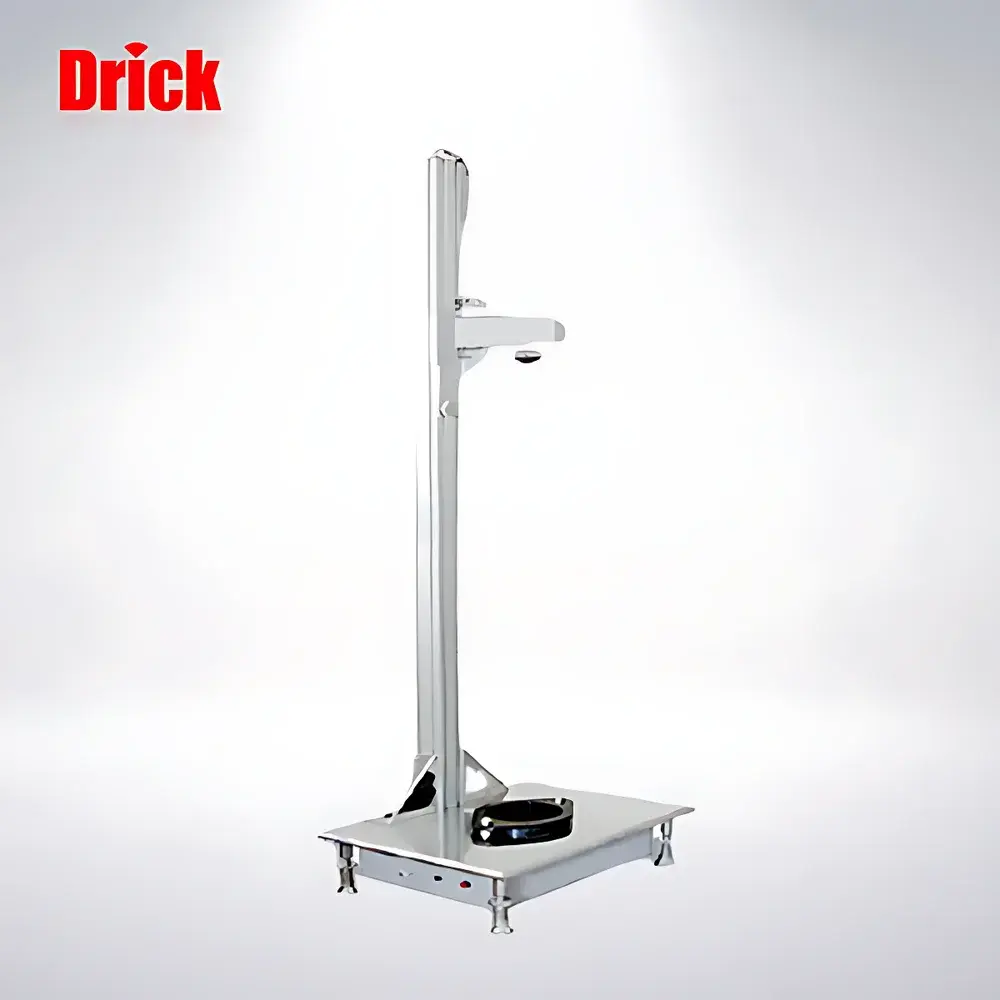
Drick DRK505 Plastic Sheet Ball Impact Tester
| Brand | Drick |
|---|---|
| Origin | Shandong, China |
| Manufacturer Type | Manufacturer |
| Region of Origin | Domestic (China) |
| Model | DRK505 |
| Test Height Range | 300–600 mm (optional 20–2000 mm) |
| Specimen Thickness Range | 0–2 mm |
| Ball Diameters | 23 mm, 25 mm, 28.6 mm, 38.1 mm, 50.8 mm (custom sizes available) |
| Specimen Clamping | Pneumatic |
| Specimen Dimensions | ≥150 mm × 50 mm |
| Overall Dimensions | 480 mm (L) × 470 mm (W) × 1170 mm (H) |
| Weight | 60 kg |
| Compliance Standards | YBB00212005–2015, YBB00222005–2015, YBB00232005–2015, YBB00242002–2015 |
Overview
The Drick DRK505 Plastic Sheet Ball Impact Tester is a precision-engineered mechanical impact testing instrument designed specifically for evaluating the impact resistance and failure behavior of thin plastic sheets and films with thicknesses up to 2 mm. It operates on the principle of controlled free-fall impact: a standardized steel ball is released from a precisely adjustable height onto the center of a horizontally clamped specimen. The resulting damage—ranging from surface deformation to complete perforation—is visually assessed or digitally recorded to determine pass/fail criteria or calculate statistical failure rates across multiple replicates. This method aligns with deterministic mechanical testing paradigms used in packaging material qualification, where quantifiable energy input (m·g·h) correlates directly with material toughness, ductility, and structural integrity under transient loading. The DRK505 is not a general-purpose impact tester; its design prioritizes repeatability, operator safety, and compliance with pharmaceutical and medical packaging standards issued by the Chinese Pharmacopoeia Commission (YBB series).
Key Features
- Pneumatically actuated specimen clamping system ensures consistent, uniform pressure distribution across the test area—eliminating edge slippage and minimizing variability in boundary conditions.
- Electromagnetically suspended steel ball release mechanism guarantees zero pre-impact acceleration interference and eliminates manual timing errors associated with hand-release methods.
- Adjustable drop height range from 300 mm to 600 mm (extendable to 20–2000 mm upon request), calibrated via precision linear scale with ±0.5 mm positional accuracy.
- Interchangeable steel ball set (23 mm, 25 mm, 28.6 mm, 38.1 mm, 50.8 mm) enables compliance with multiple regional and application-specific standards—including those requiring differentiated impact mass/energy profiles.
- Centering alignment fixture ensures repeatable impact location within ±0.3 mm tolerance relative to specimen geometric center, critical for comparative testing across batches.
- Foot-operated start switch allows hands-free initiation, improving workflow ergonomics and reducing operator-induced motion artifacts during release.
- Rigid welded steel frame with vibration-damping base minimizes energy loss to the support structure, preserving impact energy fidelity.
Sample Compatibility & Compliance
The DRK505 accommodates rigid and semi-rigid thermoplastic sheets including but not limited to PET, PVC, PP, PS, and polycarbonate—provided specimen thickness remains within the 0–2 mm operational envelope. Specimens must be flat, free of creases or thermal stress marks, and cut to minimum dimensions of 150 mm × 50 mm to ensure full engagement with the pneumatic clamping jaws. The instrument is validated for conformance with four key Chinese pharmaceutical packaging standards: YBB00212005–2015 (for polyethylene film), YBB00222005–2015 (for polypropylene film), YBB00232005–2015 (for polyester film), and YBB00242002–2015 (for aluminum-plastic composite films). While not certified to ISO 7765-1 or ASTM D1709, its mechanical architecture supports method adaptation for internal R&D use where correlation studies are established per GLP-aligned validation protocols.
Software & Data Management
The DRK505 operates as a standalone mechanical tester without embedded microprocessor control or digital data logging. All test parameters—including drop height, ball diameter, specimen ID, and pass/fail outcome—are manually recorded in laboratory notebooks or exported into LIMS-compatible spreadsheets. For traceability, users are advised to implement supplementary documentation practices aligned with ISO/IEC 17025 requirements: calibration certificates for height scale and ball mass verification (certified to ±0.1 g), maintenance logs for pneumatic pressure regulators and electromagnetic coil performance, and annual verification of clamping force uniformity. Optional integration with third-party image capture systems (e.g., high-speed cameras mounted orthogonally) enables qualitative fracture pattern analysis and time-resolved deformation tracking—though such configurations fall outside factory-supplied scope.
Applications
- Quality control of blister packaging lidding materials in pharmaceutical manufacturing environments.
- Comparative assessment of impact resistance between virgin and recycled polymer sheet grades.
- Development-stage screening of co-extruded barrier films subjected to simulated shipping drop events.
- Regulatory submission testing for NMPA registration dossiers requiring YBB-series compliance evidence.
- In-process verification of thermoforming line output where sheet embrittlement may occur due to thermal history or additive migration.
- Failure mode analysis of laminated structures under localized kinetic energy input.
FAQ
Is the DRK505 compliant with FDA 21 CFR Part 11?
No—the DRK505 does not incorporate electronic records or electronic signatures; it is a manually operated mechanical tester and therefore falls outside the regulatory scope of Part 11.
Can custom steel balls be supplied with traceable NIST-certified mass calibration?
Yes—custom diameters and material compositions (e.g., hardened stainless steel, tungsten carbide) can be provided with individual mass certification reports upon request.
What is the recommended maintenance interval for the pneumatic clamping system?
Compressed air filtration and regulator inspection should occur every 250 operating hours; cylinder seal replacement is advised every 12 months or after 5,000 cycles, whichever comes first.
Does the instrument include height calibration tools?
Yes—a certified stainless-steel height gauge with traceable calibration certificate (ISO/IEC 17025 accredited lab) is included in the standard configuration.
Can the DRK505 be used for testing metallized films?
Yes—provided the metallization layer does not compromise substrate cohesion and the total thickness remains ≤2 mm; however, reflective surfaces may require supplemental lighting for reliable visual failure assessment.






