
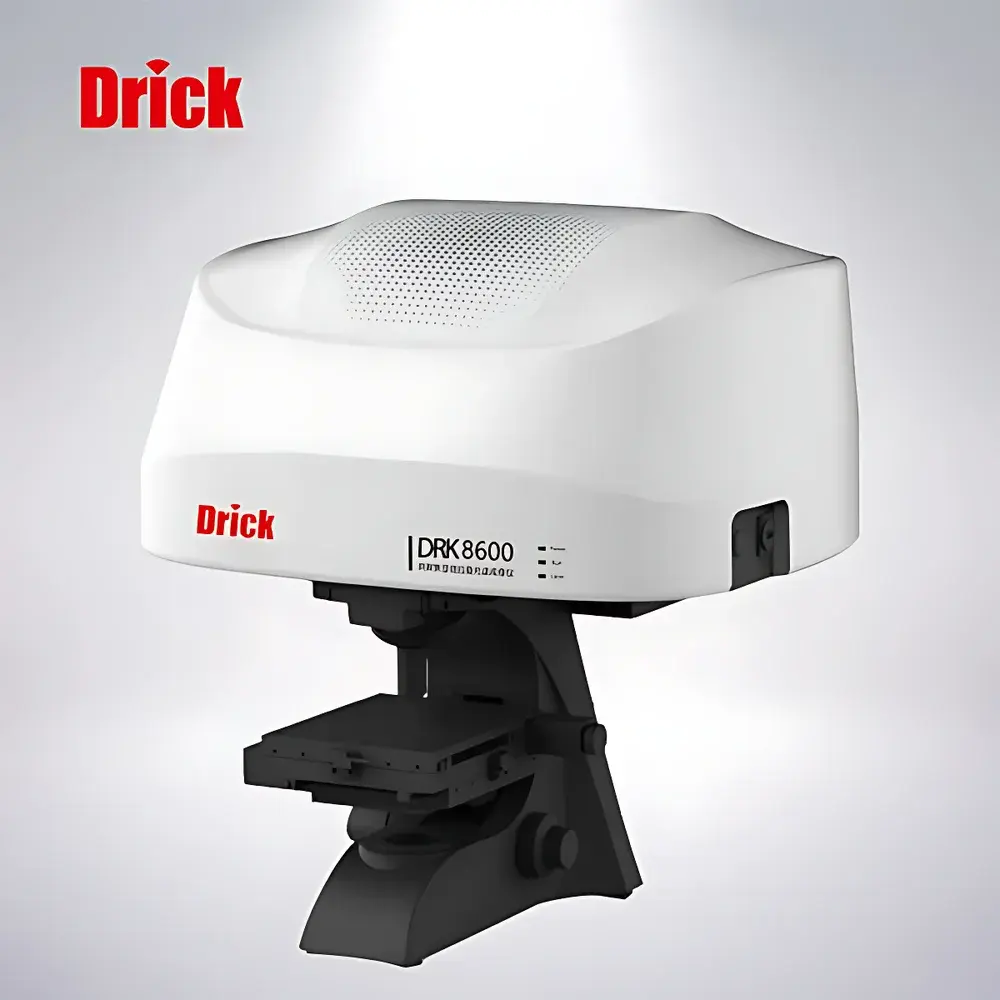
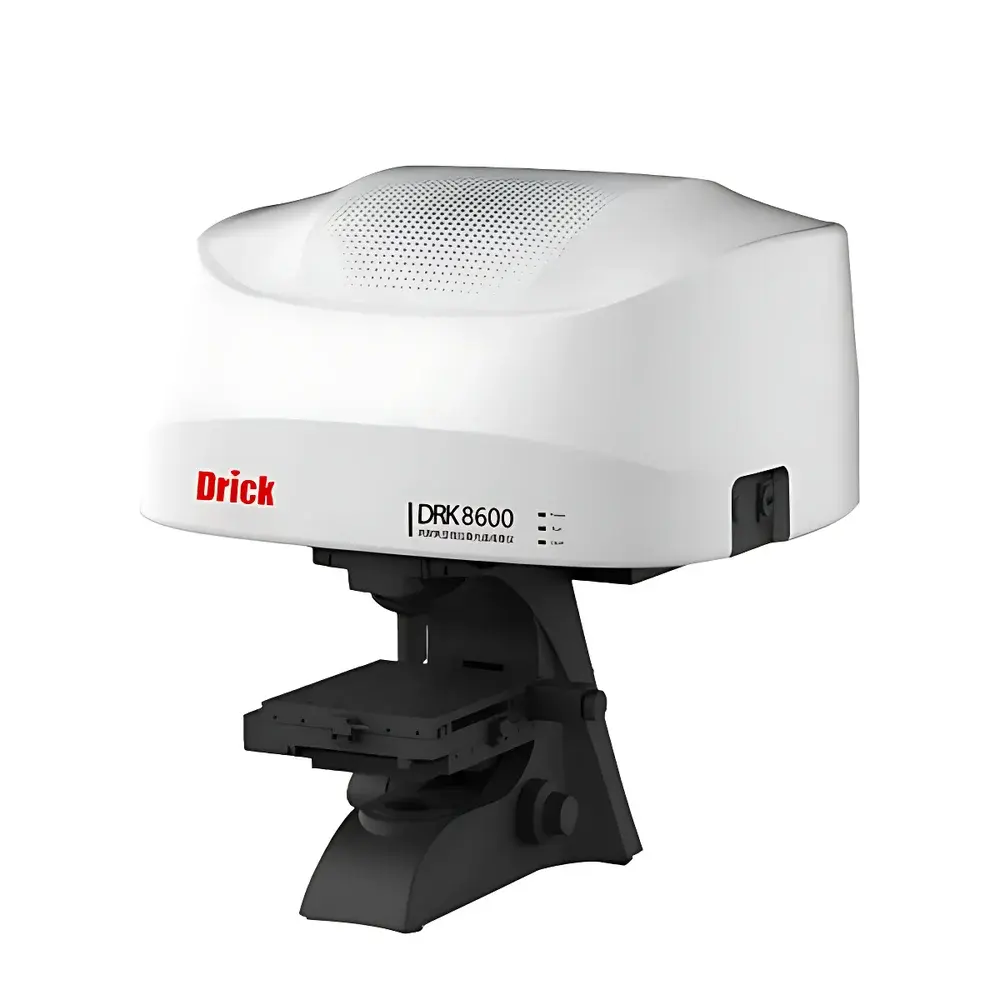
Drick DRK8600 Compact True Confocal Micro-Raman Spectroscopy Imaging System
| Brand | Drick |
|---|---|
| Origin | Shandong, China |
| Manufacturer Type | OEM Manufacturer |
| Product Category | Domestic |
| Model | DRK8600 |
| Instrument Type | Confocal Micro-Raman Spectrometer |
| Excitation Wavelength | 532 nm (standard), optional 785 nm |
| Spectral Range | 100–3500 cm⁻¹ (typical) |
| Spectral Resolution | <1.5 cm⁻¹ (FWHM) |
| Spatial Resolution | ≤0.5 µm (lateral), ≤1.2 µm (axial) |
| Laser Power Stability | ±0.5% over 4 hours |
| CCD Detector | Back-illuminated deep-depletion EMCCD, 1024 × 128 pixels |
| Mapping Step Size | Adjustable from 0.1 µm to 10 µm |
| Software Platform | RamanSuite Pro v4.2 with GLP-compliant audit trail and user permission levels |
Overview
The Drick DRK8600 Compact True Confocal Micro-Raman Spectroscopy Imaging System is an integrated benchtop instrument engineered for high-fidelity chemical identification and spatially resolved molecular mapping at the microscale. Unlike conventional widefield or pseudo-confocal Raman systems, the DRK8600 implements a true confocal optical architecture—featuring a precisely aligned pinhole aperture in conjugation with the spectrometer entrance slit—to reject out-of-focus fluorescence and scattered light, thereby delivering superior axial sectioning capability and unambiguous depth-resolved spectral acquisition. Built around a high-stability 532 nm diode-pumped solid-state (DPSS) laser (with optional 785 nm module for fluorescence suppression), the system couples with a research-grade inverted microscope platform and a thermoelectrically cooled, back-illuminated EMCCD detector to ensure high signal-to-noise ratio (SNR) even under low-light conditions. Its compact footprint (W × D × H: 620 × 540 × 380 mm) and modular design enable seamless integration into regulated laboratory environments—including ISO 17025-accredited testing labs and GMP-compliant QC suites—without requiring dedicated optical tables or vibration isolation.
Key Features
- True confocal optical design with motorized XYZ piezo stage and real-time focus tracking for sub-micron z-sectioning (axial resolution ≤1.2 µm)
- High-throughput Czerny–Turner spectrograph with holographic grating (1200 grooves/mm) and optimized stray-light rejection
- Automated laser power calibration and real-time intensity normalization to ensure inter-session reproducibility
- Integrated white-light reflectance imaging channel for precise sample navigation and co-registered morphological correlation
- Rugged aluminum-alloy optical baseplate with passive thermal stabilization (±0.1 °C drift over 8 h)
- Compliance-ready hardware architecture supporting 21 CFR Part 11 electronic signatures, audit trails, and role-based access control
Sample Compatibility & Compliance
The DRK8600 accommodates a broad range of solid, thin-film, and powder samples—including polymer blends, pharmaceutical tablets, semiconductor wafers, textile fibers, ink layers, and biological tissue sections—without destructive preparation. Standard objectives (20×, 50×, 100×, NA 0.75–0.95) support both transmission and reflection modes; optional immersion objectives extend capabilities to aqueous or oil-immersed specimens. All optical components meet RoHS and REACH directives. The system supports full traceability per ISO/IEC 17025:2017 requirements for calibration of spectral axis (NIST-traceable polystyrene and silicon standards), laser wavelength (±0.02 nm), and intensity linearity (certified neutral density filters). Validation documentation packages—including IQ/OQ protocols, URS templates, and risk assessments—are provided for regulated industries.
Software & Data Management
RamanSuite Pro v4.2 is a validated, multi-user desktop application built on a .NET framework with embedded SQLite database and encrypted local storage. It delivers automated baseline correction (Asymmetric Least Squares), peak deconvolution (Voigt fitting), multivariate analysis (PCA, cluster analysis), and hyperspectral image processing (false-color mapping, component distribution overlays). Raw spectra are stored in HDF5 format with embedded metadata (instrument configuration, operator ID, timestamp, environmental logs). Audit trail functionality records all data modifications, report exports, and user logins with immutable timestamps—fully compliant with FDA 21 CFR Part 11 and EU Annex 11 requirements. Data export options include ASTM E131-compliant .spa files, CSV, and PDF reports with digital signatures.
Applications
The DRK8600 serves as a primary analytical tool across quality control and materials R&D workflows. In pharmaceutical manufacturing, it verifies active pharmaceutical ingredient (API) polymorphic form distribution within tablet cross-sections and detects counterfeit excipients. In packaging and printing, it identifies ink composition, laminated layer integrity, and adhesive degradation mechanisms. For polymer and composite characterization, it quantifies crystallinity, filler dispersion homogeneity, and stress-induced band shifts in rubber and thermoplastics. Environmental labs apply it to microplastic identification in water filtration membranes; food safety labs use it for adulterant detection (e.g., melamine in dairy powders) and starch gelatinization profiling. Academic users leverage its mapping speed (<5 min per 100 × 100 µm² area at 1 µm step) for correlative Raman–SEM studies and in situ reaction monitoring.
FAQ
Is the DRK8600 compliant with 21 CFR Part 11 for electronic records in regulated laboratories?
Yes—the system includes configurable user roles, electronic signatures, and a tamper-evident audit trail that meets all technical and procedural requirements of 21 CFR Part 11.
Can the DRK8600 perform depth profiling on multilayer films?
Yes—its true confocal architecture enables non-destructive z-stack acquisition with axial resolution ≤1.2 µm, supporting quantitative layer-thickness estimation and interfacial chemistry analysis.
What calibration standards are included with the instrument?
Each unit ships with NIST-traceable polystyrene (1003 cm⁻¹, 1601 cm⁻¹) and silicon (520.7 cm⁻¹) reference wafers, plus certified neutral density filters for intensity calibration.
Does the software support batch processing of hyperspectral datasets?
Yes—RamanSuite Pro includes scripting modules (Python API) and automated workflow templates for unattended processing of large mapping datasets across multiple samples.
Is remote operation supported for lab automation integration?
Yes—the system provides TCP/IP and OPC UA interfaces for integration with LIMS, MES, and robotic sample handlers via standardized communication protocols.





