
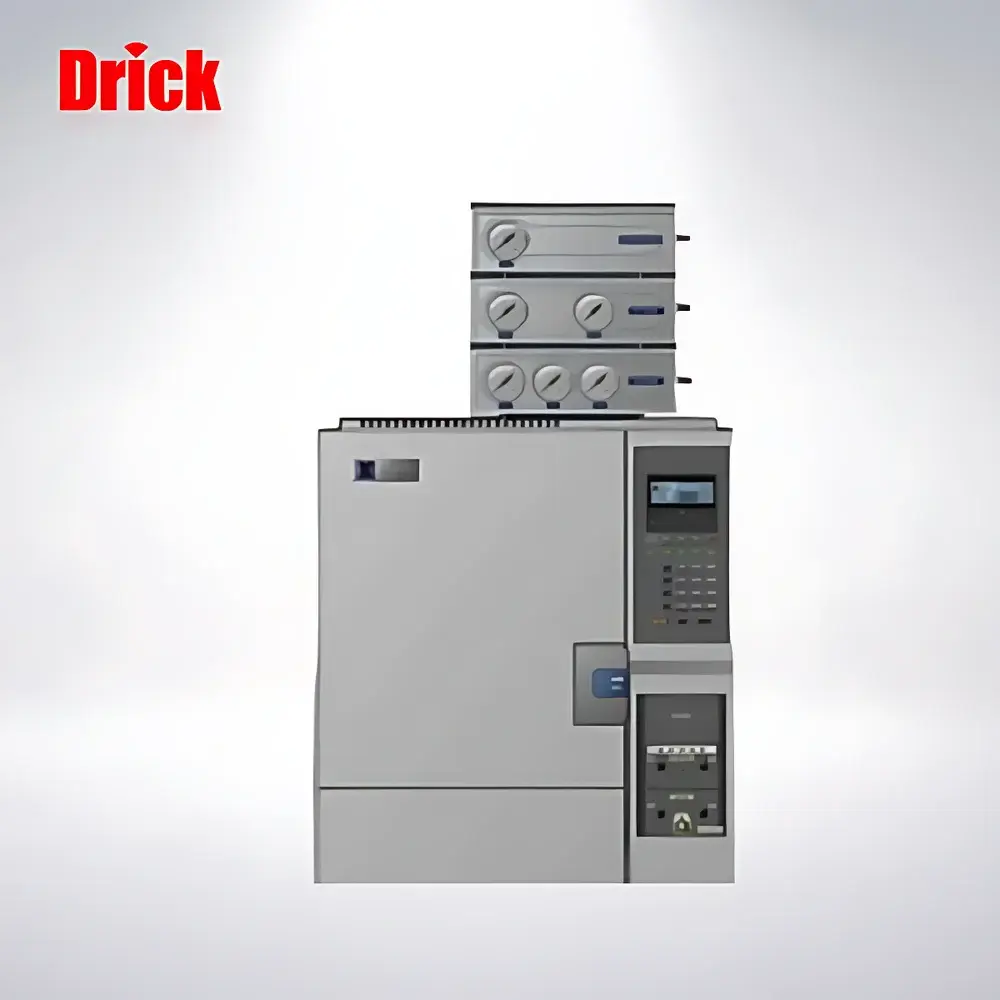
Drick GC1690 Laboratory Gas Chromatograph for Hazardous Gas Analysis
| Brand | Drick |
|---|---|
| Origin | Shandong, China |
| Manufacturer Type | OEM Manufacturer |
| Origin Category | Domestic (China) |
| Model | GC1690 |
| Instrument Type | Laboratory Gas Chromatograph |
| Application Field | Environmental Monitoring |
| Temperature Control Range | Ambient +7 °C to 420 °C |
| Heating Rate | 0.1–39.9 °C/min (programmable) |
| Oven Program Steps | 5-stage |
| Column Oven Volume | 240 × 160 × 360 mm |
| Temperature Stability | Better than ±0.1 °C |
| Ramp Time Range | 0–665 min (1 min increment) |
| Independent Over-Temperature Protection | Fixed 450 °C Circuit |
| Inlet Configurations | Packed-column on-column injection, Split/Splitless injection, Wide-Bore Capillary (WBC) injection, Packed-column vaporizing injection, 6-port gas sampling valve |
Overview
The Drick GC1690 is a benchtop laboratory gas chromatograph engineered for precise qualitative and quantitative analysis of volatile and semi-volatile hazardous compounds in environmental matrices. It operates on the fundamental principle of gas chromatography—separation of analytes based on differential partitioning between a gaseous mobile phase (carrier gas, e.g., helium, nitrogen, or hydrogen) and a stationary phase coated inside a capillary or packed column. As sample vapors are introduced via thermally controlled inlets, components elute at characteristic retention times governed by their polarity, volatility, and interaction with the stationary phase. Detection is achieved through interchangeable, industry-standard detectors—including TCD, FID, ECD, PID, and FPD—enabling method flexibility across regulatory-compliant workflows in air quality monitoring, soil vapor analysis, industrial emissions testing, and workplace exposure assessment.
Key Features
- High-precision column oven with vertical thermal architecture to minimize heat radiation interference from inlet and detector zones; maximum operating temperature of 420 °C with independent 450 °C hardware overtemperature cutoff
- Five-stage programmable temperature ramping with resolution of 0.1 °C/min and ramp time control from 0 to 665 minutes (1-minute increments)
- Thermal stability better than ±0.1 °C across the full operating range (ambient +7 °C to 420 °C)
- Modular inlet system supporting five injection modes: packed-column on-column, split/splitless, wide-bore capillary (WBC), packed-column vaporizing, and 6-port gas sampling valve
- Front-panel keypad and LCD interface with real-time parameter display; optional RS232/USB connectivity for external control and data logging
- Auto back-flush and programmable oven cooling via motorized rear door actuation
Sample Compatibility & Compliance
The GC1690 accommodates gaseous, liquid, and solid samples after appropriate pretreatment (e.g., thermal desorption, headspace, purge-and-trap, or solvent extraction). Its design supports compliance with major environmental testing standards including EPA Methods 8010, 8015, 8021, and 8260 for VOCs and SVOCs; ISO 16000-6 for indoor air; and HJ 604–2017 and HJ 639–2012 for ambient and exhaust gas analysis in China. The instrument’s temperature control fidelity and reproducible injection performance meet GLP requirements for routine QA/QC validation. While not pre-certified for 21 CFR Part 11, its audit-ready operation log and parameter locking capability facilitate integration into GMP-aligned laboratories when paired with compliant LIMS or chromatography data systems (CDS).
Software & Data Management
The GC1690 operates standalone but is compatible with third-party chromatography data systems (CDS) such as Chromeleon, OpenLab CDS, or N2000-based platforms via standard serial or USB communication protocols. Raw signal output supports analog voltage (±1 V) and digital TTL trigger synchronization. Built-in memory retains up to 100 method files and 200 chromatogram records. All temperature programs, detector settings, and injection parameters are fully editable and timestamped. Audit trails—when enabled via external CDS—capture user actions, method changes, and calibration events in accordance with ALCOA+ principles (Attributable, Legible, Contemporaneous, Original, Accurate, Complete, Consistent, Enduring, Available).
Applications
- Regulatory monitoring of benzene, toluene, ethylbenzene, xylenes (BTEX), chlorinated solvents, and aldehydes in ambient air and stack emissions
- Analysis of halogenated hydrocarbons (e.g., CFCs, HCFCs, PFCs) in refrigerant recycling and landfill gas studies
- Quantification of residual solvents in pharmaceutical excipients per ICH Q3C guidelines
- Odorant profiling in wastewater treatment facilities using sulfur-containing compound detection (e.g., H2S, mercaptans)
- Quality control of industrial gases (e.g., natural gas composition, syngas purity) via calibrated TCD or FID response
FAQ
Does the GC1690 support method transfer from other GC platforms?
Yes—its standardized detector interfaces, consistent temperature programming syntax, and compatibility with common column dimensions (0.1–0.53 mm ID capillaries; 1–4 m packed columns) enable straightforward method translation from Agilent, Shimadzu, or Thermo instruments.
Is hydrogen carrier gas supported safely?
Hydrogen is supported with proper lab ventilation and leak-check procedures; however, the GC1690 does not include integrated hydrogen sensors or automatic shutdown—users must implement external safety protocols per OSHA 1910.101 and local fire codes.
Can the instrument be upgraded with a mass spectrometer detector?
The GC1690 features a standard GC/MS interface port and vacuum-compatible column outlet; retrofitting requires third-party MS coupling hardware and alignment verification, but no firmware modification is needed.
What maintenance intervals are recommended for routine operation?
Column trimming every 50 injections, inlet liner replacement every 100 injections, and detector cleaning every 200–300 runs—frequency varies by matrix complexity and detector type. Annual calibration verification against NIST-traceable standards is advised.
Is remote monitoring or network control available?
Native Ethernet or Wi-Fi is not built-in, but RS232-to-Ethernet converters or USB-to-IP gateways enable remote access when integrated with enterprise-grade CDS environments.
Related Products





