
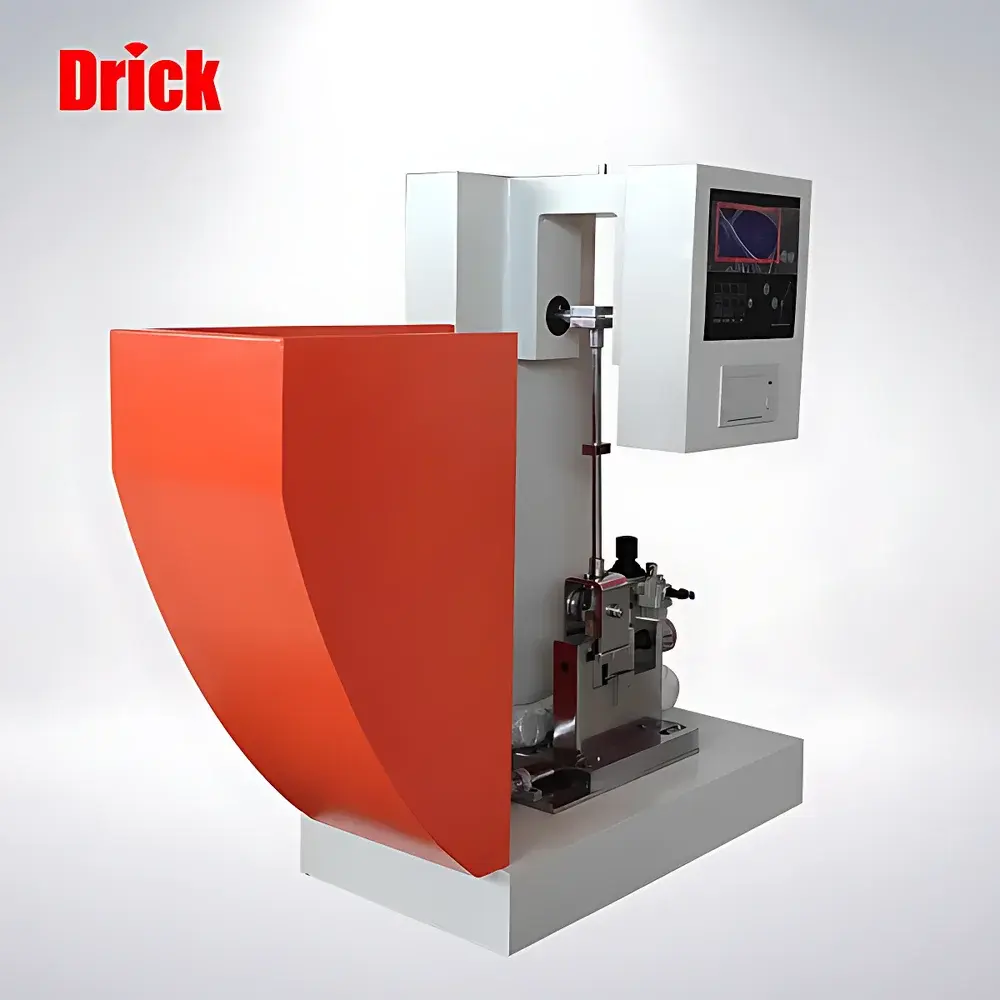
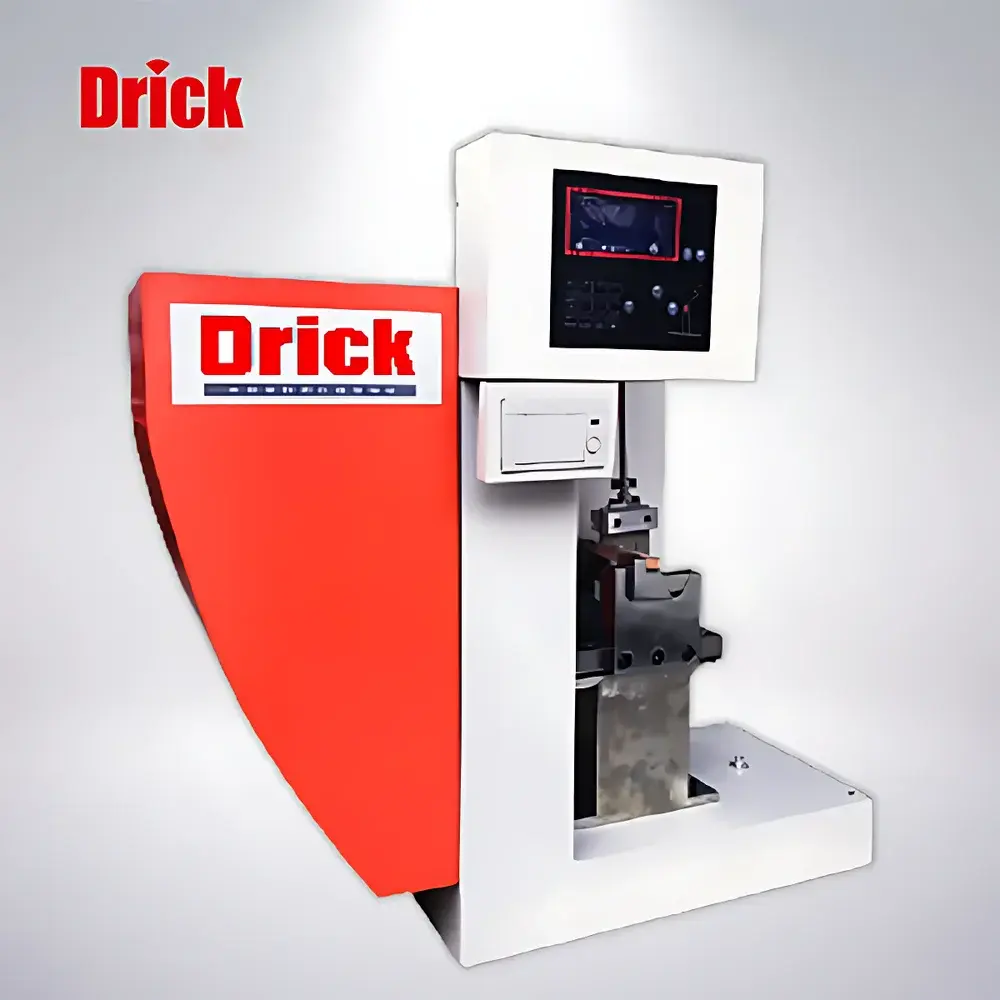
Drick JC-Series Charpy/IZOD Impact Tester (GB/T 1043 Compliant)
| Brand | Drick |
|---|---|
| Origin | Shandong, China |
| Manufacturer Type | Direct Manufacturer |
| Model | JC- |
| Impact Energy Levels | 0 J, 1 J, 2 J, 4 J, 5 J |
| Impact Velocity | 2.9 m/s |
| Span Length Options | 40 mm, 60 mm, 62 mm, 70 mm |
| Pre-lift Angle | 150° |
| Dimensions (L×W×H) | 500 mm × 350 mm × 780 mm |
| Weight | 130 kg (including accessory case) |
| Power Supply | AC 220 V ±10%, 50 Hz |
| Operating Environment | 10–35 °C, RH ≤80%, vibration-free and non-corrosive atmosphere |
Overview
The Drick JC-Series Charpy/IZOD Impact Tester is a precision-engineered physical property testing instrument designed for determining the notched and unnotched impact resistance of rigid thermoplastics, reinforced nylons, fiber-reinforced composites (e.g., glass-reinforced plastics), ceramics, cast stone, electrical insulating materials, and other non-metallic engineering materials. It operates on the principle of pendulum-type impact testing in accordance with the fundamental mechanics of fracture energy absorption—measuring the kinetic energy required to fracture a standardized specimen supported as a simple beam (three-point bending configuration). The tester complies fully with GB/T 1043–2008 (Chinese National Standard for Plastics—Determination of Charpy Impact Properties), ISO 179–1:2010, ISO 9854:2017, GB/T 18743–2002 (for PP-R pipe materials), and DIN 53453, ensuring international methodological alignment for quality control, R&D validation, and regulatory submission workflows.
Key Features
- Modular pendulum system with selectable impact energy levels (0 J, 1 J, 2 J, 4 J, 5 J) calibrated per ISO 13802 requirements for traceable energy accuracy;
- High-stability mechanical base with precision-machined anvil and support jaws; span length configurable at 40 mm, 60 mm, 62 mm, or 70 mm to accommodate diverse specimen geometries per standard specifications;
- Digital angular measurement via high-resolution optical encoder (circular grating), enabling real-time acquisition of pre-lift angle (150°), swing angle, and residual angle post-fracture;
- Automatic energy loss compensation algorithm integrated into firmware—correcting for bearing friction, air resistance, and pivot hysteresis to deliver repeatable, ISO-compliant impact energy values;
- Robust structural architecture (130 kg total mass including accessories) minimizes dynamic coupling with laboratory floor vibrations, supporting stable operation in shared QC lab environments;
- Compliance-ready design: meets mechanical and metrological prerequisites for GLP/GMP-aligned laboratories conducting ASTM D6110, ISO 179, or GB/T 1043 testing under auditable conditions.
Sample Compatibility & Compliance
The JC-Series accommodates standardized rectangular bar specimens (typically 80 mm × 10 mm × 4 mm) with optional notching tools (A-type or B-type per ISO 179) for comparative toughness evaluation. It supports both unnotched (Charpy U) and notched (Charpy V) configurations, making it suitable for screening brittle-to-ductile transitions, evaluating batch consistency in polymer compounding, and validating material substitutions in automotive or electrical housing applications. All mechanical components—including pendulum arm geometry, anvil radius (8 mm ± 0.05 mm), and support jaw radius (2 mm ± 0.05 mm)—are manufactured and verified per ISO 13802 Annex A dimensional tolerances. Calibration certificates are provided with NIST-traceable reference specimens upon request.
Software & Data Management
Equipped with embedded microcontroller-based data acquisition, the JC-Series outputs digital readings of absorbed energy (J), impact strength (kJ/m²), pre-lift angle, and residual angle directly to an integrated LCD interface. Optional PC connectivity (RS-232 or USB-to-serial) enables seamless integration with Drick’s proprietary ImpactTest Suite v3.x software. This application supports automated report generation compliant with ISO/IEC 17025 documentation requirements—including operator ID, timestamped test logs, statistical summaries (mean, SD, CV%), and audit trail export in CSV or PDF format. Data integrity safeguards include password-protected parameter modification, electronic signature fields, and full compliance with FDA 21 CFR Part 11 principles when configured with user access controls and change history logging.
Applications
- Quality assurance of injection-molded plastic components (e.g., ABS housings, PC lenses, POM gears);
- Evaluation of aging effects (thermal, UV, hydrolytic) on impact performance of polyolefins and engineering thermoplastics;
- Validation of additive packages (impact modifiers, fillers, flame retardants) during formulation development;
- Third-party certification testing for CE marking (EN ISO 179), CCC (China Compulsory Certification), and RoHS-compliant material declarations;
- Teaching laboratories delivering hands-on instruction in polymer physics, fracture mechanics, and standardization principles per ISO/IEC Guide 99 and VIM.
FAQ
What standards does this impact tester fully comply with?
It satisfies the mechanical and metrological requirements of GB/T 1043–2008, ISO 179–1:2010, ISO 9854:2017, GB/T 18743–2002, and DIN 53453. Full compliance documentation is available upon request.
Can the JC-Series perform both Charpy and IZOD configurations?
The base JC-Series is optimized for GB/T 1043–compliant Charpy (simply supported beam) testing. IZOD-capable variants (clamped cantilever configuration) are available under separate model designation (JC-I Series) with dedicated clamping fixtures and recalibrated energy scales.
Is calibration verification included with delivery?
Yes—a factory calibration certificate referencing traceable impact energy standards is supplied. Users may perform routine verification using certified reference specimens (available separately) per ISO 13802 Clause 8.
What environmental conditions are required for valid test results?
Testing must be conducted within 10–35 °C ambient temperature, relative humidity ≤80%, and in a location isolated from mechanical vibration sources and corrosive atmospheres, as specified in GB/T 1043 Clause 5.2.
Does the system support LIMS integration?
Via optional RS-232/USB output and ImpactTest Suite software, raw data and summary reports can be exported in structured formats compatible with major LIMS platforms (e.g., LabWare, Thermo Fisher SampleManager, STARLIMS).



