
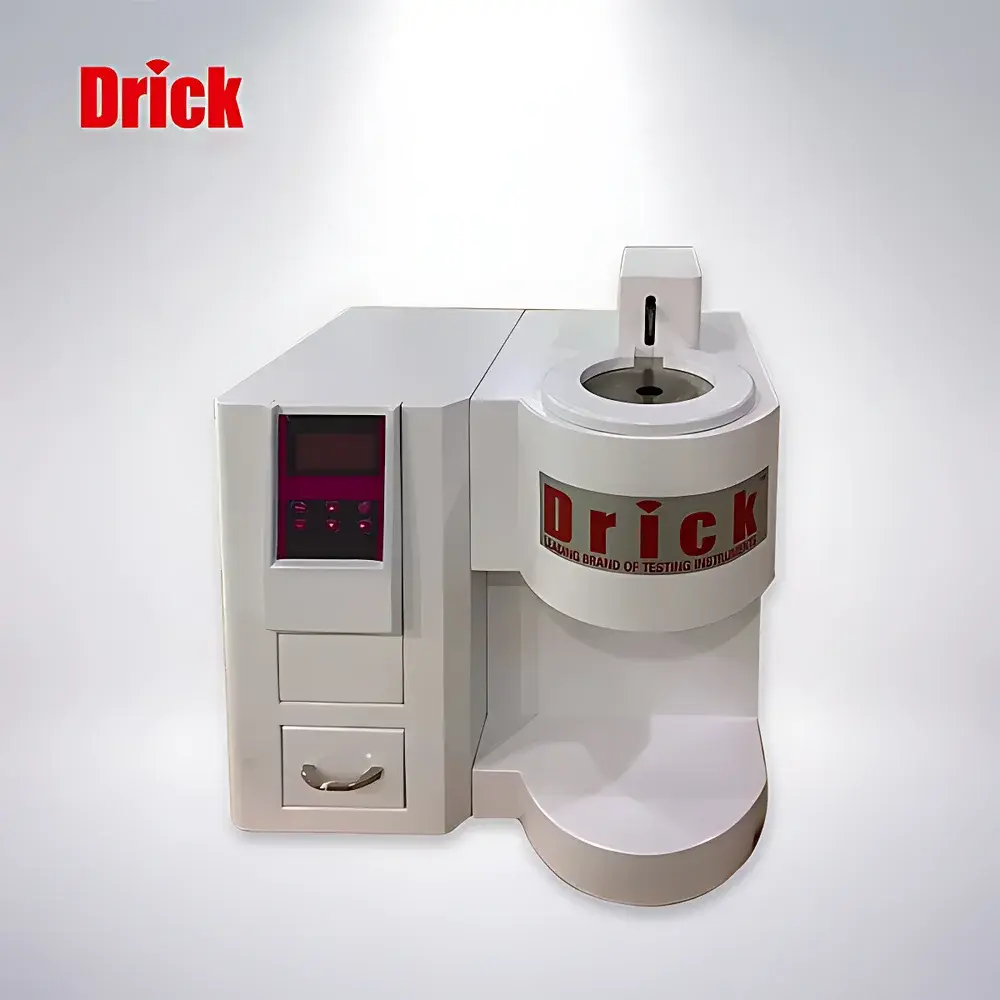
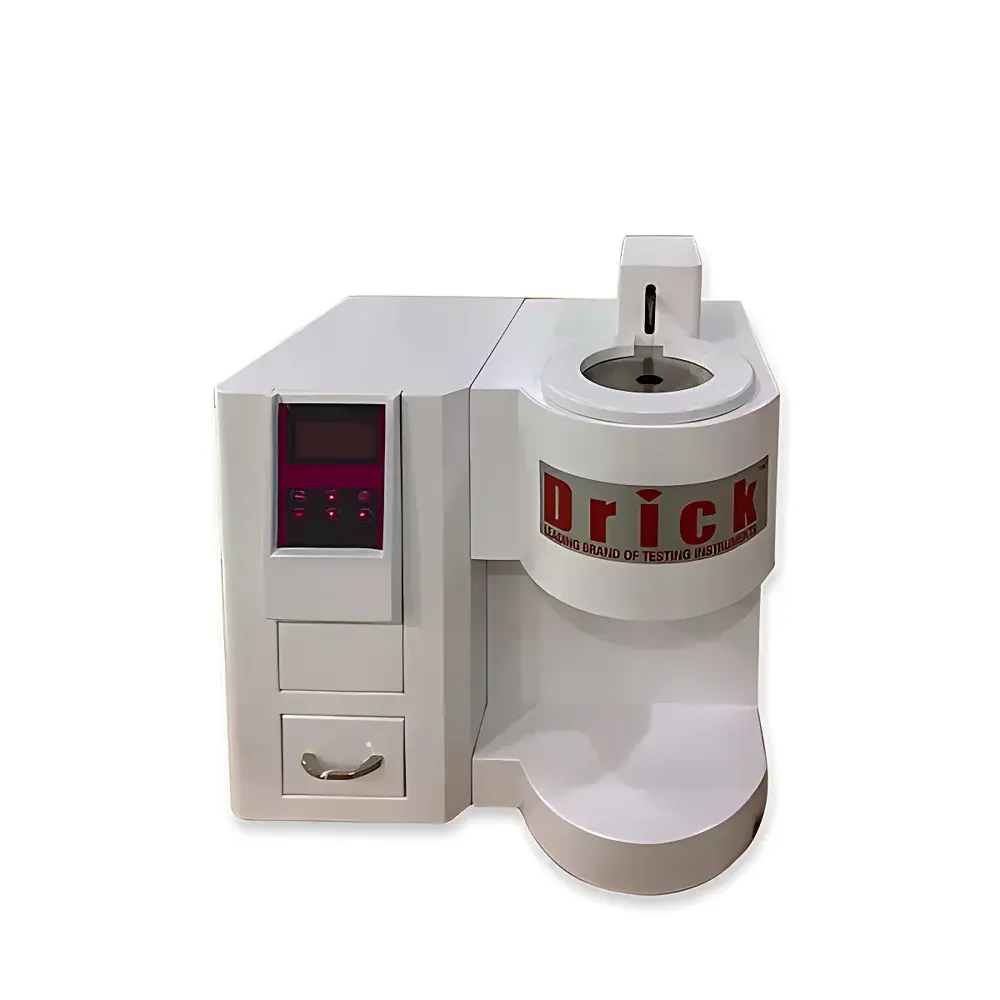
Drick XRL-400C Melt Flow Indexer (MFI) / Melt Mass Flow Rate (MFR) and Melt Volume Flow Rate (MVR) Tester
| Brand | Drick |
|---|---|
| Origin | Shandong, China |
| Manufacturer Type | Direct Manufacturer |
| Product Category | Domestic |
| Model | XRL-400C |
| Test Method | Standard Gravimetric & Volumetric Extrusion |
| Type | Conventional Melt Flow Indexer |
| Temperature Range | 50–400 °C |
| Temperature Control Accuracy | ±0.1 °C |
| Temperature Display Resolution | 0.01 °C |
| MFR Range | 0.01–600.00 g/10 min |
| MVR Range | 0.01–600.00 cm³/10 min |
| Melt Density Range | 0.001–9.999 g/cm³ |
| Barrel ID | 9.55 ± 0.025 mm, Length: 160 mm |
| Piston Head Diameter | 9.475 ± 0.01 mm, Mass: 106 g |
| Die ID | 2.095 mm, Length: 8 ± 0.025 mm |
| Standard Loads | 0.325, 1.2, 2.16, 3.8, 5.0, 10.0, 21.6 kg (±0.5% accuracy) |
| Displacement Measurement Range | 0–30 mm, Accuracy: ±0.05 mm |
| Power Supply | 220 V ± 10%, 50 Hz |
| Heating Power | 550 W |
| Dimensions (L×W×H) | 560 × 376 × 530 mm |
Overview
The Drick XRL-400C Melt Flow Indexer is a precision-engineered instrument designed for the standardized determination of melt mass flow rate (MFR) and melt volume flow rate (MVR) of thermoplastic polymers under defined temperature and load conditions. Based on the principle of controlled extrusion through a standardized capillary die—governed by ASTM D1238, ISO 1133, GB/T 3682, and DIN 53735—the XRL-400C quantifies polymer melt viscosity in the molten state, serving as a critical quality control parameter for raw material acceptance, process validation, and product consistency in polymeric manufacturing.
This instrument operates via gravimetric (MFR) and volumetric (MVR) measurement modes, enabling calculation of melt density when both values are obtained. Its robust thermal architecture supports stable operation across a wide temperature range (50–400 °C), accommodating high-melting engineering resins—including polycarbonate (PC), polyamide (PA), polyphenylsulfone (PPSU), and fluoropolymers—as well as commodity thermoplastics such as polyethylene (PE), polypropylene (PP), ABS, PS, and POM.
Key Features
- Intelligent PID temperature control with ±0.1 °C stability and 0.01 °C display resolution ensures reproducible thermal conditions per test standard requirements.
- Automated extrudate cutting mechanism synchronized with preset time or piston displacement (time-controlled or displacement-controlled testing).
- High-precision optical encoder for real-time piston displacement tracking (0–30 mm, ±0.05 mm accuracy), supporting MVR derivation and flow behavior analysis.
- Quick-load system facilitates rapid installation and removal of standard test loads (0.325–21.6 kg), minimizing operator intervention and mechanical wear.
- LCD-based human-machine interface with native Chinese character support (expandable to touchscreen or PC-integrated microcontroller variants); displays real-time MFR, MVR, and calculated melt density.
- Compliant barrel geometry (ID: 9.55 ± 0.025 mm, L: 160 mm), piston (head ID: 9.475 ± 0.01 mm, mass: 106 g), and die (ID: 2.095 mm, L: 8 ± 0.025 mm) meet dimensional tolerances specified in ISO 1133-1 and ASTM D1238 Annex A.
Sample Compatibility & Compliance
The XRL-400C is validated for use with all thermoplastic materials requiring standardized melt flow characterization per international regulatory and industrial frameworks. It conforms to the dimensional, thermal, and procedural specifications outlined in ISO 1133-1 (Method A & B), ASTM D1238 (Condition J, K, L, M, N, O), GB/T 3682-2018, DIN 53735, UNI 5640, and JJG 878–94. The instrument’s design satisfies the mechanical and metrological criteria of JB/T 5456–2015 (“Technical Specifications for Melt Flow Indexers”).
For laboratories operating under GLP or GMP environments, optional configurations (e.g., XRL-400CW microcontroller variant) support 21 CFR Part 11-compliant audit trails, electronic signatures, and secure data export—enabling traceability for pharmaceutical excipient testing (e.g., polyethylene glycols) or medical-grade polymer qualification.
Software & Data Management
The base XRL-400C model features embedded firmware with local data retention for up to five consecutive test records. For advanced analytical workflows, the optional XRL-400CW microcontroller version integrates with Windows-based software that acquires, plots, and archives temperature-vs.-time profiles, piston displacement curves, and multi-parameter result tables. All digital outputs include timestamping, operator ID, environmental metadata (ambient temperature/humidity if externally logged), and calibration status flags. Export formats include CSV, PDF reports, and XML-compatible structured data—facilitating integration into LIMS or ERP systems.
Calibration verification routines are built-in for temperature sensors (Pt100), load cells (for optional electronic balance coupling), and displacement encoders—supporting routine IQ/OQ documentation per ISO/IEC 17025 requirements.
Applications
- Raw material supplier qualification and batch release testing in polymer compounding and masterbatch production.
- In-process monitoring during extrusion, injection molding, and blow molding operations to correlate MFR/MVR shifts with degradation, contamination, or thermal history.
- Research and development of polymer blends, filled composites, and reactive extrusion formulations where rheological consistency directly impacts dispersion and interfacial adhesion.
- Regulatory submission support for FDA 510(k) or CE-marked medical devices using thermoplastic components (e.g., tubing, housings, connectors).
- Educational laboratories teaching polymer physics, processing engineering, and quality assurance methodologies at undergraduate and graduate levels.
FAQ
What standards does the XRL-400C comply with?
It meets ISO 1133-1, ASTM D1238, GB/T 3682, DIN 53735, UNI 5640, JJG 878–94, and JB/T 5456 technical specifications.
Can the XRL-400C measure both MFR and MVR simultaneously?
Yes—by performing sequential gravimetric and volumetric measurements under identical thermal and load conditions, melt density is derived automatically.
Is external weighing equipment required for MFR testing?
A calibrated analytical balance (0.0001 g resolution) is required for gravimetric MFR; the instrument supports manual or optional automated balance interfacing.
How is temperature uniformity verified across the barrel?
The unit incorporates dual Pt100 sensors (upper and lower zones) and undergoes factory thermal mapping per ISO 1133 Annex C; users may perform periodic verification using NIST-traceable immersion probes.
What maintenance is recommended for long-term accuracy?
Quarterly cleaning of the barrel and die with brass brushes and solvent; annual recalibration of temperature sensors, load application system, and displacement encoder against certified reference standards.




