
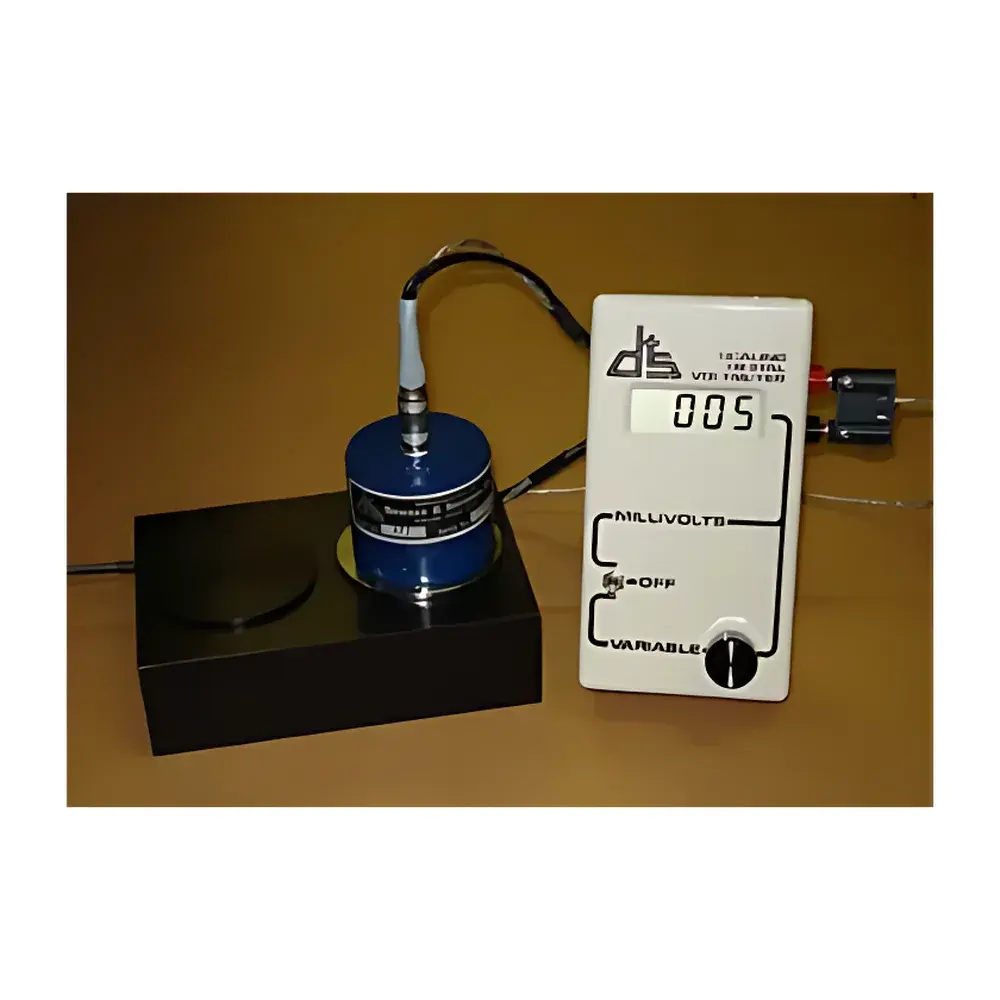
D&S AE1 RD1 Emissometer
| Brand | D&S |
|---|---|
| Origin | USA |
| Model | AE1 RD1 |
| Emissivity Range | 0.05–0.95 (total hemispherical) |
| Measurement Principle | Null-comparison radiometric method with heated detector cavity |
| Sample Temperature Range | Up to 54 °C (130 °F), must match reference standard temperature |
| Minimum Sample Diameter | 5.7 cm (2.25 in) |
| Detector Response Time | ≤10 s per reading |
| Repeatability | ±0.01 |
| Linearity Error | <±0.01 over full emissivity scale |
| Output | 2.4 mV at 25 °C, ε=0.9, 150 Ω load |
| Power Supply | 100–240 V AC, 50–60 Hz, converted to 12 V DC |
| Standard Bodies Included | Two high-emissivity (ε≈0.95) and two low-emissivity (ε≈0.05) reference standards |
| Thermal Equilibration | External heat sink required to maintain sample and standard at identical temperature |
| Compliance | Designed for ASTM C1371, ISO 18434-1, and NASA-HDBK-4002A conformance in surface emissivity validation |
Overview
The D&S AE1 RD1 Emissometer is a precision null-comparison radiometric instrument engineered for the direct, contactless measurement of total hemispherical emissivity (ε) of solid surfaces at near-ambient to moderately elevated temperatures. Unlike spectral or directional emissometers, the AE1 RD1 operates on a calibrated thermal radiation balance principle: its electrically heated detector cavity establishes a stable, uniform blackbody-like reference environment. When placed atop a reference standard of known emissivity, the instrument’s microvolt output is nulled and scaled via the integrated RD1 digital voltmeter—transforming voltage into a linear, traceable emissivity value. This methodology eliminates dependence on absolute temperature measurement, sample emissivity modeling, or spectral assumptions, delivering high reproducibility (±0.01) under controlled thermal equilibrium conditions. The system is purpose-built for laboratory-based materials qualification, thermal coating verification, spacecraft thermal control surface characterization, and calibration traceability in accordance with ASTM C1371 (“Standard Test Method for Determination of Emissivity of Materials Near Room Temperature Using Portable Emittance Meters”) and ISO 18434-1 (“Condition monitoring and diagnostics of machines — Thermography — Part 1: General procedures”).
Key Features
- Null-comparison architecture ensures immunity to ambient thermal drift and detector nonlinearity—output voltage scales linearly with emissivity across 0.05–0.95 range, with linearity error <±0.01.
- Electrically heated detector cavity (no sample heating required) enables rapid stabilization (~30 min warm-up) and consistent cavity temperature control independent of sample thermal mass.
- Two-step calibration protocol: (1) null against high- or low-emissivity reference standard; (2) direct readout of unknown sample emissivity on RD1 voltmeter—no software or computation needed.
- Modular probe design supports geometry flexibility: standard head accommodates ≥5.7 cm diameter flat surfaces; optional AE-AD1 and AE-AD3 adapters enable measurements on cylindrical specimens ≥2.54 cm in diameter, including multi-sample parallel configurations.
- Integrated thermal equilibration support: includes dedicated heat sink to ensure simultaneous, isothermal contact between sample and reference standard—critical for compliance with ASTM C1371 temperature-matching requirements.
- Self-contained, portable configuration: complete system (AE1 sensor + RD1 meter + transport case, 33×40×18 cm) operates from universal AC input (100–240 V, 50–60 Hz) with regulated 12 V DC output.
Sample Compatibility & Compliance
The AE1 RD1 is validated for use with opaque, non-transmissive solids exhibiting stable surface morphology at temperatures up to 54 °C (130 °F). Samples must be flat or gently curved within the probe’s field-of-view footprint; highly reflective, oxidized, or textured metallic surfaces—including anodized aluminum, polished stainless steel, and thermal-control paints—are routinely characterized. Each unit ships with four NIST-traceable reference standards: two high-emissivity (ε ≈ 0.95, oxidized copper) and two low-emissivity (ε ≈ 0.05, electropolished Inconel) bodies—dual sets allow active calibration and archival reference preservation. The system satisfies core metrological requirements for GLP-compliant thermal property reporting and supports audit-ready documentation when used in conjunction with laboratory temperature logs and standard body certification records. It is not intended for translucent media, liquids, or surfaces undergoing phase change.
Software & Data Management
The AE1 RD1 operates as a hardware-calibrated analog instrument with no embedded firmware or data logging capability. Emissivity values are recorded manually from the RD1’s 3½-digit LED display (resolution: 0.001 emissivity unit). For laboratories requiring electronic data capture, the RD1’s analog output (0–10 mV full scale) may be interfaced with external DAQ systems compliant with IEEE 1241 or IEC 61000-4-30. While no proprietary software is supplied, the instrument’s deterministic analog behavior and defined transfer function (V = k·ε + b) facilitate integration into LIMS environments supporting ASTM E2500-13 Annex A3 traceability frameworks. All calibration constants, standard body certificates, and operator procedure logs must be maintained per ISO/IEC 17025:2017 Clause 7.7 (Measurement Traceability) and FDA 21 CFR Part 11 if used in regulated thermal validation workflows.
Applications
- Thermal management validation for aerospace components (e.g., radiator panels, MLI outer layers, thermal control coatings on satellite bus structures).
- Quality assurance of industrial infrared heater emitters, furnace linings, and high-temperature insulation materials.
- Research-grade emissivity mapping of novel nanocomposite coatings, metamaterials, and selective solar absorbers.
- Reference standard calibration services accredited to ISO/IEC 17025, where AE1 RD1 serves as a primary transfer standard for secondary emissivity meters.
- Educational labs demonstrating fundamental radiative heat transfer principles, Kirchhoff’s law, and gray-body approximation limits.
FAQ
What is the minimum sample temperature stability requirement during measurement?
Sample and reference standard must be held at identical temperature within ±0.5 °C for ≥5 minutes prior to measurement—achieved using the supplied thermal sink and ambient-stabilized lab environment.
Can the AE1 RD1 measure spectral emissivity?
No. It measures total hemispherical emissivity only. Spectral resolution requires Fourier-transform infrared (FTIR) or grating monochromator-based systems.
Is the RD1 voltmeter calibrated independently?
Yes. RD1 is a D&S-branded precision microvoltmeter with factory calibration certificate (NIST-traceable); recalibration interval is recommended annually or after 500 hours of operation.
Does the system comply with FDA or aerospace regulatory requirements?
While not certified as a medical device, the AE1 RD1 meets technical criteria for use in GMP thermal validation per NASA-HDBK-4002A and ESA ECSS-Q-ST-70-08C; full compliance depends on lab-specific SOPs and audit documentation.
How often must reference standards be recertified?
D&S recommends recertification every 24 months or after mechanical damage, oxidation, or exposure to >100 °C—certificates include uncertainty budgets per ISO/IEC 17025 Annex A.




