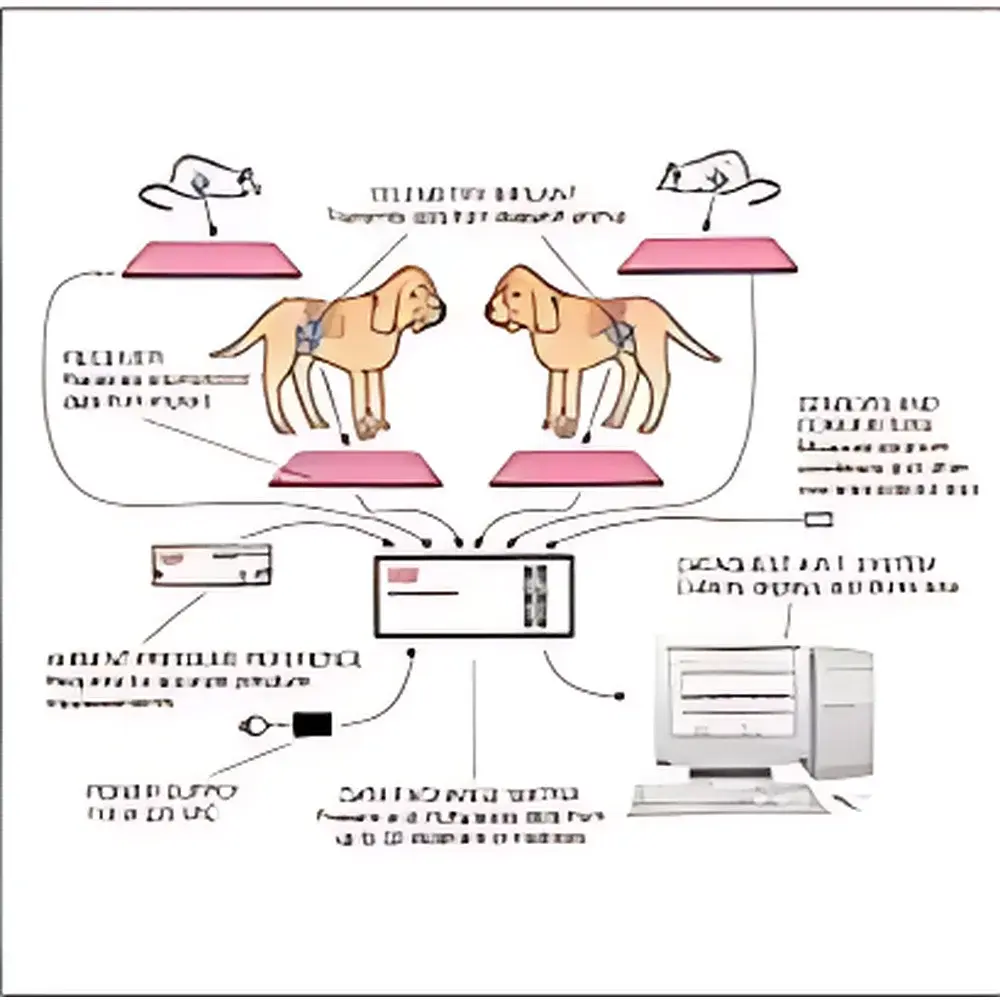
DSI Implantable Physiological Signal Telemetry System
| Origin | USA |
|---|---|
| Manufacturer Type | Authorized Distributor |
| Origin Category | Imported |
| Model | DSI Implantable Physiological Signal Telemetry System |
| Pricing | Available Upon Request |
Overview
The DSI Implantable Physiological Signal Telemetry System is a rigorously validated, FDA-registered (Class II) wireless telemetry platform engineered for chronic, unrestrained, and conscious physiological monitoring in preclinical research. Based on proven radio-frequency (RF) telemetry architecture operating in the 402–405 MHz Medical Device Radiocommunication Service (MDRS) band, the system enables continuous, high-fidelity acquisition of hemodynamic, electrophysiological, thermal, and behavioral parameters without tethering, restraint, or anesthesia-induced confounders. Its core measurement principle relies on miniaturized implantable transmitters that integrate biocompatible sensors, low-noise analog front-ends, 16-bit analog-to-digital conversion, and regulated RF transmission—ensuring signal integrity across long-term studies (up to 6 months in vivo). Designed explicitly for GLP-compliant cardiovascular, neuroscience, pharmacology, and toxicology studies, the system supports regulatory submissions requiring ISO 13485–certified manufacturing traceability and full audit trails per FDA 21 CFR Part 11.
Key Features
- Implantable transmitter architecture with hermetically sealed titanium or biopolymer housings, validated for chronic implantation per ISO 10993–1 biocompatibility standards.
- Simultaneous multi-parameter acquisition: arterial pressure (AP), left ventricular pressure (LVP), venous pressure (VP), intracranial pressure (ICP), electrocardiogram (ECG), electromyogram (EMG), electroencephalogram (EEG), electrooculogram (EOG), core body temperature (Tcore), and locomotor activity (via onboard 3-axis accelerometer).
- Pressure transducers calibrated to ASTM F2027–22 specifications: full-scale range –20 to +300 mmHg; absolute accuracy ±3 mmHg; long-term drift ≤2 mmHg/month after initial stabilization.
- Temperature sensors traceable to NIST standards: resolution 0.01°C; accuracy ±0.1°C; drift <0.05°C per 14 days.
- Scalable receiver network supporting up to 400 concurrent implants per data exchange unit (DEU), with automatic channel assignment and real-time signal quality monitoring.
- Cross-cage compatibility: integrated orthogonal loop antennas enable reliable signal reception from both polycarbonate and stainless-steel housing environments without repositioning.
Sample Compatibility & Compliance
The system supports longitudinal studies across species including mice (≥17 g), rats (≥175 g), rabbits, dogs, minipigs, sheep, and non-human primates (≥2.5 kg). Implant selection is governed by allometric scaling principles and surgical feasibility—e.g., PA-C10 (1.4 g, 1.1 cc) for murine AP, TA-F40 (7.25 g, 3.5 cc) for porcine Tcore, and D70-PCT (49 g, 33 cc) for large-animal multi-parameter telemetry. All implants meet USP Class VI and ISO 10993–6 (implantation) requirements. The entire platform adheres to IEC 60601–1 (medical electrical equipment safety), FCC Part 95 Subpart E (telemetry device emissions), and supports 21 CFR Part 11 electronic record/electronic signature validation when deployed with compliant IT infrastructure.
Software & Data Management
Data acquisition and analysis are performed using Ponemah v6.x software—a validated, audit-trail-enabled application compliant with ALCOA+ data integrity principles. Ponemah provides synchronized multi-channel visualization, automated event detection (e.g., arrhythmia, seizure onset), spectral analysis (FFT-based HRV, EEG power bands), pressure-volume loop derivation, and customizable export to MATLAB, Python (via .mat/.csv), and CDF formats. Raw data files are stored with embedded metadata (implant ID, calibration coefficients, timestamped firmware version), enabling full traceability from acquisition to publication. Optional integration with LabArchives ELN and Veeva Vault ensures alignment with GxP documentation workflows.
Applications
This system is routinely deployed in: cardiovascular safety pharmacology (ICH S7B, S7A); hypertension and heart failure modeling; CNS drug efficacy assessment (seizure threshold, sleep architecture); metabolic disease progression (diabetes-induced autonomic dysfunction); and surgical recovery monitoring (post-implant inflammation kinetics). Its capacity for within-subject crossover designs reduces inter-animal variability and statistical cohort size—directly supporting the 3Rs (Replacement, Reduction, Refinement) framework endorsed by AAALAC International and the NIH Office of Laboratory Animal Welfare.
FAQ
What is the maximum duration of continuous recording supported by DSI implants?
Implants support uninterrupted telemetry for ≥180 days in vivo under standard battery configurations; extended-life variants (e.g., D70 series) achieve >12 months with duty-cycle optimization.
Can the same receiver be used interchangeably across different animal cages?
Yes—each receiver operates independently and may be relocated between cages without recalibration; signal handoff between receivers is managed automatically via Ponemah’s network scheduler.
How is data security and integrity maintained during transmission?
All RF links employ AES-128 encryption; raw data packets include CRC-32 error checking; Ponemah enforces write-once archival storage with immutable hash logging per FDA 21 CFR Part 11 Annex 11 requirements.
Are calibration certificates provided with each implant?
Yes—each device ships with NIST-traceable calibration reports, including pressure hysteresis curves, temperature linearity plots, and noise floor characterization (input-referred RMS voltage).
Does the system support real-time remote monitoring during acute experiments?
Ponemah supports live streaming to remote workstations over secure LAN/WAN; latency is <100 ms end-to-end, enabling real-time intervention decisions in ischemia-reperfusion or neurostimulation paradigms.