Dual-Channel and Multi-Channel Monitor Ionization Chamber
| Detector Type | Ventilated parallel-plate ionization chamber |
|---|---|
| Environmental Rating | Waterproof, ventilated, fully guarded, non-perturbing |
| Applicable Radiation Quality | 70–250 MeV protons |
| Field Size Range | 3–10 mm diameter |
| Polarity Effect | <1% |
| Nominal Response | 325 nC/Gy (in air, under ⁶⁰Co beam) |
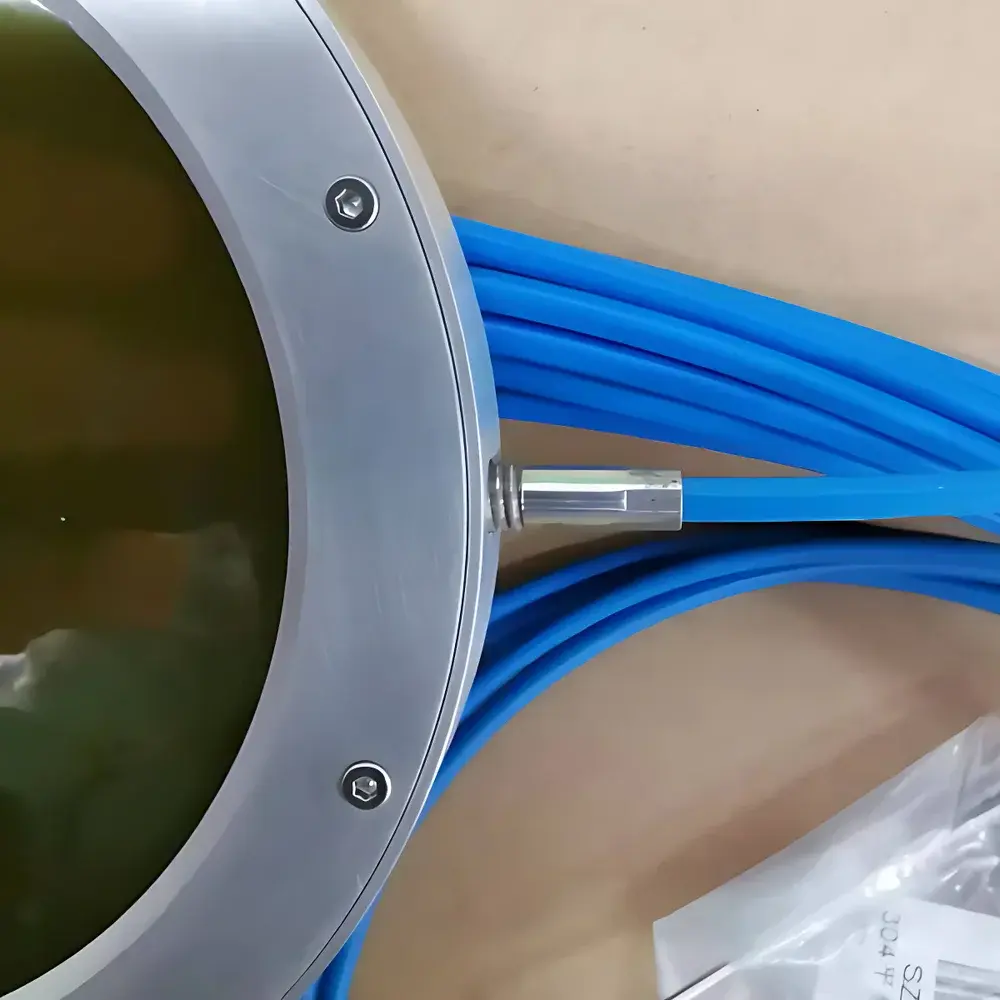
| Outer Dimensions | 120–150 mm diameter × 10–15 mm height |
| Sensitive Volume Dimensions | 58.0 mm diameter × 2 mm depth |
| Entrance Window Thickness | 0.1 mm insulating paint + 0.5 mm PMMA + 0.02 mm graphite electrode |
| Exit Window Thickness | 1.16 mm |
| Collecting Electrode Position | distal to entrance window |
| Collecting Electrode Diameter | 57.6 mm |
| Sensitive Volume | 5.2 cm³ |
| Sensitive Area | 25.1 cm² |
| Guard Ring Width | 4 mm |
| Nominal Operating Voltage | 400 V (max ±500 V) |
| Leakage Current | ≤ ±100 fA |
| Ion Collection Efficiency at Nominal Voltage | ion collection time = 67 µs |
| Maximum Dose Rate | 21 Gy/s (99.5% saturation), 42 Gy/s (99.0% saturation) |
| Maximum Dose per Pulse | 0.9 mGy (99.5% saturation), 1.8 mGy (99.0% saturation) |
Overview
The Dual-Channel and Multi-Channel Monitor Ionization Chamber is a high-precision, ventilated parallel-plate ionization chamber engineered for real-time, absolute dosimetry in proton therapy beamlines and other high-energy charged particle applications. Designed specifically for use with 70–250 MeV proton beams, it operates as a reference-class transmission monitor—providing stable, reproducible charge collection without perturbing the incident radiation field. Its non-perturbing geometry, fully guarded electrode structure, and optimized vented design ensure minimal beam scattering and consistent response across wide dynamic ranges. The chamber complies with IEC 60731 and AAPM TG-51 recommendations for reference-class ionization chambers used in clinical beam calibration and quality assurance protocols. It is suitable for integration into gantry-mounted or fixed-beamline monitoring systems where high spatial fidelity, low polarity dependence (<1%), and robust environmental resilience (including moisture resistance) are critical operational requirements.
Key Features
- Ventilated parallel-plate architecture enabling stable atmospheric pressure equilibrium during extended irradiation cycles
- Full guarding system with 4 mm guard ring width to minimize leakage current (≤ ±100 fA) and edge effects
- Optimized entrance window stack: 0.1 mm insulating paint + 0.5 mm PMMA + 0.02 mm graphite electrode ensures uniform electric field penetration and minimal energy loss
- Exit window thickness of 1.16 mm provides mechanical integrity while preserving beam transmission characteristics
- Collecting electrode positioned distally to entrance window, with precise 57.6 mm diameter, ensuring defined sensitive volume of 5.2 cm³ and sensitive area of 25.1 cm²
- Nominal operating voltage of 400 V (±500 V max) supports rapid ion collection (67 µs collection time) and high linearity up to 42 Gy/s dose rate
- Waterproof housing and sealed internal electronics enable reliable operation in clinical vault environments with variable humidity
Sample Compatibility & Compliance
This ionization chamber is validated for use with monoenergetic and spread-out Bragg peak (SOBP) proton beams in the 70–250 MeV range. Its 3–10 mm circular field compatibility supports both small-field collimation and broad-beam commissioning measurements. The chamber meets structural and electrical requirements outlined in IEC 60731:2011 (Medical electrical equipment – Dosimeters for use in radiotherapy) and aligns with AAPM Report No. 100 (Radiation Therapy Physics) for reference dosimetry in particle therapy. It supports traceable calibration against primary standards maintained by national metrology institutes (e.g., NIST, PTB, NPL) and is compatible with electrometers compliant with IEC 61674:2017. No user recalibration is required between routine QA checks when operated within specified voltage and temperature (15–35°C) and pressure (70–106 kPa) limits.
Software & Data Management
The chamber interfaces seamlessly with industry-standard radiotherapy QA platforms—including Elekta Integrity, Varian Portal Dosimetry, and independent beam analysis software such as DOSIsoft and OmniPro I’mRT—via analog voltage or digital current output (optional). When paired with a compliant electrometer, it supports automated data logging with timestamped acquisition, audit trail generation, and export in DICOM-RT and CSV formats. Full compliance with FDA 21 CFR Part 11 is achievable through configurable electronic signature workflows and secure user access controls in integrated QA management systems. All measurement records include metadata on ambient conditions (temperature, pressure, humidity), applied bias voltage, and electrometer gain settings to support GLP/GMP-compliant documentation for regulatory audits.
Applications
- Real-time beam intensity monitoring during proton therapy delivery
- Reference dosimetry for beam output calibration (MU/Gy) in accordance with TRS-398 and AAPM TG-258
- Small-field output factor verification for pencil beam scanning nozzles
- Long-term stability tracking across daily, monthly, and annual QA programs
- Commissioning of passive scattering and active scanning beamlines
- Intercomparison studies between proton therapy centers participating in IROC or ESTRO-ACROP harmonization initiatives
FAQ
What is the recommended electrometer pairing for optimal signal-to-noise performance?
A high-input-impedance, low-noise electrometer with ≥10¹⁵ Ω input resistance and sub-femtoampere baseline stability is advised—such as the PTW Unidos E, IBA Razor, or Standard Imaging DOSE1.
Can this chamber be used for carbon ion beams?
While structurally compatible, its nominal response is calibrated for ⁶⁰Co and proton beams; carbon ion applications require beam-specific re-characterization per IAEA TRS-483 guidelines.
Is temperature/pressure correction required during clinical use?
Yes—standard atmospheric correction factors per IAEA TRS-398 must be applied using real-time environmental readings from an integrated sensor or external monitor.
How often does the chamber require factory recalibration?
Annual recalibration is recommended for clinical use; however, in-house constancy checks using a stable reference source should be performed daily prior to patient treatment.
Does the chamber support pulsed beam mode operation?
Yes—the 67 µs ion collection time and 99.5% saturation at 0.9 mGy/pulse enable accurate per-pulse dose monitoring in synchrotron-based pulsed delivery systems.