
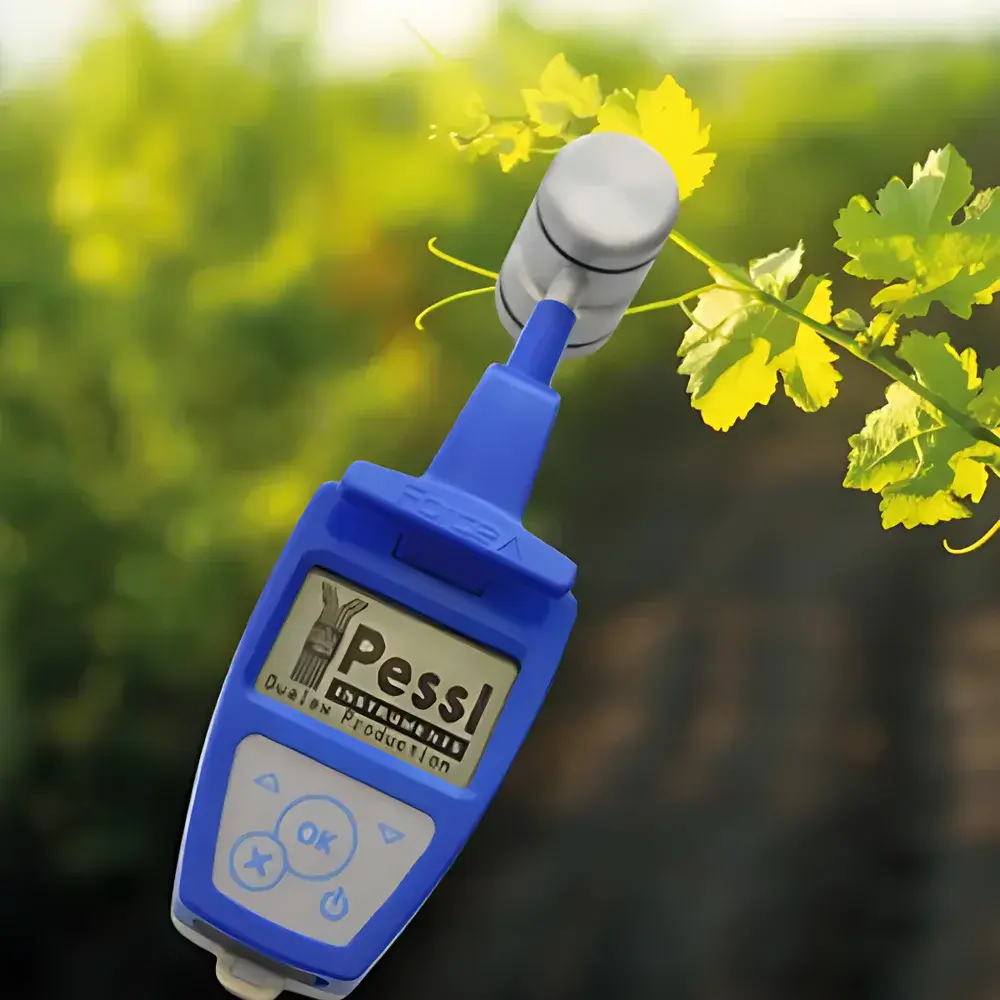
DUALEX Portable Dual-Parameter Leaf Optical Sensor (Zealquest-branded, Austria-manufactured)
| Brand | Zealquest |
|---|---|
| Origin | Austria |
| Model | DUALEX |
| Measurement Parameters | Chlorophyll Content (CHL, µg/cm²), Flavonol Index (FLAV), Nitrogen Balance Index (NBI) |
| Measurement Principle | Dual-wavelength transmittance (for CHL) and flavonol-modulated chlorophyll fluorescence shielding (for FLAV) |
| Accuracy | ±5% |
| Reproducibility | 4.5% (CHL), 3.5% (FLAV) |
| Repeatability | 1.3% (CHL), 2% (FLAV) |
| Measurement Area | 19.6 mm² |
| Max Leaf Thickness | 1.5 mm |
| Measurement Time | <1 s |
| Display | LCD with audible feedback |
| GPS | Built-in, positional accuracy <2.5 m |
| Data Storage | 10,000 measurements |
| Output Format | CSV |
| Interface | USB cable |
| Operating Temperature | 5–45 °C |
| Battery | Rechargeable Li-ion, 6 h runtime |
| Weight | 220 g |
| Dimensions | 205 × 65 × 55 mm |
Overview
The DUALEX Portable Dual-Parameter Leaf Optical Sensor is an advanced, field-deployable instrument engineered for non-destructive, real-time quantification of leaf-level physiological biomarkers in living plants. Developed and manufactured in Austria by Pessl Instruments and distributed globally under the Zealquest brand, the DUALEX operates on two complementary optical principles: (1) dual-wavelength transmittance spectroscopy at far-red (730 nm) and near-infrared (850 nm) bands to determine chlorophyll content (CHL, expressed in µg/cm²), and (2) differential chlorophyll fluorescence shielding induced by epidermal flavonol absorption under UV excitation (375 nm) to derive the flavonol index (FLAV). The nitrogen balance index (NBI) is computed as the ratio CHL/FLAV — a physiologically grounded proxy for leaf nitrogen status that precedes visible chlorosis. Unlike destructive chemical assays or single-parameter chlorophyll meters, DUALEX delivers simultaneous, co-localized measurements of two functionally antagonistic metabolites, enabling early detection of nutritional imbalance, abiotic stress onset, and phenological shifts with high temporal resolution.
Key Features
- Non-invasive leaf clamping design ensures zero tissue damage; enables longitudinal monitoring of individual leaves across developmental stages.
- Sub-second measurement cycle (<1 s) in auto-trigger mode, with immediate on-device display and acoustic confirmation.
- Integrated high-sensitivity GPS module records georeferenced coordinates (accuracy <2.5 m) for spatially explicit field mapping and GIS integration.
- Onboard data management supports hierarchical organization: user-defined files → measurement groups → sequential IDs; automatic calculation of mean, standard deviation, and coefficient of variation per group.
- Compact ergonomic form factor (205 × 65 × 55 mm, 220 g) permits one-handed operation in greenhouse, nursery, orchard, or open-field conditions.
- Robust optical path with fixed 19.6 mm² measurement area and calibrated 8 cm leaf clamp ensures consistent sampling geometry and representative mid-lamina readings.
Sample Compatibility & Compliance
DUALEX is validated for use on intact, fully expanded leaves of dicotyledonous and monocotyledonous species, including but not limited to Arabidopsis thaliana, tomato, grapevine, apple, tea, wheat, maize, and soybean. It accommodates leaf thickness up to 1.5 mm without mechanical compression artifacts. The device conforms to IEC 61000-4 electromagnetic compatibility standards and meets CE marking requirements for portable electronic instrumentation. While not certified for GLP or GMP environments per se, its audit-ready data export (.csv), timestamped measurements, and traceable GPS metadata support compliance with ISO 17025-accredited laboratory workflows and FAO-recommended protocols for precision nutrient management. All firmware and calibration routines are traceable to Pessl Instruments’ Austrian manufacturing QA system.
Software & Data Management
Measurements are stored internally in a structured, time-stamped database (capacity: 10,000 records). Data export occurs via standard USB 2.0 interface to Windows/macOS platforms using vendor-provided DUALEX Manager software — a lightweight desktop application supporting batch import, spectral QC visualization, NBI trend analysis, and export to CSV, Excel, or comma-delimited text for downstream statistical processing (R, Python, SAS). The software enforces immutable record integrity: no post-acquisition editing of raw CHL, FLAV, or GPS values is permitted. Audit logs capture operator ID (if assigned), session start/end timestamps, and firmware version. For regulated environments, optional configuration enables adherence to FDA 21 CFR Part 11 requirements through digital signature integration and electronic record retention policies.
Applications
- Nitrogen Use Efficiency (NUE) Monitoring: NBI serves as an early-warning indicator of nitrogen deficit or excess, enabling site-specific top-dressing decisions prior to chlorophyll degradation — critical for optimizing yield and minimizing nitrate leaching in horticultural and arable systems.
- Abiotic Stress Phenotyping: Elevated FLAV reflects UV-B exposure, drought-induced oxidative pressure, or heavy metal accumulation; concurrent CHL decline indicates photosynthetic impairment — enabling high-throughput screening of stress-tolerant genotypes.
- Phytochemical Profiling in Medicinal Plants: Correlates FLAV with bioactive flavonoid concentrations (e.g., quercetin, kaempferol) in tea, ginkgo, and St. John’s wort, supporting harvest timing optimization.
- Fruit Tree Canopy Management: Spatial NBI mapping informs pruning strategies and irrigation scheduling in orchards by identifying zones of suboptimal nitrogen assimilation.
- Eco-Physiological Field Studies: Enables comparative analysis of CHL/FLAV dynamics across elevation gradients, soil types, or climate treatments in long-term ecological research networks.
FAQ
How does DUALEX differentiate between chlorophyll and flavonol signals optically?
It employs two independent optical pathways: one measures transmittance at 730 nm (chlorophyll-absorbing) vs. 850 nm (reference); the other compares chlorophyll fluorescence intensity under UV excitation (375 nm) with and without flavonol-mediated shielding — requiring no chemical extraction or labeling.
Can DUALEX be used on conifer needles or highly pubescent leaves?
Yes, provided needle thickness ≤1.5 mm and surface pubescence does not obstruct full contact between leaf tissue and optical windows; validation data exist for Picea abies and Olea europaea.
Is factory recalibration required, and how often?
Annual recalibration against Pessl’s master reference standards is recommended for metrological continuity; field verification using supplied calibration check leaf is advised before each major campaign.
Does DUALEX comply with ISO 10212 or ASTM E2858 for leaf pigment quantification?
While DUALEX is not certified to those specific standards, its optical methodology aligns with the physical principles outlined in ISO 10212 (leaf chlorophyll measurement) and ASTM E2858 (non-destructive plant stress assessment), and it is widely cited in peer-reviewed literature applying those frameworks.
What battery life can be expected under continuous field use?
Under typical intermittent sampling (one measurement every 3–5 seconds), the rechargeable Li-ion battery sustains >6 hours of operation; cold temperatures (<10 °C) reduce effective runtime by ~15% due to reduced ion mobility.




