
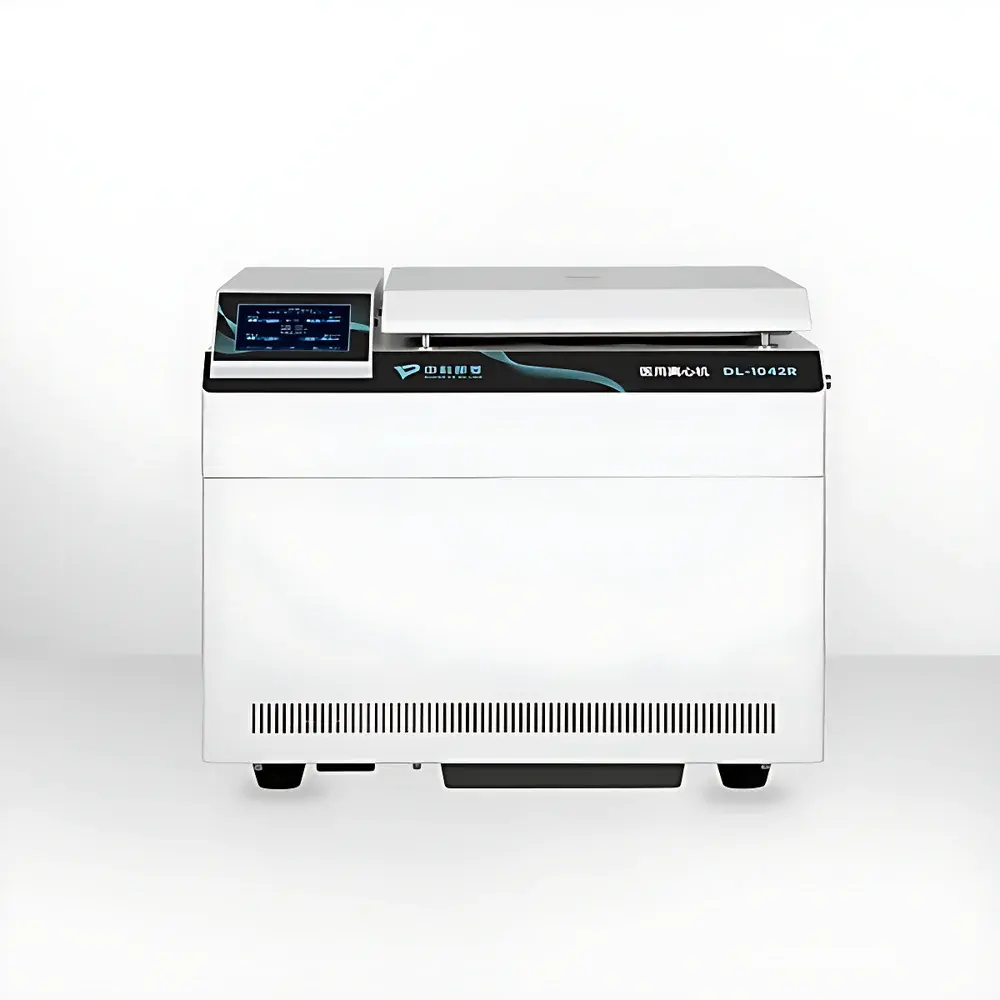
Duling DL-1042R Benchtop Low-Speed Refrigerated Centrifuge
| Brand | Duling |
|---|---|
| Origin | Anhui, China |
| Manufacturer Type | Authorized Distributor |
| Country of Manufacture | China |
| Model | DL-1042R |
| Instrument Type | Benchtop Centrifuge |
| Speed Range | 0–5500 rpm |
| Max RCF | 5400 × g |
| Max Capacity | 4 × 250 mL (horizontal rotor) |
| Temperature Range | –20 °C to +40 °C |
| Dimensions (L×W×H) | 620 × 648 × 525 mm |
| Drive System | Brushless AC Frequency-Controlled Motor |
| Safety | Dual Interlocked Lid Lock, Automatic Imbalance Detection & Shutdown, Overspeed Protection, Acoustic Alert |
| Control | Microprocessor-Based Touchpad Interface with Simultaneous LED Display of Speed, RCF, Time, and Temperature |
| Programmability | 20 User-Defined Protocols, 15 Acceleration/Deceleration Profiles, Short Spin & “At Set RCF” Modes |
| Compliance | Designed to meet ISO 13485-aligned manufacturing practices |
Overview
The Duling DL-1042R is a microprocessor-controlled benchtop low-speed refrigerated centrifuge engineered for reproducible, temperature-stable sedimentation of biological suspensions in routine laboratory environments. It operates on the principle of radial acceleration-induced phase separation—applying controlled centrifugal force (RCF) to accelerate gravitational settling of particles based on density, size, and shape. With a maximum rotational speed of 5500 rpm and an RCF ceiling of 5400 × g, the DL-1042R is optimized for applications involving intact cells, bacterial pellets, whole blood fractionation, and large-volume tissue homogenates—where high g-forces are unnecessary and thermal stability is critical. Its refrigeration system maintains sample integrity across a wide operational range (–20 °C to +40 °C), ensuring consistent viscosity and minimizing enzymatic or metabolic activity during prolonged runs.
Key Features
- Brushless AC frequency-controlled motor delivering maintenance-free operation, stable torque output, and extended service life without carbon brush replacement.
- Dual interlocked lid mechanism: mechanical latch engages automatically upon rotor acceleration and remains secured until full deceleration—meeting IEC 61010-2-020 safety requirements for centrifuge enclosures.
- Real-time simultaneous LED display of speed (rpm), relative centrifugal force (× g), elapsed time, and chamber temperature—enabling immediate verification of operational parameters without menu navigation.
- 20 programmable protocols with non-volatile memory storage; users may save, recall, and modify methods—including acceleration/deceleration profiles (15-step ramping options) tailored to shear-sensitive samples such as primary lymphocytes or organelle isolates.
- “At Set RCF” mode allows direct input and regulation of centrifugal force independent of rotor geometry—eliminating manual conversion between rpm and × g when switching between horizontal and angular rotors.
- Short-spin (pulse) function enables rapid, transient centrifugation (e.g., brief pellet repositioning or supernatant aspiration prep) without entering full protocol mode.
- Automatic imbalance detection with audible alert and immediate rotor stoppage if mass asymmetry exceeds ±5 g per bucket—verified during both acceleration and steady-state rotation.
Sample Compatibility & Compliance
The DL-1042R supports standard horizontal swing-out rotors accommodating up to four 250 mL bottles (e.g., polypropylene or polycarbonate centrifuge bottles), as well as optional adapters for microtiter plates (96-well), conical tubes (15–50 mL), and PCR strip carriers. Its chamber design permits use of sealed buckets compliant with biosafety level 2 (BSL-2) containment standards. While not certified to ISO 22870 or CLIA for clinical diagnostics out-of-the-box, the instrument’s architecture supports integration into quality management systems aligned with ISO/IEC 17025 and FDA 21 CFR Part 11 when paired with validated data export firmware and electronic logbook solutions. All thermal performance and RCF accuracy specifications adhere to ASTM E2500-13 guidance for verification of laboratory equipment.
Software & Data Management
The DL-1042R features embedded firmware supporting USB-based parameter export (CSV format) for traceable recordkeeping. Optional PC connectivity enables remote monitoring via RS-232 or Ethernet (with add-on interface module), allowing synchronization with LIMS platforms and automated generation of run logs—including timestamps, operator ID fields, rotor serial numbers, and deviation flags (e.g., temperature excursion >±1 °C). Audit trail functionality meets GLP requirements for method validation documentation, including version-controlled protocol archives and immutable change history for all user-modified settings.
Applications
- Cell culture harvest: gentle pelleting of adherent and suspension mammalian cells at ≤3000 × g to preserve membrane integrity and viability.
- Clinical specimen processing: separation of serum/plasma from whole blood using standardized protocols compliant with CLSI GP44-A6 guidelines.
- Microbiology workflows: concentration of bacterial cultures (e.g., E. coli, S. aureus) prior to DNA extraction or antibiotic susceptibility testing.
- Food & beverage QC: sediment analysis in dairy emulsions, juice cloud stability assessment, and yeast harvesting in fermentation labs.
- Environmental testing: isolation of particulate matter from aqueous environmental samples prior to gravimetric or elemental analysis.
FAQ
What is the minimum temperature achievable during operation?
The refrigeration system reaches and maintains –20 °C under standard ambient conditions (25 °C, 50% RH); cooling rate is approximately 12 min from +25 °C to –20 °C with empty chamber.
Can the DL-1042R be used with fixed-angle rotors?
Yes—though optimized for horizontal rotors, it accepts optional fixed-angle rotors (e.g., 6 × 50 mL) provided they are dynamically balanced and certified for ≤5500 rpm operation.
Is calibration certificate included with shipment?
A factory-issued calibration report verifying temperature uniformity (±1.5 °C across chamber), speed accuracy (±10 rpm), and RCF linearity is supplied; third-party ISO/IEC 17025 calibration is available upon request.
How does the auto-balance system respond to uneven loading?
The system continuously monitors vibration spectra via piezoelectric sensors; imbalance ≥±5 g triggers audible alarm and halts acceleration within 0.8 seconds—no manual reset required before restart.
Does the instrument support password-protected user access levels?
Yes—three-tier access control (Operator, Supervisor, Administrator) governs protocol editing, calibration adjustment, and service mode activation, supporting multi-user lab environments under ISO 15190-compliant SOPs.



