
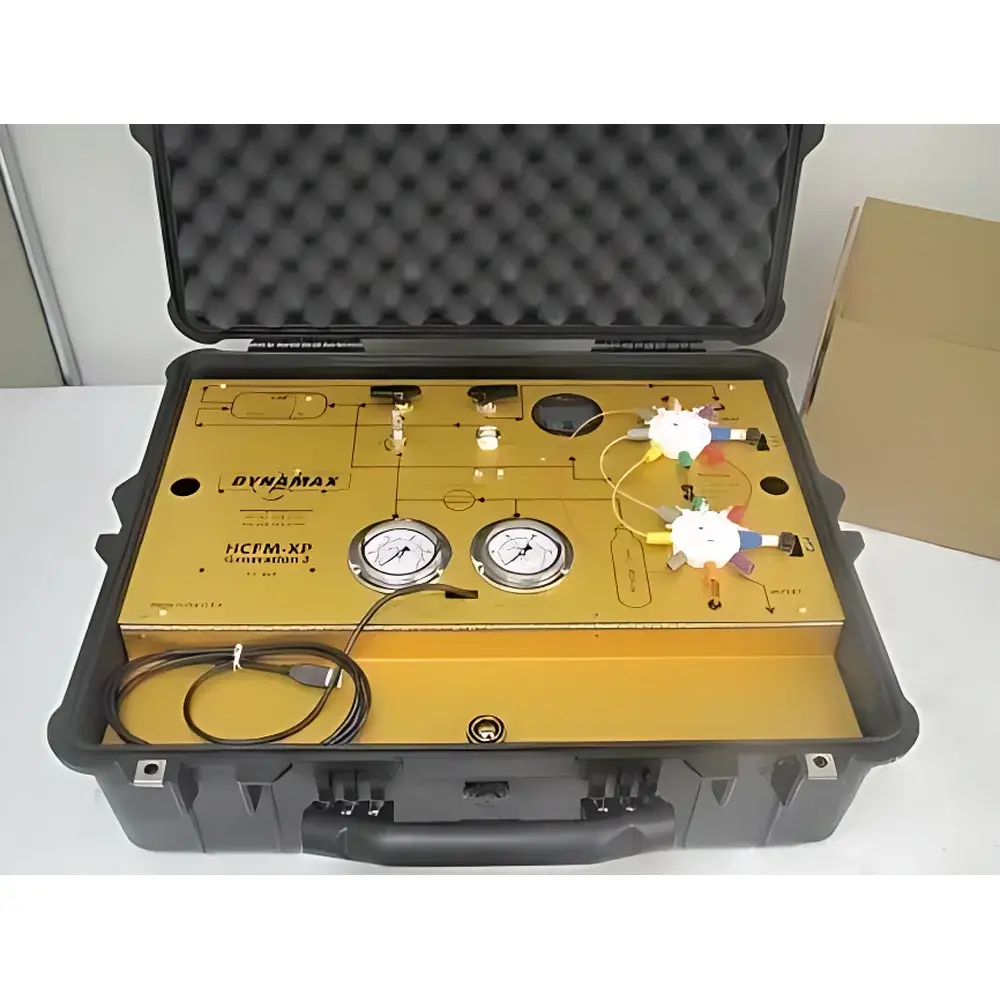
Dynamax HCFM-XP Gen3 Portable Plant Hydraulic Conductance Meter
| Brand | Dynamax |
|---|---|
| Origin | USA |
| Model | HCFM-XP Gen3 |
| Measurement Diameter Range | 1–36 mm |
| Flow Rate Range | 0.01–350 g/h (5 selectable ranges) |
| Hydraulic Conductance Range | 7.7×10⁻⁸ to 3.5×10⁻⁴ kg·s⁻¹·MPa⁻¹ |
| Pressure Output Resolution | 0.1 kPa |
| Max Operating Pressure | 620 kPa |
| Deaerated Water Reservoir Capacity | 0.7 L |
| Compressed Gas Cylinder Capacity | 170 L (at STP), CGA-580 valve |
| Data Acquisition | 1 reading per 2 s |
| A/D Conversion | 24-bit dual analog/digital |
| Dimensions (L×W×H) | 61×48×23 cm |
| Weight | 15 kg |
| Power & Interface | USB-powered, integrated data logging |
Overview
The Dynamax HCFM-XP Gen3 Portable Plant Hydraulic Conductance Meter is a field-deployable instrument engineered for precise, in situ quantification of xylem-specific hydraulic conductance (Kh) and hydraulic resistance in excised plant tissues. It operates on the principle of steady-state or quasi-steady-state pressure-driven flow, applying controlled, calibrated hydrostatic or pneumatic pressure across a cut sample—such as stem segments, petioles, or root sections—to induce water movement through the xylem conduit network. By measuring volumetric flow rate under known pressure gradients, the system computes hydraulic conductance using the fundamental relationship Kh = F / ΔP, where F is flow rate (kg·s⁻¹) and ΔP is the applied pressure differential (MPa). This methodology aligns with standardized protocols described in ASTM D5125 and widely adopted in plant hydraulics research (e.g., Tyree & Ewers, 1991; Sperry et al., 2017). The Gen3 iteration integrates enhanced pressure stability, improved deaeration integrity, and real-time signal conditioning to minimize cavitation artifacts and ensure reproducibility across diverse species and tissue types.
Key Features
- Integrated portable workstation housed in a rugged, IP54-rated transport case (61 × 48 × 23 cm), enabling rapid deployment across forest plots, agroecological transects, or greenhouse corridors without external power or benchtop infrastructure.
- Five-step flow-rate range selection (0.01–350 g/h) with automatic range-switching logic, optimized for low-conductance roots and high-conductance herbaceous stems alike.
- NIST-traceable pressure transducer calibration with ±0.25% full-scale accuracy and 0.1 kPa resolution, supporting compliance with GLP documentation requirements for environmental physiology studies.
- Onboard 24-bit dual analog/digital signal acquisition ensures minimal quantization noise during transient flow stabilization, critical for detecting subtle embolism-induced declines in Kh.
- Dedicated deaerated water reservoir (0.7 L) coupled with a high-capacity 170 L (STP) compressed gas cylinder (CGA-580 interface) enables >8 hours of continuous operation without refilling or re-pressurization under typical field conditions.
- Real-time linear regression engine computes conductance values instantaneously from slope analysis of flow vs. pressure time-series, with automatic averaging over user-defined stabilization windows (default: 60 s).
Sample Compatibility & Compliance
The HCFM-XP Gen3 accommodates cylindrical plant tissues with diameters spanning 1–36 mm—including woody branches, maize stalks, grapevine canes, rice culms, and intact root systems—via interchangeable stainless-steel sample holders with O-ring-sealed compression fittings. All wetted surfaces are chemically inert (316 stainless steel, PTFE, borosilicate glass), preventing leaching or surface adsorption that could bias solute-free water flow measurements. The system meets ISO/IEC 17025:2017 general requirements for competence of testing and calibration laboratories when operated with documented SOPs and periodic verification against reference standards. Its pressure control architecture supports adherence to USDA ARS and NSF-funded plant hydraulics protocols requiring traceable uncertainty budgets (<5% expanded uncertainty at k=2).
Software & Data Management
Data acquisition and visualization are managed via the proprietary HCFM Control Suite (v4.2+), a Windows-based application supporting USB 2.0 communication. The software records timestamped pressure, flow, temperature, and calculated conductance values in CSV and HDF5 formats, with embedded metadata fields for sample ID, operator, site GPS coordinates, and ambient RH/T. Audit trails include full parameter change logs and digital signatures compliant with FDA 21 CFR Part 11 for regulated environmental monitoring programs. Exported datasets integrate natively with R packages (plantecophys, hydraulics) and Python libraries (scipy.optimize, statsmodels) for downstream modeling of vulnerability curves (P50), Huber value estimation, and whole-plant transpiration scaling.
Applications
- Quantifying drought-induced xylem embolism resistance across genotypes in crop breeding trials (e.g., sorghum, wheat, soybean).
- Validating hydraulic architecture models linking leaf-specific conductivity to crown allometry in temperate and tropical forests.
- Assessing rootstock-scion hydraulic mismatch in perennial horticulture (e.g., citrus, apple, almond).
- Field validation of remote-sensing–derived stomatal conductance proxies using ground-truthed Kh time series.
- Teaching laboratory modules on plant water relations, including hands-on demonstration of Poiseuille’s law in biological conduits.
FAQ
What sample preparation protocols are recommended prior to measurement?
Excised samples should be rehydrated under dark, high-humidity conditions (≥95% RH) for ≥2 hours to restore native xylem tension. Cut ends must be trimmed underwater with a razor blade immediately before insertion into the chamber to prevent air entry.
Can the system measure intact plants or only excised tissues?
The HCFM-XP Gen3 is designed exclusively for excised, bench-top measurements. Intact plant hydraulic assessment requires complementary techniques such as thermal dissipation probes or sap flow sensors.
Is calibration required between samples?
No routine recalibration is needed between samples; however, a system blank (water-only flow test) is advised every 10–15 measurements to verify baseline drift and seal integrity.
How does the instrument handle temperature fluctuations during extended field use?
An internal thermistor monitors reservoir temperature (±0.1 °C) and applies viscosity correction factors to flow calculations in real time, referencing published water property tables (IAPWS-95 formulation).
What maintenance is required for long-term reliability?
Monthly inspection of O-rings and pressure relief valves, quarterly replacement of deaerated water, and annual NIST-traceable transducer recalibration by authorized Dynamax service centers are recommended per the maintenance logbook included with shipment.
Related Products




