
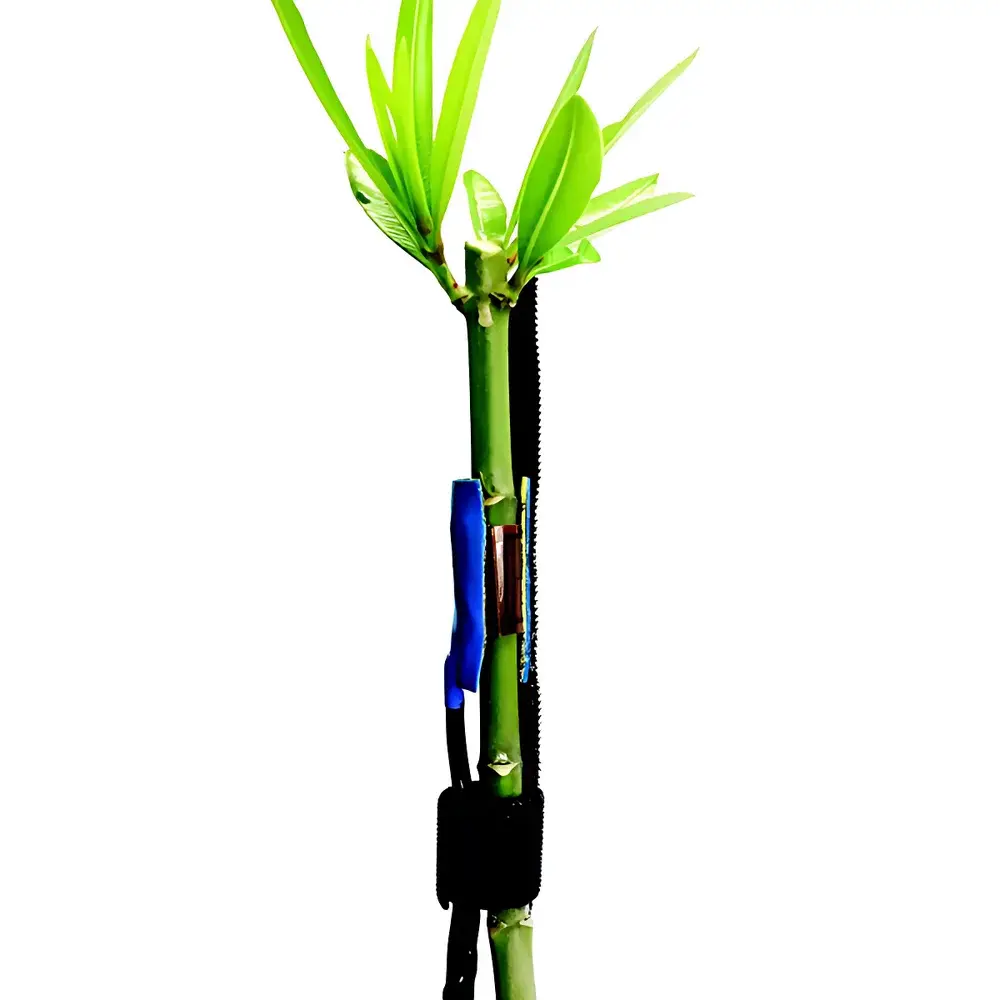
Dynamax SGDC EXO-Skin Wrap-Around Stem Flow Sensor
| Brand | Dynamax |
|---|---|
| Origin | USA |
| Model | SGDC |
| Type | Heat Balance-Based Stem Flow Sensor |
| Compliance | Validated per USDA-ARS protocols (Lascano et al., 2016, *Agric. Sci.*) |
| Channel Requirement | 2 differential analog inputs (temperature + heater voltage/current) |
| Stem Diameter Range | 7–25 mm (model-dependent) |
| Enclosure Design | EXO-Skin conformal wrap |
| Heater Architecture | Molded, low-thermal-mass resistive element |
| Environmental Protection | IP67-rated moisture barrier |
| Calibration Traceability | NIST-traceable thermistor and voltage references |
Overview
The Dynamax SGDC EXO-Skin Wrap-Around Stem Flow Sensor is an engineered advancement in heat balance-based sap flow measurement for woody and semi-woody plant species. It operates on the stem heat balance (SHB) principle: a constant, low-power resistive heater applies axial thermal energy to the xylem; temperature differentials upstream and downstream of the heating zone—measured via precision thermistors—are used to quantify convective heat transport by transpiring sap. Unlike thermal dissipation (TDP) or heat pulse methods, SHB provides continuous, absolute volumetric flow rates (g·h⁻¹ or mL·h⁻¹) without empirical calibration against environmental variables. The SGDC refines this methodology through geometric and thermal optimization—reducing thermal lag, minimizing boundary-layer interference, and suppressing diurnal artifacts such as morning spikes caused by transient radial water redistribution. Its deployment requires only two differential analog channels on a compatible data logger (e.g., Campbell Scientific CR series, HOBO RX3000), enabling scalable multi-sensor networks with minimal hardware overhead.
Key Features
- EXO-Skin conformal wrap architecture ensures mechanical stability and thermal coupling on irregular, tapered, or bark-textured stems—eliminating need for custom mounting brackets or epoxy adhesion.
- Molded, low-mass heater element delivers uniform axial heat flux with improved thermal response time (<1.2 s 90% rise) and reduced self-heating drift over extended deployments (≥12 months).
- Dual-point temperature sensing (upstream/downstream) integrated into a single sensor body enables direct calculation of conductive heat loss—critical for correcting SHB-derived sap flux under low-flow conditions (e.g., nighttime, drought stress).
- IP67-rated encapsulation prevents moisture ingress at the sensor-stem interface, mitigating signal drift from condensation or dew accumulation—a known source of error in long-term field studies.
- Reduced channel count (2 differential inputs vs. legacy 4–6) simplifies wiring, lowers power consumption, and doubles node density per data logger—supporting high-resolution spatial monitoring across heterogeneous canopies.
- Validated against gravimetric transpiration measurements under controlled and field conditions (USDA-ARS, 2016); mean absolute error < 8.3% across species including Vitis vinifera, Populus deltoides, and Quercus virginiana.
Sample Compatibility & Compliance
The SGDC is designed for perennial dicotyledonous species with intact phloem and secondary growth. Compatible stem diameters range from 7 mm (SGDC-7) to 25 mm (SGDC-25), with model-specific minimum/maximum thresholds ensuring optimal thermal contact and mechanical retention. Each variant maintains consistent heater geometry and thermistor placement relative to vascular cambium depth. The sensor meets ISO 17025-aligned validation practices per USDA-ARS protocol A-2015-087 and supports GLP-compliant data acquisition when paired with loggers featuring audit-trail-enabled firmware (e.g., Campbell Scientific LoggerNet v5.2+ with security logging). No CE, UKCA, or FDA clearance is applicable, as the device is non-invasive and exempt from medical or safety certification under IEC 61000-6-3 (industrial emission limits).
Software & Data Management
Raw voltage and thermistor resistance outputs are processed using Dynamax’s open-source SapFlow Toolkit (v3.1+), which implements the corrected SHB equation per Burgess et al. (2001) and incorporates real-time conductive heat loss compensation. Output formats include CSV, NetCDF4, and CF-compliant metadata headers for interoperability with FAIR-aligned platforms (e.g., AgMIP, TRY Plant Trait Database). When deployed with the Agrisensors Cloud Platform, data undergo automated QA/QC: spike detection (Chauvenet’s criterion), thermal equilibrium validation, and gap-filling via piecewise cubic Hermite interpolation. All processing scripts are version-controlled on GitHub and compliant with NIH Data Management and Sharing Policy requirements.
Applications
- Long-term drought response phenotyping in orchard and vineyard systems (e.g., daily sap flux integral as proxy for whole-plant water use efficiency).
- Validation of land surface models (LSMs) in eddy covariance flux towers—providing species-specific transpiration partitioning at sub-canopy resolution.
- Rootstock-scion interaction studies in grafted horticultural crops, where differential xylem conductivity must be resolved independently of stomatal conductance.
- Ecophysiological assessment of invasive species’ hydraulic strategies under climate change scenarios (e.g., Tamarix ramosissima in riparian zones).
- Calibration anchor for remote sensing-based evapotranspiration algorithms (e.g., METRIC, SEBAL) requiring ground-truthed point-scale transpiration estimates.
FAQ
How does the SGDC differ from traditional stem heat balance sensors?
It integrates conductive heat loss correction directly into the sensor architecture—eliminating post-hoc modeling—and reduces channel count by co-locating heater drive and temperature sensing circuitry.
Can SGDC be used on herbaceous or monocot stems?
No. Its thermal design assumes radial symmetry and secondary xylem structure; it is not validated for maize, sugarcane, or young seedlings lacking lignified tissue.
What data logger compatibility is required?
Any logger supporting ±50 mV differential analog inputs, 16-bit ADC resolution, and programmable excitation (e.g., Campbell CR1000X, Onset HOBO RX3000, Delta-T DL2e) with sampling ≥1 Hz for transient analysis.
Is field recalibration necessary?
No—factory calibration uses NIST-traceable thermistors and voltage standards; field verification is recommended annually using a reference thermocouple and digital multimeter per ASTM E230/E230M Annex A2.
Does SGDC support wireless telemetry?
Yes—when interfaced with Dynamax’s SapIP Node (LoRaWAN or cellular NB-IoT), raw sensor outputs are transmitted at user-defined intervals (1–60 min) with onboard edge processing for spike filtering and unit conversion.





