
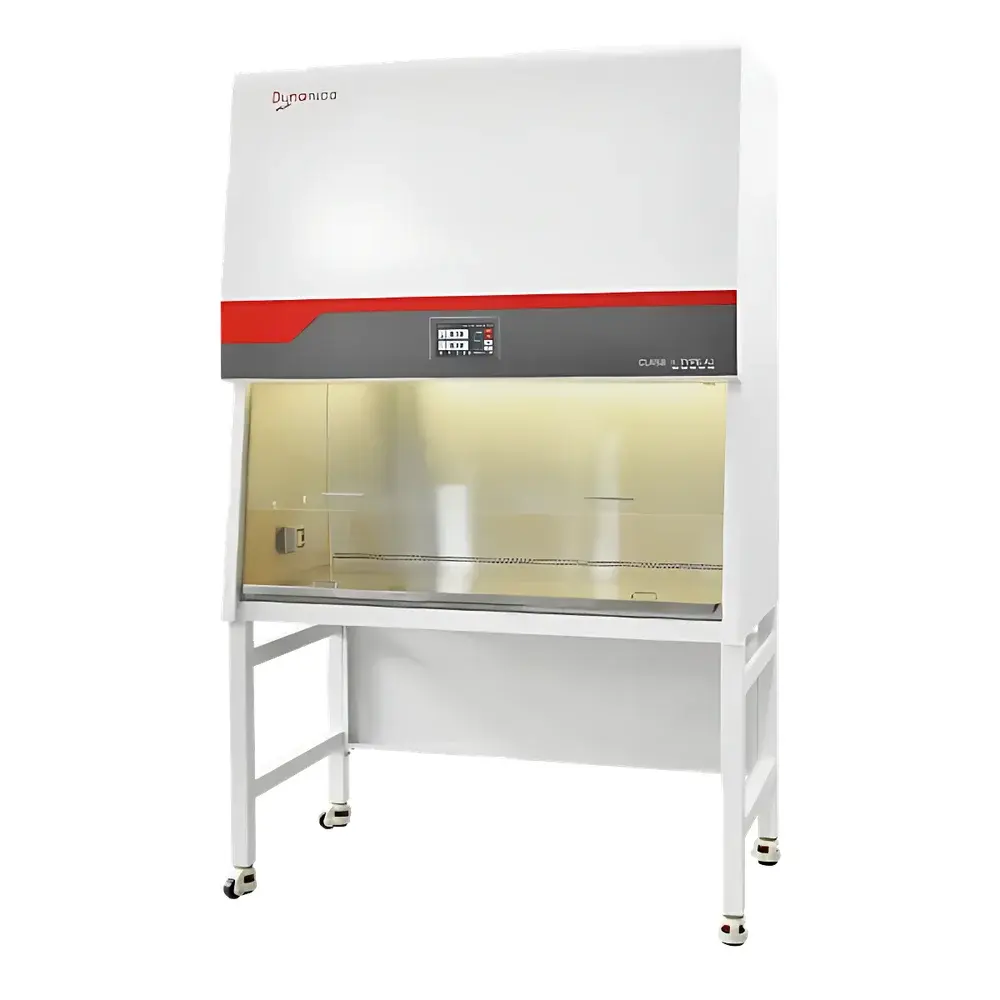
Dynamica EHS-530 Class II Type A2 Biological Safety Cabinet
| Brand | Dynamica |
|---|---|
| Model | EHS-530 |
| Cabinet Class | Class II, Type A2 |
| Construction Material | 304 Stainless Steel Interior (One-Piece Seamless Welded) |
| External Dimensions (L×W×H) | 1950 × 750 × 2100 mm |
| Internal Work Area Dimensions (L×W×H) | 1862 × 574 × 628 mm |
| HEPA/ULPA Filtration Efficiency | ≥99.9995% @ 0.12 µm |
| Airflow System | Recirculating (70% re-circulated, 30% exhausted via dedicated duct or thimble connection) |
| Motor Type | Brushless DC ECM Motor with Variable Speed Control |
| Control Interface | DynaAir Color Touchscreen Controller with Real-Time Airflow Monitoring |
| Sensor | High-Sensitivity Thermal Anemometer for Inflow & Downflow Velocity Detection |
| Compliance | EN 12469:2000, NSF/ANSI 49-2022, ISO 14644-1 Class 5 (ISO Class 5 Equivalent), GLP-Ready Configuration |
Overview
The Dynamica EHS-530 is a Class II, Type A2 biological safety cabinet engineered for precision containment and personnel protection in moderate-risk biosafety level (BSL-2) and select BSL-3 applications. It operates on the principle of laminar downflow combined with inward-facing inflow—both air streams filtered through certified HEPA filters (≥99.9995% efficiency at 0.12 µm particle size). Approximately 70% of the total airflow is recirculated within the work chamber after passing through the supply HEPA filter, while 30% is exhausted externally via a hard-ducted or thimble-connected exhaust system. This dual-path airflow architecture ensures continuous operator protection against aerosolized biohazards while maintaining product sterility during aseptic procedures. The cabinet meets internationally recognized performance standards including NSF/ANSI 49-2022 and EN 12469:2000, and is validated for use in laboratories adhering to Good Laboratory Practice (GLP) and Good Manufacturing Practice (GMP) frameworks.
Key Features
- Monolithic 304 stainless steel interior—fully welded, seamless, and corrosion-resistant—with rounded corners for effortless decontamination and microbial clearance validation.
- DynaAir intelligent color touchscreen controller providing real-time visualization of inflow velocity, downflow velocity, filter differential pressure, and operational status alerts.
- Brushless DC ECM motor delivering precise, energy-efficient airflow control with extended service life and reduced thermal drift—critical for long-duration incubation or cell culture workflows.
- Antimicrobial polymer-coated air plenums and ductwork, inhibiting microbial colonization in low-velocity zones where condensation or biofilm formation may occur.
- Ergonomic sloped sash design minimizing optical reflection and glare during prolonged visual inspection or micromanipulation tasks.
- Integrated high-sensitivity thermal anemometers calibrated per ISO 17025-accredited protocols, enabling traceable verification of face velocity (≥0.5 m/s) and vertical downflow (≥0.3 m/s).
Sample Compatibility & Compliance
The EHS-530 accommodates standard laboratory equipment including centrifuges (up to 3,000 rpm), pipette aids, microcentrifuges, and open-flame devices (when used with caution and appropriate risk assessment). It supports routine handling of bacterial cultures (e.g., E. coli, S. aureus), fungal spores, human clinical specimens, primary cell isolates, and lentiviral vectors under BSL-2 conditions. The cabinet’s structural integrity and airflow stability have been verified per ASTM F2273 Annex A1 for sash movement tolerance and NSF/ANSI 49 Annex D for smoke pattern visualization. All electronic components—including the DynaAir controller—are configured with audit-trail logging compatible with FDA 21 CFR Part 11 requirements when deployed in regulated QA/QC environments.
Software & Data Management
The DynaAir controller firmware supports event-driven data logging with timestamped records of airflow deviations, filter loading, door position changes, and alarm triggers. Exportable CSV logs facilitate integration into LIMS platforms or internal quality management systems. Optional RS-485 or Ethernet interfaces enable remote monitoring via SCADA-compatible architectures. Firmware updates are digitally signed and version-controlled; configuration backups can be stored locally or transferred via USB 2.0 port. Calibration parameters remain locked during routine operation unless accessed via administrator credentials—ensuring data integrity during regulatory audits.
Applications
- Microbiology & Environmental Testing: Preparation of selective/differential media, isolation of enteric pathogens, anaerobic culture setup, and wastewater microbiome sampling.
- Clinical Diagnostics: Specimen processing in clinical chemistry, hematology, molecular pathology, and PCR pre-amplification zones—particularly where cross-contamination mitigation is mandated by CLIA or CAP guidelines.
- Cell Therapy & Regenerative Medicine: Aseptic expansion of mesenchymal stem cells (MSCs), induced pluripotent stem cells (iPSCs), and CAR-T manufacturing steps compliant with ISO 13485 and EU Annex 1.
- Pharmaceutical Development: Sterile formulation testing, excipient blending, and stability study sample preparation under cGMP-aligned environmental controls.
- Animal Biosafety Research: Handling of infected murine tissues, aerosol challenge studies with non-transmissible zoonotic agents, and post-exposure necropsy workflows.
FAQ
What is the minimum required external exhaust duct static pressure for stable operation?
The EHS-530 maintains nominal airflow performance across a static pressure range of –125 Pa to –250 Pa at the exhaust collar; system commissioning requires verification using a manometer prior to certification.
Can this cabinet be installed without external ducting?
Yes—when used in thimble mode with a dedicated canopy or roof-mounted blower, provided room air exchange rates meet ASHRAE 110-recommended minimums (≥6 air changes per hour) and ambient temperature remains between 15–30°C.
Is the HEPA filter certified to IEST-RP-CC001 standards?
All factory-installed HEPA filters undergo sodium chloride (NaCl) aerosol challenge testing per IEST-RP-CC001-2022 Section 5.3 and are supplied with individual test certificates traceable to NIST standards.
Does the controller support multi-language UI localization?
The DynaAir interface supports English, German, French, Spanish, and simplified Chinese language packs—configured via firmware update utility accessible through authorized service portals.
How often should the inflow velocity sensor be recalibrated?
Annual calibration is recommended; however, field verification using a NIST-traceable anemometer is advised before each certification cycle or after any physical impact to the front grille.




