
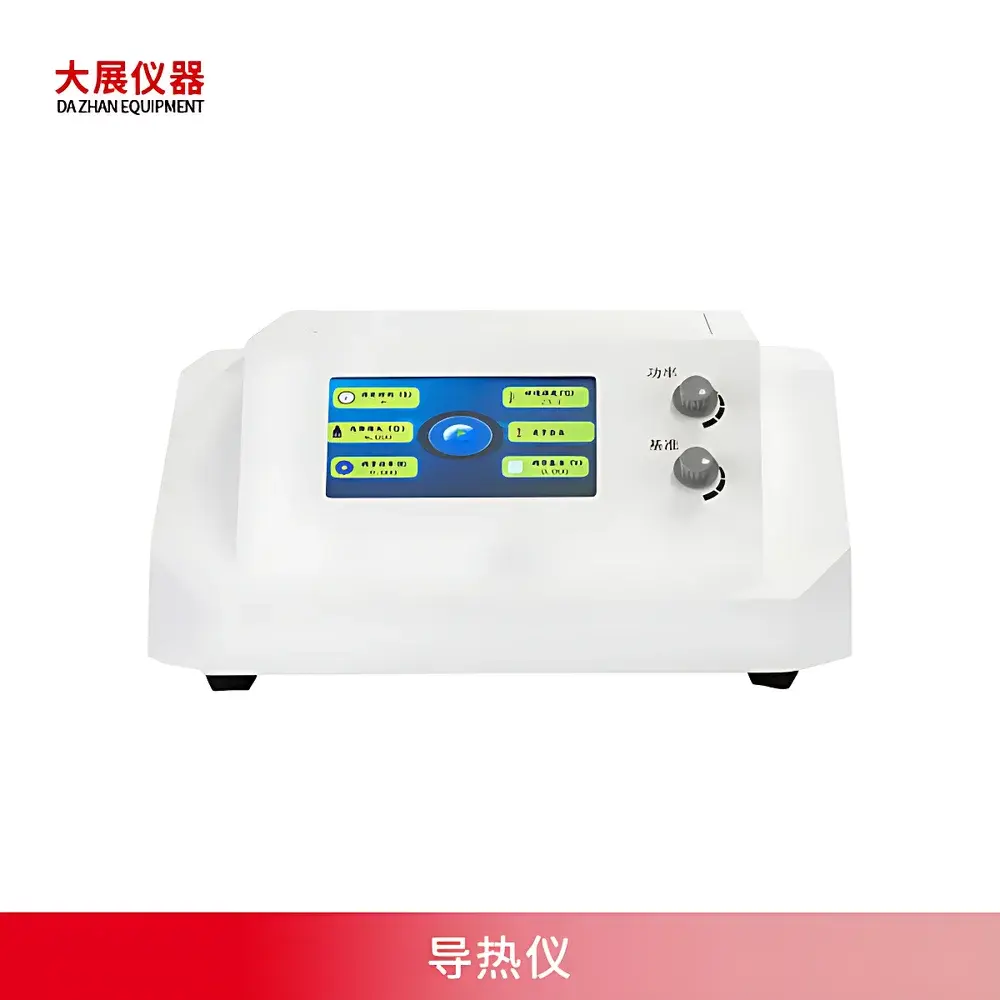
DZDR-S DAZHAN Transient Plane Source (TPS) Thermal Conductivity Analyzer
| Brand | DAZHAN (Nanjing Dazhan Instrument Co., Ltd.) |
|---|---|
| Origin | Jiangsu, China |
| Manufacturer Type | Authorized Distributor |
| Country of Origin | China |
| Model | DZDR-S |
| Instrument Type | Transient Plane Source (TPS) Method |
| Sample Throughput | Single-sample mode |
| Test Environment | Ambient pressure |
| Thermal Conductivity Range | 0.0001–300 W/(m·K) |
| Accuracy | ±3% |
| Repeatability | ≤3% |
| Temperature Range | 25–130 °C (extendable to −40–300 °C with optional thermal chamber) |
| Sample Dimensions (min.) | 15×15×3.75 mm (Probe #1), 30×30×7.5 mm (Probe #2), 50×50×15 mm (Probe #3) |
| Probe Options | Dual-spiral planar sensors (7.5 mm, 15 mm, 50 mm diameters) |
| Power Consumption | <500 W (AC 220 V) |
| Probe Power | ≤1 W (P1), ≤20 W (P2), ≤22 W (P3) |
| Sample Form Compatibility | Solids (bulk, powder, film, coating), liquids, gels, pastes, and colloids |
| Physical Dimensions (L×W×H) | 440 × 390 × 220 mm |
| Powder Test Kit | Optional standard container set (customizable) |
Overview
The DZDR-S is a high-precision transient plane source (TPS) thermal conductivity analyzer engineered for rapid, contact-based measurement of thermal transport properties across diverse material classes. Based on the ISO 22007-2 standard for transient plane source methods, the instrument applies a controlled, short-duration Joule heating pulse to a dual-spiral nickel sensor embedded in a thin insulating film. The resulting temperature rise—recorded as a function of time—is analyzed using inverse modeling based on Fourier’s heat conduction equation under transient boundary conditions. This principle eliminates reliance on steady-state equilibrium, thereby avoiding errors associated with interfacial contact resistance, edge losses, or long thermal equilibration times typical of guarded hot plate or laser flash methods. Designed for laboratory and quality control environments, the DZDR-S delivers direct, absolute thermal conductivity values without calibration against reference standards—making it suitable for R&D validation, process monitoring, and material specification compliance.
Key Features
- Transient Plane Source (TPS) methodology compliant with ISO 22007-2 and ASTM D7984 guidelines for thermal conductivity measurement;
- Triple-probe configuration (7.5 mm, 15 mm, 50 mm diameters) enabling scalable testing—from micro-volume samples to bulk industrial specimens;
- Measurement duration programmable between 5 and 160 seconds per test, optimized for throughput without sacrificing resolution;
- No sample-specific preparation required: accommodates irregular surfaces, anisotropic structures, and heterogeneous matrices—including powders in standardized containers;
- Non-destructive operation: samples remain intact and reusable post-measurement, critical for precious or limited-availability materials;
- Integrated high-resolution data acquisition circuitry with 24-bit ADC and real-time thermal response capture at sub-millisecond intervals;
- Modular thermal stage supporting ambient-to-130 °C operation; optional cryogenic (-40 °C) and high-temperature (300 °C) extensions available for extended environmental profiling.
Sample Compatibility & Compliance
The DZDR-S accepts unrestricted sample morphologies—solid blocks, granular powders, viscous pastes, dispersions, thin films, coatings, foams, and low-viscosity liquids—without requiring machining, pressing, or metallization. Minimal geometric constraints apply: for each probe size, samples must exceed twice the probe diameter in lateral dimensions and half the probe radius in thickness to satisfy one-dimensional heat flow assumptions. The system supports GLP-compliant workflows via timestamped audit trails, user-access controls, and electronic signature capability (aligned with FDA 21 CFR Part 11 requirements when deployed with validated software modules). All measurements adhere to traceable uncertainty budgets consistent with ISO/IEC 17025 metrological frameworks.
Software & Data Management
Bundled PC-based analysis software provides full instrument control, real-time curve visualization, automatic baseline correction, and multi-parameter fitting (k, α, ρcp). Raw thermal response datasets are stored in HDF5 format for interoperability with MATLAB, Python (NumPy/Pandas), and statistical analysis platforms. Export options include CSV, PDF reports with metadata (operator ID, timestamp, environmental conditions), and batch-mode summary tables. Audit logs record all parameter modifications, calibration events, and result exports—enabling retrospective verification during internal audits or regulatory inspections. Software architecture supports network deployment in shared lab environments with role-based permissions.
Applications
- Thermal characterization of advanced composites (carbon fiber-reinforced polymers, metal matrix composites);
- Quality assurance of thermal interface materials (TIMs), phase change materials (PCMs), and battery electrode slurries;
- R&D screening of aerogels, MOFs, and nanostructured insulation systems;
- Process validation for sintered ceramics, graphite grades, and refractory metals;
- Regulatory documentation for medical device packaging, aerospace-grade adhesives, and electronics encapsulants;
- Academic research in phonon transport, nanoscale thermal boundary resistance, and anisotropic heat flow modeling.
FAQ
What standards does the DZDR-S comply with?
The instrument implements the transient plane source method per ISO 22007-2 and aligns with ASTM D7984 for thermal conductivity determination in solids and liquids.
Can the DZDR-S measure anisotropic materials?
Yes—by orienting the planar sensor parallel or perpendicular to principal axes and comparing directional k-values, provided sample geometry satisfies minimum aspect ratio requirements.
Is calibration required before each test?
No. The TPS method is absolute and self-calibrating; however, periodic verification using NIST-traceable reference materials (e.g., Pyroceram 9606) is recommended quarterly.
Does the system support automated batch testing?
Manual single-sample loading is standard; automated sample changers are available as OEM-integrated add-ons for high-throughput labs.
How is contact resistance mitigated in TPS measurements?
The dual-spiral sensor design ensures uniform current distribution and symmetric heat flux generation, while mathematical deconvolution removes interfacial impedance effects inherent in static techniques.



