
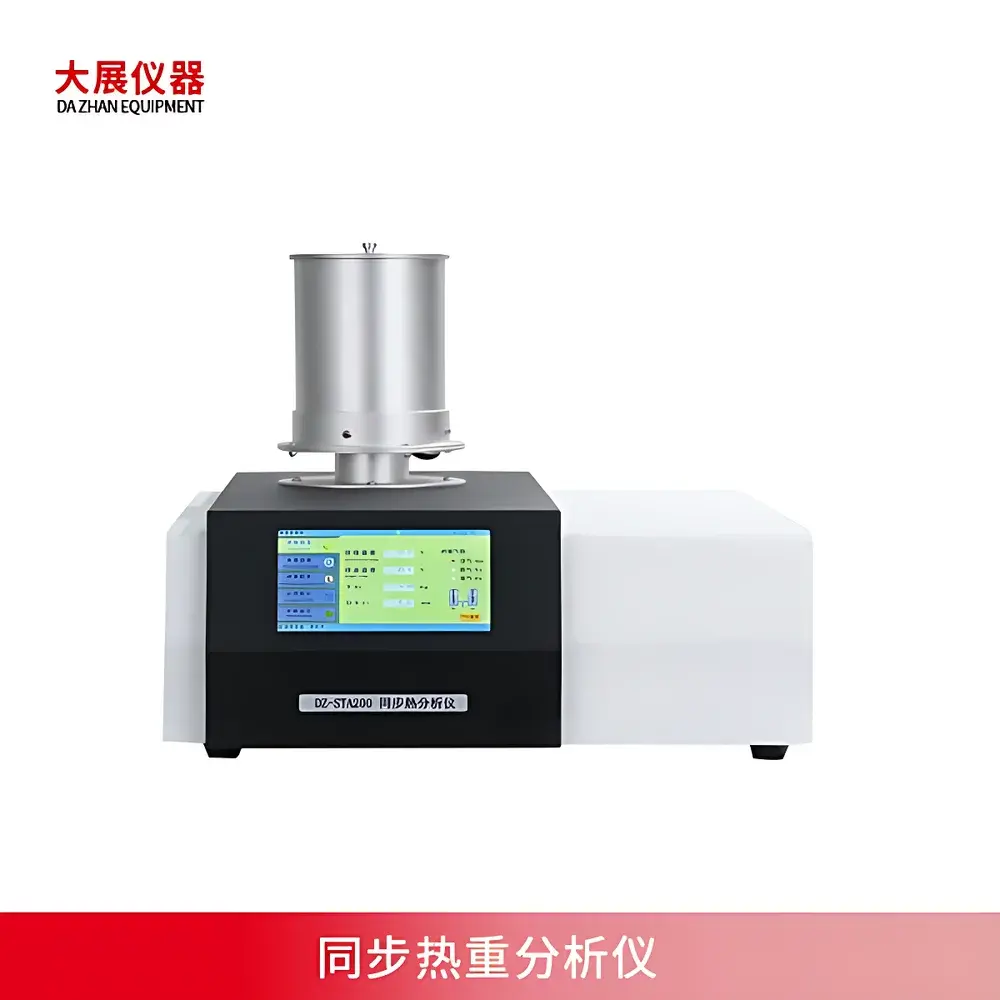
DZHAN DZ-STA200 Simultaneous Thermal Analyzer (TG-DSC)
| Brand | DAZHAN |
|---|---|
| Origin | Jiangsu, China |
| Model | DZ-STA200 |
| Coupling Technique | TG-DSC |
| Temperature Range | Ambient to 1250 °C |
| Heating Rate | 0.1–100 °C/min |
| Maximum Sample Mass | 30 g |
| Atmosphere Control | Inert, Oxidizing, Reducing |
| Temperature Resolution | 0.01 °C |
| Temperature Stability | ±0.1 °C |
| Balance Sensitivity | 0.01 mg |
| DSC Range | ±800 mW |
| DSC Resolution | 0.001 mW |
| Display | 7-inch 24-bit Color Touchscreen |
| Communication Interface | USB 2.0 |
| Gas Control | Dual-channel Mass Flow Controller with Integrated Flow Meters |
| Calibration | Multi-point Temperature & Enthalpy Calibration |
| Software Compliance | Audit Trail, Data Export (CSV, Excel, PDF), GLP-Ready Reporting |
Overview
The DZHAN DZ-STA200 Simultaneous Thermal Analyzer is an integrated thermogravimetric-differential scanning calorimetry (TG-DSC) system engineered for precision measurement of mass change and heat flow under controlled thermal conditions. Based on the principle of simultaneous dual-signal detection—where a single sample undergoes concurrent thermogravimetric analysis (TGA) and differential scanning calorimetry (DSC) in one furnace—it delivers time-synchronized, spatially co-located thermal data critical for mechanistic interpretation of decomposition pathways, phase transitions, reaction kinetics, and compositional stability. The instrument operates across a broad temperature range from ambient to 1250 °C, supporting high-fidelity characterization of ceramics, metal oxides, polymers, pharmaceuticals, catalysts, and energy materials. Its robust furnace architecture—featuring dual-layer bottom insulation—minimizes thermal radiation interference with the microbalance, ensuring long-term baseline stability and measurement reproducibility essential for quantitative thermal analysis.
Key Features
- Simultaneous acquisition of TG, DTG (derivative thermogravimetry), and DSC signals from a single sample run—eliminating inter-run variability and enabling direct correlation of mass loss events with enthalpic transitions.
- High-resolution microbalance with 0.01 mg sensitivity and extended capacity up to 30 g, configurable for both high-precision low-mass measurements and bulk-sample screening.
- Programmable temperature control supporting linear heating, isothermal holds, and multi-segment cooling profiles—with ramp rates adjustable from 0.1 to 100 °C/min and temperature stability maintained within ±0.1 °C.
- Dual independent analog-to-digital (AD) acquisition circuits optimized for parallel signal capture: one dedicated to TG/DTG force transduction, the other to DSC heat flux and reference thermocouple signals—ensuring temporal alignment and minimal cross-talk.
- Integrated atmosphere management system with two independently regulated gas channels, digital mass flow controllers, and real-time flow monitoring—supporting inert (N₂, Ar), oxidizing (air, O₂), and reducing (H₂/N₂, CO) environments in static or dynamic configurations.
- 7-inch 24-bit color touchscreen interface with embedded calibration routines, intuitive parameter setup, and on-device TG zeroing and sensitivity adjustment—reducing dependency on external PCs during routine operation.
Sample Compatibility & Compliance
The DZ-STA200 accommodates standard ceramic crucibles (Al₂O₃, Pt, graphite) compatible with aggressive atmospheres and high-temperature applications. It supports sample forms including powders, granules, thin films, and small monoliths (≤30 g). All hardware and firmware comply with fundamental requirements for Good Laboratory Practice (GLP) environments: full audit trail logging, user-access-level controls, electronic signature support, and secure data storage. While not pre-certified to ISO 11357, ASTM E1269, or USP , its operational parameters align with these standards’ methodological frameworks—enabling users to develop and validate SOPs meeting regulatory expectations for thermal characterization in pharmaceutical development, quality control, and materials certification.
Software & Data Management
The proprietary DZHAN Thermal Analysis Suite provides comprehensive post-run processing—including baseline correction, peak deconvolution, kinetic modeling (e.g., Kissinger, Ozawa-Flynn-Wall), and quantitative residue analysis. Raw data are stored in vendor-neutral binary format with embedded metadata (operator ID, timestamp, atmosphere settings, calibration history). Export options include CSV for third-party statistical analysis, Excel-compatible worksheets for reporting, and publication-ready PDF reports with customizable templates. USB 2.0 bidirectional communication enables remote instrument control, real-time data streaming, and synchronized software updates—facilitating integration into centralized lab informatics systems. All software modules implement role-based access control and maintain immutable records of parameter modifications per ICH-GCP and FDA 21 CFR Part 11 principles.
Applications
The DZ-STA200 serves as a foundational tool in R&D and QA/QC workflows across multiple sectors. In materials science, it characterizes thermal decomposition thresholds of battery cathode materials, sintering behavior of advanced ceramics, and oxidative stability of carbon composites. In pharmaceuticals, it determines dehydration kinetics of hydrates, polymorphic transition temperatures, excipient compatibility, and residual solvent content per ICH Q5C guidelines. Chemical engineers apply it to catalyst deactivation studies, polymer pyrolysis mechanisms, and combustion efficiency evaluation. Environmental labs use it for ash content quantification, organic matter loss-on-ignition (LOI), and thermal profiling of contaminated soils. Food scientists employ it for moisture binding analysis, starch gelatinization enthalpies, and lipid oxidation onset detection.
FAQ
What types of crucibles are supported?
Standard alumina (Al₂O₃), platinum (Pt), and graphite crucibles are compatible—selected based on sample reactivity, maximum temperature, and atmospheric conditions.
Can the instrument perform isothermal stability testing?
Yes—programmable hold segments allow precise isothermal control at any temperature between ambient and 1250 °C, with duration configurable up to 999 hours.
Is calibration traceable to national standards?
Multi-point temperature and enthalpy calibration routines are implemented using certified reference materials (e.g., indium, zinc, alumina); users may document traceability through internal SOPs aligned with ISO/IEC 17025.
Does the software support kinetic analysis models?
Yes—the built-in kinetics module includes Arrhenius, Friedman, and model-free Ozawa-Flynn-Wall methods, with exportable activation energy and pre-exponential factor outputs.
How is data integrity ensured during long-duration runs?
Continuous checksum validation, automatic backup upon power interruption, and cyclic redundancy checking (CRC) on all acquired datasets ensure bit-level fidelity across multi-day experiments.



