
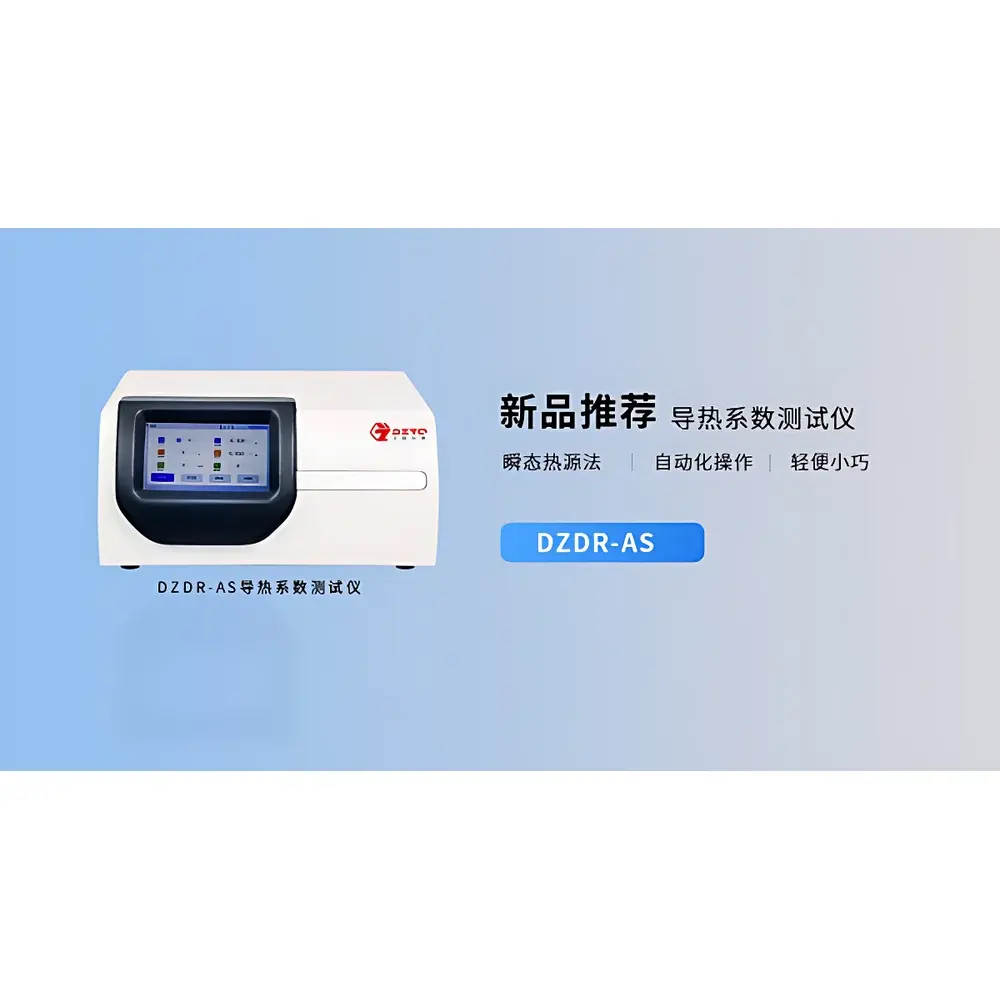
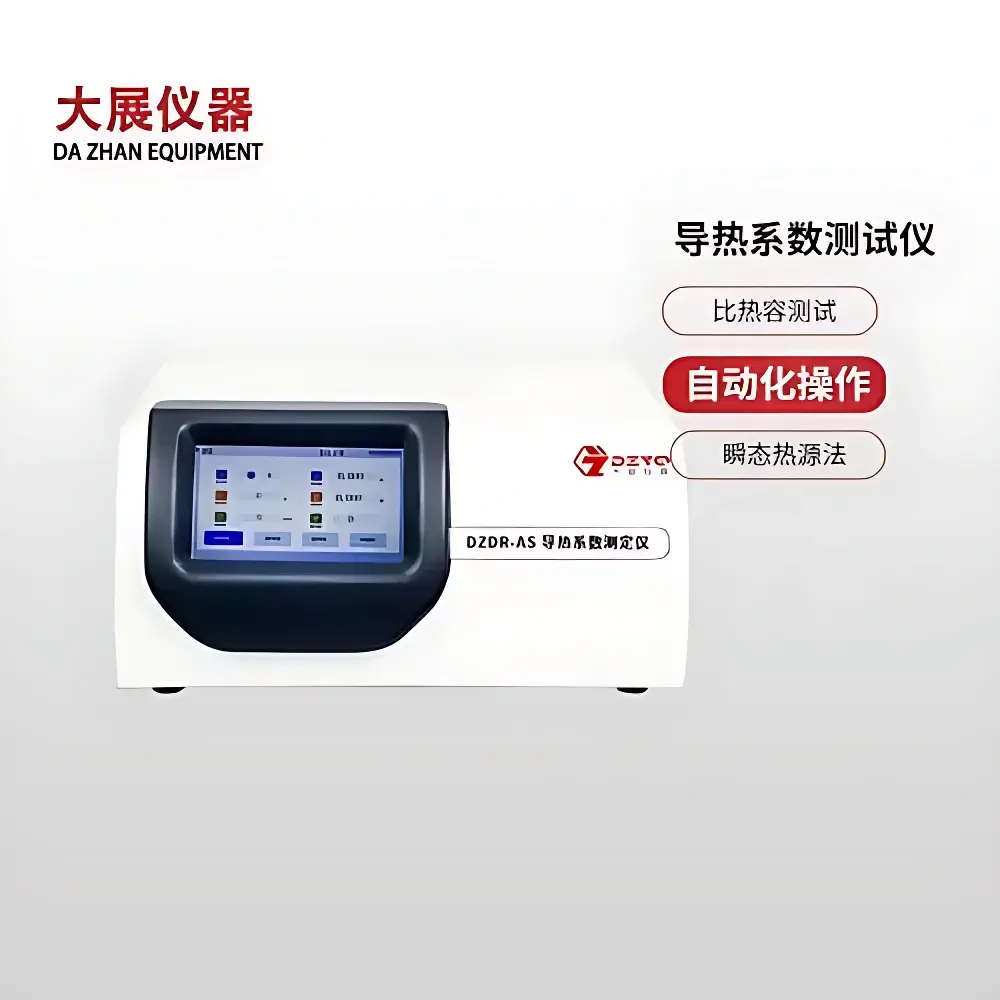
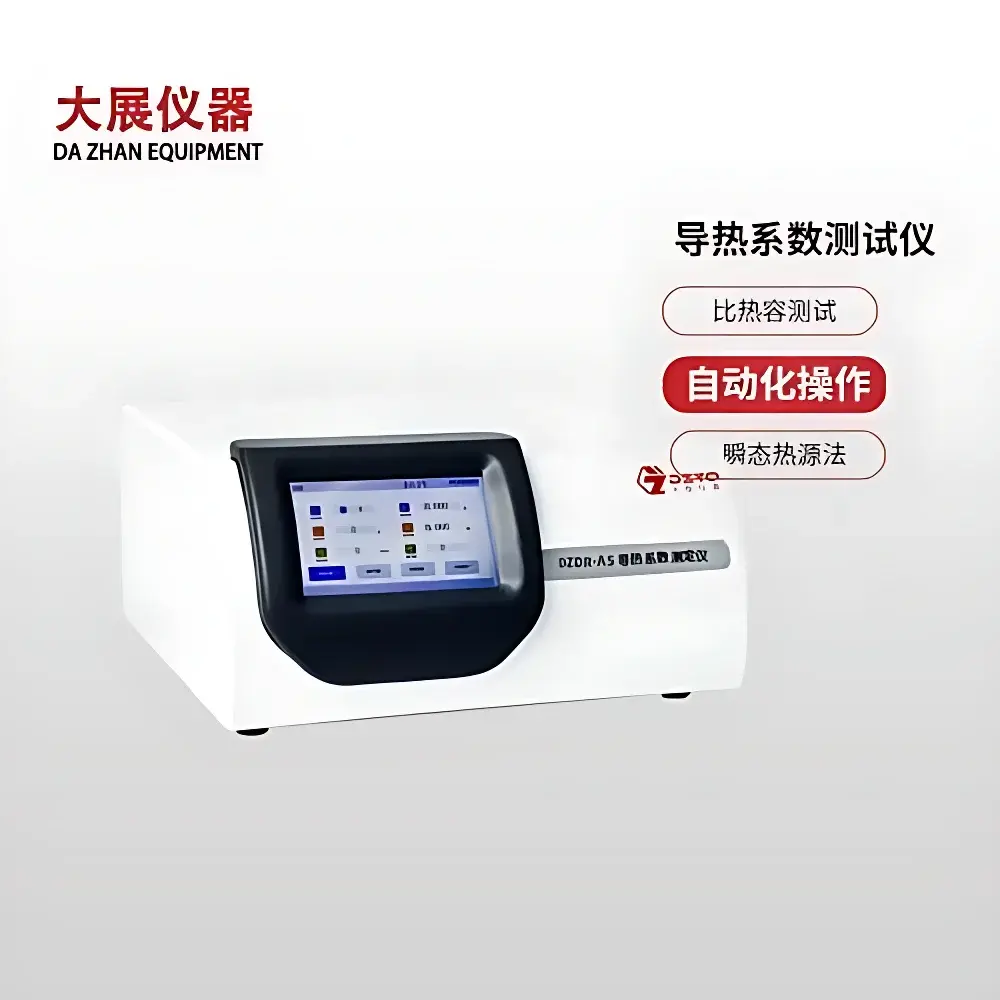
DZHAN DZDR-AS Portable Transient Plane Source (TPS) Thermal Conductivity Analyzer
| Brand | DAZHAN |
|---|---|
| Origin | Jiangsu, China |
| Manufacturer Type | Authorized Distributor |
| Country of Origin | China |
| Model | DZDR-AS |
| Instrument Principle | Transient Plane Source (TPS) Method |
| Sample Capacity | Single sample per test |
| Test Environment | Ambient temperature |
| Thermal Conductivity Range | 0.00001–50 W/(m·K) |
| Resolution | 0.0001 W/(m·K) |
| Repeatability | ≤1% |
| Accuracy | ±0.00001 W/(m·K) |
| Temperature Range | −30 °C to 200 °C |
| Sample Form Compatibility | Solids (bulk, metallic, powder, film), liquids, gels, pastes, and thermal insulation materials |
| Probe Configuration | Dual high-precision TPS sensors (standard) |
| Minimum Solid Sample Dimensions | 15 mm × 15 mm × 3.75 mm (Probe #1) or 30 mm × 30 mm × 7.5 mm (Probe #2) |
| Liquid/Powder Sample Volume | 18 mL via dedicated fixture |
| Measurement Duration | ≤160 s |
| Power Consumption | <300 W |
Overview
The DZHAN DZDR-AS Portable Transient Plane Source (TPS) Thermal Conductivity Analyzer is a compact, field-deployable instrument engineered for rapid, high-fidelity determination of thermal conductivity (λ), thermal diffusivity (α), and volumetric heat capacity (ρcp) across a broad spectrum of homogeneous and heterogeneous materials. It operates on the well-established transient plane source method—a standardized technique grounded in one-dimensional unsteady-state heat conduction theory within an infinite medium. During measurement, a thin, electrically resistive sensor (acting simultaneously as heater and thermometer) delivers a short, controlled current pulse, generating a localized thermal perturbation. The resulting time-dependent temperature rise at the sensor surface is recorded with microsecond resolution. By fitting the measured temperature-time response to analytical solutions of Fourier’s heat equation under idealized boundary conditions, the system computes λ, α, and ρcp without requiring prior knowledge of material density or specific heat. This first-principles approach eliminates calibration drift associated with steady-state methods and ensures traceable, physics-based results compliant with ISO 22007-2 and ASTM D5470 standards.
Key Features
- True portability: Integrated battery-ready design with lightweight chassis (<8.5 kg) and ergonomic carrying handle—enables on-site testing in production floors, R&D labs, quality control stations, or field service environments without external power dependency.
- Automated parameter optimization: Intelligent firmware dynamically establishes optimal heating power and baseline thermal offset for each sample type, minimizing user intervention and reducing operator-induced variability.
- Dual-sensor architecture: Two interchangeable TPS probes included—one optimized for low-conductivity insulators (e.g., aerogels, foams), the other for high-conductivity metals and ceramics—ensuring consistent signal-to-noise ratio across the full 0.00001–50 W/(m·K) range.
- Expanded thermophysical characterization: Software upgrade enables direct calculation of volumetric heat capacity (ρcp = λ/α), supporting advanced thermal modeling, phase-change analysis, and material homogeneity assessment.
- Bidirectional control interface: Synchronized operation between embedded touchscreen and PC-based software allows real-time parameter adjustment, live curve visualization, and remote diagnostics—ideal for GLP-compliant workflows requiring audit trails.
- Thermal stability assurance: Active temperature stabilization module maintains probe and sample interface within ±0.1 °C during measurement, critical for accurate α derivation and reproducible λ values under ambient fluctuations.
Sample Compatibility & Compliance
The DZDR-AS accommodates unrestricted sample morphology—including rigid solids (metals, polymers, ceramics), flexible films, granular powders, viscous pastes, Newtonian and non-Newtonian liquids, and porous insulation matrices—without requiring metallization, coating, or geometric machining. Its non-destructive, contact-based measurement protocol conforms to ISO 22007-2 (Plastics — Determination of thermal conductivity and thermal diffusivity — Part 2: Transient plane heat source (hot disc) method) and supports validation against ASTM D5470 (Standard Test Method for Thermal Transmission Properties of Thermally Conductive Electrical Insulation Materials). All firmware and data handling routines comply with FDA 21 CFR Part 11 requirements for electronic records and signatures, including secure user authentication, immutable audit logs, and encrypted data export (CSV, PDF, XML).
Software & Data Management
The proprietary DZDR-Analysis Suite v4.2 provides a validated, GxP-aligned environment for acquisition, processing, and reporting. Key capabilities include: automated outlier detection using Grubbs’ test; batch processing of up to 99 sequential measurements with statistical summary (mean, SD, CV%, confidence intervals); customizable report templates compliant with ISO/IEC 17025 laboratory accreditation; and integration-ready API for LIMS and MES systems. Raw time-temperature datasets are stored with full metadata (operator ID, timestamp, environmental conditions, probe serial number, calibration certificate expiry), satisfying traceability requirements for ISO 9001 and IATF 16949 audits.
Applications
- Quality assurance of thermal interface materials (TIMs), phase-change pads, and graphite sheets in electronics packaging.
- Rapid screening of polymer composites and carbon-fiber-reinforced thermoplastics for aerospace structural components.
- Characterization of cryogenic insulation foams and vacuum-jacketed pipe linings in energy infrastructure.
- Validation of thermal performance claims for building envelope materials (aerogel blankets, mineral wool, vacuum insulation panels).
- Research into nanofluids, metal-organic frameworks (MOFs), and thermoelectric alloys where precise λ–T dependence over −30 °C to 200 °C is required.
FAQ
What standards does the DZDR-AS comply with for thermal conductivity measurement?
It adheres to ISO 22007-2 and ASTM D5470 for transient plane source methodology, with full documentation supporting metrological traceability to NIST-traceable reference materials.
Can the instrument measure anisotropic materials?
No—the standard configuration assumes isotropic thermal behavior. Anisotropy evaluation requires orthogonal multi-directional probing, which is not supported by the single-plane sensor geometry.
Is calibration verification required between tests?
Yes—daily verification using certified reference samples (e.g., Pyroceram 9606, λ = 3.98 W/(m·K) at 23 °C) is recommended per ISO/IEC 17025 Clause 7.7.1.
Does the software support multi-user role-based access control?
Yes—administrator, analyst, and reviewer roles with configurable permissions for method editing, result approval, and audit log viewing are enforced via Windows Active Directory integration.
What is the minimum sample thickness required for reliable measurement?
For solid samples, minimum thickness must exceed 2× the probe radius to satisfy the semi-infinite medium assumption—typically ≥7.5 mm for Probe #2 and ≥3.75 mm for Probe #1, as specified in the technical documentation.
Related Products



