
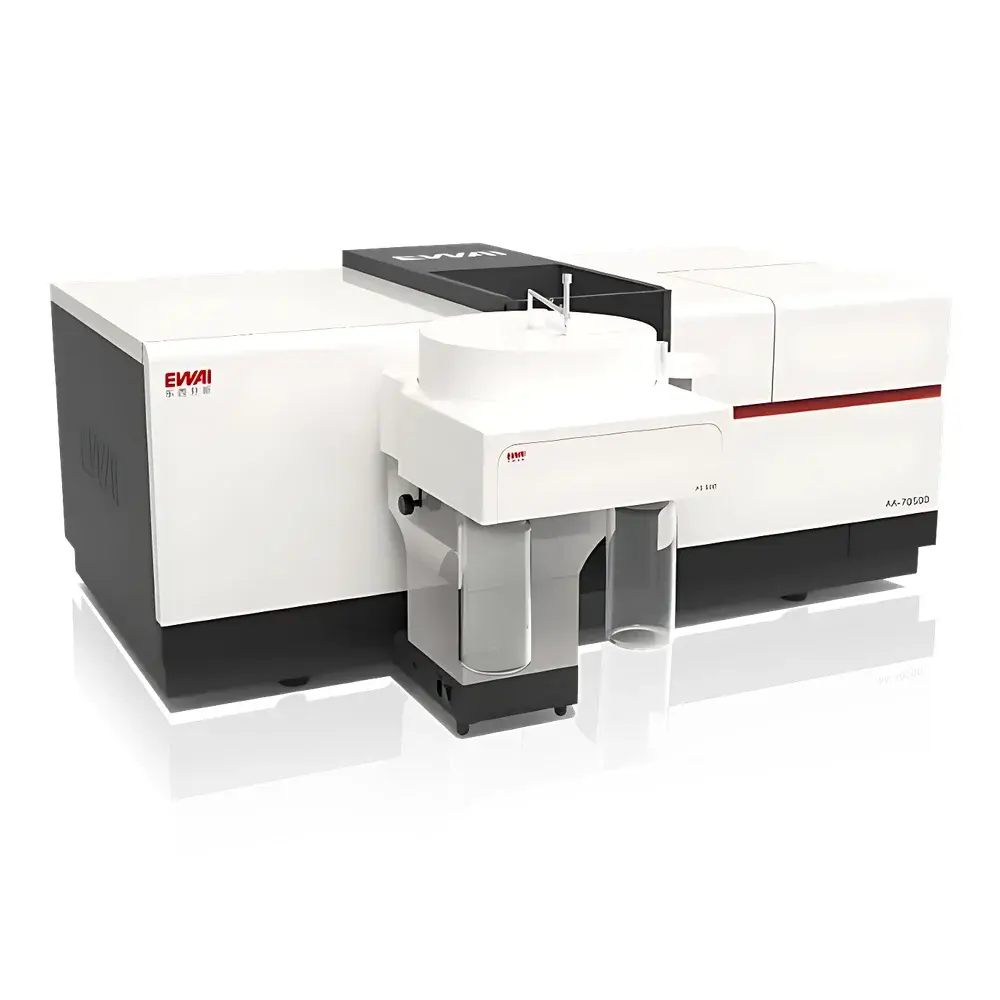
East & West Analysis AA-7050D Flame and Graphite Furnace Atomic Absorption Spectrometer
| Brand | East & West Analysis |
|---|---|
| Origin | Beijing, China |
| Manufacturer Type | Direct Manufacturer |
| Instrument Type | Flame and Graphite Furnace Atomic Absorption Spectrometer |
| Wavelength Accuracy | ±0.1 nm |
| Wavelength Repeatability | ≤0.05 nm |
| Spectral Bandwidth | 0.1, 0.2, 0.4, 0.7, 1.0, 2.0 nm (auto-switching slits) |
| Resolution | <0.1 nm |
| Lamp Turret | 8-position, fully motorized and computer-controlled |
| Background Correction | Deuterium Lamp and Self-Reversal (SR) Methods |
| Baseline Stability | ≤0.003 A/30 min (dynamic), ≤0.002 A/30 min (static) |
| Characteristic Concentration (Cu) | <0.02 µg/mL |
| Detection Limit (Cu) | <0.003 µg/mL |
| RSD | ≤0.45% |
| Auto-Peak Search | Yes, including auto-zero, spectral scan, lamp alignment, mirror positioning, and energy balancing |
Overview
The East & West Analysis AA-7050D is a dual-beam flame and graphite furnace atomic absorption spectrometer engineered for high-precision elemental quantification in environmental, pharmaceutical, food safety, clinical, and industrial quality control laboratories. Based on the fundamental principle of atomic absorption spectroscopy—where ground-state free atoms in a gaseous state absorb characteristic wavelengths of light—the AA-7050D employs a full-reflection optical path design to minimize stray light and maximize signal fidelity. Its dual-beam architecture continuously monitors and compensates for hollow cathode lamp (HCL) intensity drift in real time, enabling stable baseline performance essential for trace-level analysis. The instrument supports both flame atomization (for higher concentration samples) and electrothermal graphite furnace atomization (for sub-ppt detection), offering analytical flexibility without hardware reconfiguration. Integrated flame emission capability further extends its utility for alkali and alkaline earth metal analysis (e.g., Na, K, Ca), eliminating the need for separate instrumentation.
Key Features
- Dual-beam all-reflective optical system with real-time HCL drift correction and automatic baseline compensation—ensuring consistent sensitivity across extended measurement sessions.
- Six-step auto-switching spectral bandwidth selection (0.1–2.0 nm) optimized for resolution versus signal-to-noise trade-offs per element and matrix complexity.
- High-precision wavelength drive with ±0.1 nm accuracy and ≤0.05 nm repeatability—critical for compliance with ASTM E1907, ISO 8288, and USP requirements.
- 8-position motorized lamp turret controlled via software; enables rapid, repeatable lamp positioning and simultaneous preheating of two lamps to reduce method cycle time.
- Dual background correction modes: deuterium arc lamp for broad-band correction and self-reversal (SR) for high-accuracy correction in complex matrices with structured background.
- Wide-dynamic-range photomultiplier tube (PMT) with low dark current and high quantum efficiency—optimized for both flame (µg/mL) and furnace (pg/mL) detection ranges.
- Automated peak search routine: performs zero adjustment, spectral scanning, lamp alignment, mirror optimization, and energy balancing—all triggered by method-defined element parameters.
Sample Compatibility & Compliance
The AA-7050D accommodates aqueous solutions, digested environmental solids (EPA Method 200.7, 200.8), biological tissues (AOAC 999.10), and acid-digested food samples (ISO 11885). Its graphite furnace module supports platform-assisted temperature programming with integrated Zeeman background correction (via optional upgrade), meeting detection sensitivity requirements for regulated metals in drinking water (EPA 200.9) and pharmaceutical catalyst residues (ICH Q2(R2)). The system’s firmware and data handling architecture support audit trails, electronic signatures, and user access levels—aligning with FDA 21 CFR Part 11 and GLP/GMP documentation standards when deployed with compliant LIMS or ELN integration.
Software & Data Management
Controlled via EW-ASW v3.x analytical software, the AA-7050D provides method development wizards, multi-point calibration with linear/non-linear fitting (including weighted least squares), QC check sample scheduling, and automated report generation in PDF or CSV formats. All raw absorbance/time traces, instrument parameter logs, and user actions are timestamped and stored with immutable metadata. Data export complies with ASTM E1482 and ISO/IEC 17025 traceability frameworks. Optional network deployment allows centralized instrument monitoring and remote diagnostics across multi-site laboratory networks.
Applications
- Environmental testing: Pb, Cd, As, Cr, and Ni in soil extracts and wastewater per EPA and ISO protocols.
- Pharmaceutical QA/QC: residual catalyst metals (Pd, Pt, Rh) in active pharmaceutical ingredients (APIs).
- Food and beverage: Na, K, Ca, Mg, Fe, Zn in fortified cereals, dairy, and infant formula (AOAC, Codex Alimentarius).
- Clinical research: Cu, Zn, Se, and Mn in serum and whole blood using graphite furnace mode.
- Geological and metallurgical analysis: base and precious metals in ore leachates and refinery intermediates.
FAQ
What atomization techniques does the AA-7050D support?
It supports both air-acetylene flame atomization and electrothermal graphite furnace atomization—switchable via software command without manual hardware changes.
Is the instrument compliant with regulatory data integrity standards?
Yes—when configured with audit trail logging enabled and user role management, it meets core requirements of FDA 21 CFR Part 11, EU Annex 11, and ISO/IEC 17025 for analytical instrument validation.
Can background correction be selected automatically per method?
Yes—background correction mode (D₂ or SR) and bandwidth are programmable within each method file and executed autonomously during sequence runs.
What is the typical detection limit for lead (Pb) in graphite furnace mode?
Under optimized conditions (platform atomization, Pd-Mg modifier, integrated Zeeman correction), Pb detection limits are typically ≤1.2 pg, consistent with ISO 11170 performance criteria.
Does the system support remote operation and monitoring?
Yes—via Ethernet-connected PC with EW-ASW software; optional VNC-based remote desktop access enables off-site troubleshooting and method validation support.




