
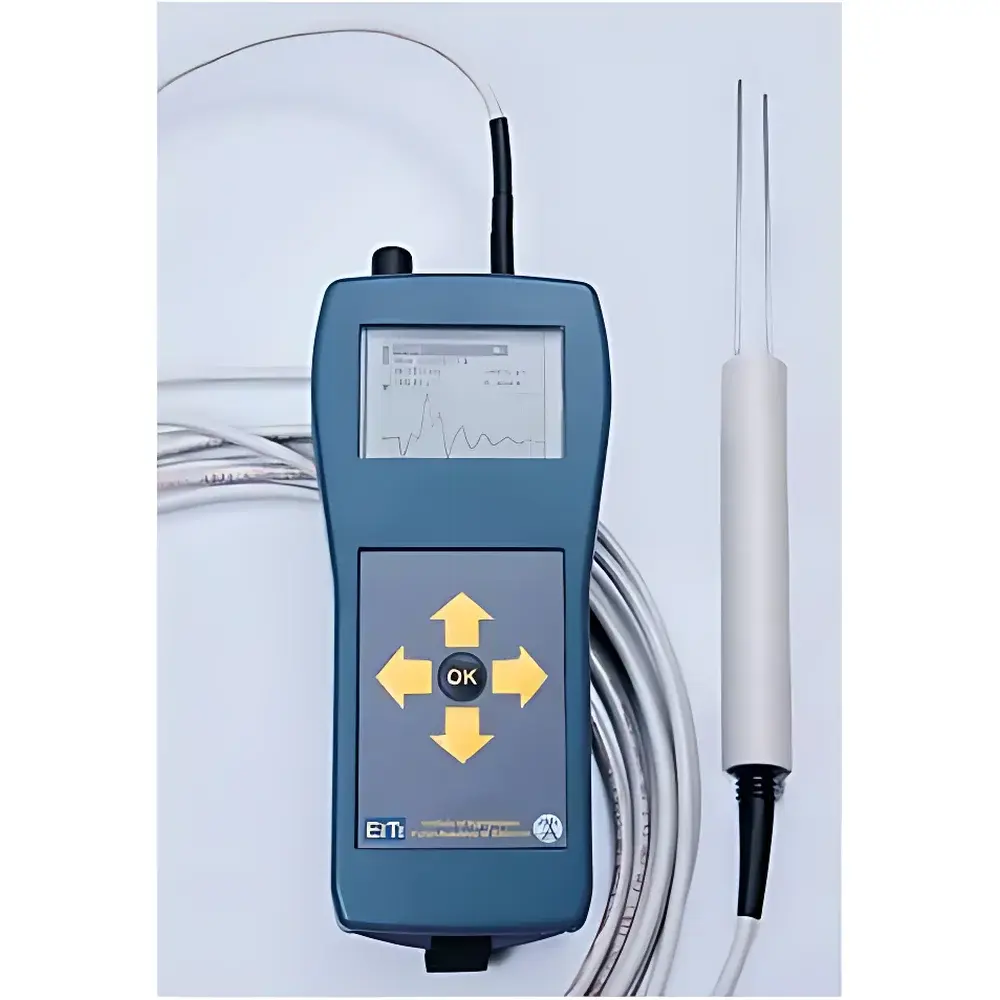
EasyTest FOM/mts Portable Soil Moisture, Temperature and Salinity Meter (TDR-Based)
| Brand | EasyTest |
|---|---|
| Origin | Imported |
| Manufacturer Type | Authorized Distributor |
| Model | FOM/mts |
| Measurement Principle | Time-Domain Reflectometry (TDR) |
| Volumetric Water Content Range | 0–100% |
| Temperature Range | −20 to +50 °C |
| Bulk Electrical Conductivity Range | 0.000–1 S/m |
| VWC Accuracy | ±2% of reading |
| Temperature Accuracy | ±0.5 °C |
| EC Accuracy | ±0.01 S/m |
| VWC Resolution | 0.1% |
| Temperature Resolution | 0.1 °C |
| EC Resolution | 0.001 S/m |
| Measurement Time | <5 s |
| Operating Temperature | 0–50 °C |
| Dimensions | 180 × 85 × 58 mm |
| Weight | 0.35 kg (with battery) |
| Display | 160 × 128 pixel monochrome LCD |
| Pulse Shape | sin² waveform |
| Rise Time | 200 ps |
| Data Storage | 1,000 labeled measurements |
| Battery | 3.6 V, 1600 mAh Li-ion (no memory effect, auto-charging with overcharge protection) |
| Cable Length Options | 1.5–6.0 m |
| Storage Temp. | −10 to +50 °C |
| Maintenance Interval | Recharge every 3–4 months |
Overview
The EasyTest FOM/mts Portable Soil Moisture, Temperature and Salinity Meter is a field-deployable, microprocessor-controlled instrument engineered for in situ, real-time characterization of soil physical properties using Time-Domain Reflectometry (TDR). Unlike capacitance-based or impedance sensors, TDR measures the dielectric permittivity of soil by propagating a high-speed electromagnetic pulse along parallel rod probes inserted into the medium. The travel time and attenuation of the reflected signal correlate directly with volumetric water content (VWC), bulk electrical conductivity (EC), and temperature—enabling simultaneous, non-destructive quantification without soil extraction or calibration drift under variable salinity conditions. The device implements the Malicki et al. (1996, Eur. J. Soil Sci.) empirical calibration model for robust VWC estimation across diverse soil textures, while also supporting user-defined conversion to apparent dielectric constant (Ka) for research-grade interpretation. Its compact form factor (180 × 85 × 58 mm), low mass (0.35 kg with battery), and integrated 160 × 128-pixel LCD enable rapid deployment in remote agricultural plots, ecological monitoring transects, and hydrological field campaigns.
Key Features
- True TDR architecture with sin²-shaped pulse generation and 200 ps rise time—ensuring high temporal resolution and minimal signal dispersion in heterogeneous soils.
- Simultaneous acquisition of volumetric water content (0–100%), temperature (−20 to +50 °C), and bulk electrical conductivity (0.000–1 S/m) in a single <5-second measurement cycle.
- Onboard real-time clock (RTC) and internal temperature sensor for timestamped, thermally compensated data logging.
- 1,000-entry memory with user-definable labels—supporting stratified sampling across multiple locations or time-series profiling without external hardware.
- Configurable probe cable lengths (1.5 m to 6.0 m) and optional integrated GPS module for georeferenced metadata capture compliant with ISO 2859-1 and ASTM D5084 sampling protocols.
- USB 2.0 interface for direct data export to Windows/Linux workstations; no proprietary drivers required.
- Rechargeable 3.6 V, 1600 mAh lithium-ion battery with intelligent charging circuitry—featuring automatic cutoff, overcharge protection, and wall-mount AC adapter compatibility.
Sample Compatibility & Compliance
The FOM/mts is validated for use in mineral soils (sand, loam, clay), organic-rich substrates (peat, compost), and saline-affected profiles up to 1 S/m bulk EC. Its TDR methodology inherently corrects for solution-phase conductivity effects on dielectric response—a critical advantage over frequency-domain sensors in coastal, irrigated, or reclaimed farmland applications. The instrument meets mechanical and environmental requirements per IEC 60529 (IP54 ingress protection), operates within the thermal limits specified in ISO 11274 for field soil sensors, and supports audit-ready data provenance when paired with timestamped, GPS-tagged records. While not certified for GMP/GLP-regulated pharmaceutical manufacturing, its measurement traceability aligns with FAO guidelines for irrigation scheduling and USDA-NRCS soil moisture network protocols.
Software & Data Management
Data retrieval occurs via native USB connection using standard CDC ACM serial emulation—enabling seamless integration with third-party platforms including MATLAB, Python (PySerial), R (readr), and commercial GIS tools (QGIS, ArcGIS Pro). Exported datasets include UTC timestamps, probe ID, VWC (% vol), temperature (°C), bulk EC (S/m), Ka (unitless), and GPS coordinates (if enabled). No cloud dependency or vendor-hosted software is required. All firmware updates are delivered as signed binary packages compatible with Windows 10/11 and Ubuntu LTS distributions. Audit trails—including measurement start time, battery voltage, and internal sensor self-test status—are embedded in each record to satisfy basic 21 CFR Part 11 data integrity expectations for environmental monitoring workflows.
Applications
- Precision agriculture: Irrigation scheduling based on root-zone VWC thresholds and salinity stress indicators.
- Soil hydrology research: Calibration/validation of vadose zone models (e.g., HYDRUS-1D) using high-temporal-resolution in situ profiles.
- Environmental remediation: Tracking leachate plume migration via time-lapse EC anomalies in containment barriers.
- Ecological monitoring: Quantifying drought stress responses in native vegetation through seasonal VWC–temperature–EC covariance analysis.
- Construction QA/QC: Verifying compaction moisture targets in earthen embankments and landfill liner systems per ASTM D1557 and EN 13286-2.
FAQ
Does the FOM/mts require soil-specific calibration?
No—its core VWC algorithm applies the Malicki et al. (1996) universal calibration, validated across >200 soil types. However, users may implement site-specific regressions using the optional Ka output mode.
Can the instrument operate continuously in unattended mode?
It is designed for manual or periodic spot measurements—not for permanent burial or solar-powered telemetry. For long-term deployments, external power and data loggers are recommended.
Is the probe compatible with frozen soils?
Measurements below 0 °C are physically possible but not validated; ice formation alters dielectric behavior and may compromise accuracy. The device’s operating range begins at −20 °C ambient, but probe insertion in frozen ground is mechanically inadvisable.
How is temperature compensation applied during EC measurement?
The internal thermistor provides real-time correction of EC values to 25 °C using the standard 2% / °C temperature coefficient for aqueous solutions.
What file format is used for exported data?
CSV (comma-separated values) with UTF-8 encoding, header row, and ISO 8601 timestamps—fully compatible with spreadsheet, statistical, and geospatial software environments.





