
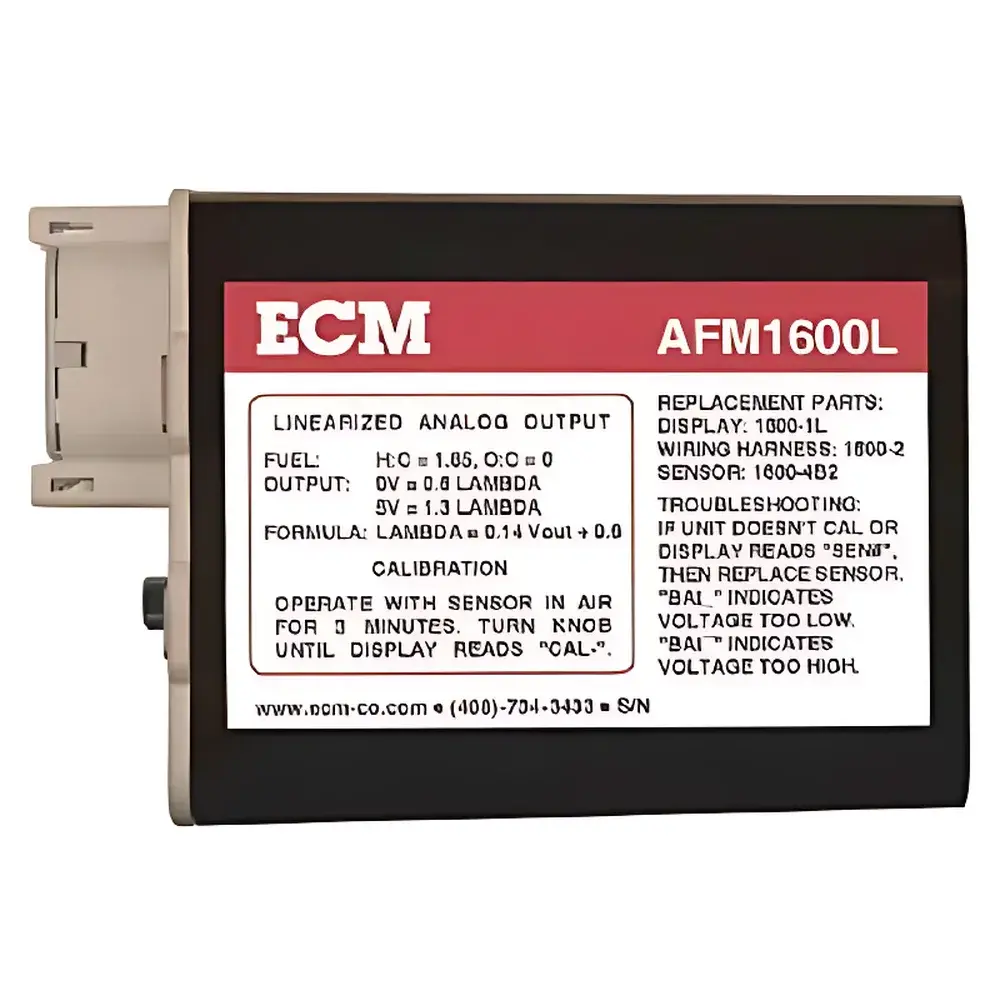
ECM AFM1600D Fast Oxygen Analyzer
| Brand | ECM |
|---|---|
| Origin | USA |
| Model | AFM1600D |
| Measurement Range | 0–25% O₂ |
| Accuracy | ±0.2% absolute |
| Calibration | ambient air (20.95% O₂) |
| Output | 0–5 V linear analog |
| Power Supply | 11–28 VDC |
| Operating Temperature | −20 to +85 °C |
| Sensor Thread | M18×1.5 |
| Dimensions | 68 mm × 32 mm × 100 mm |
| Weight | 125 g |
| Sensor Type | Bosch LSU 4.2 wideband lambda sensor |
| Cable Length | 3 m |
Overview
The ECM AFM1600D Fast Oxygen Analyzer is a high-performance, compact electrochemical gas analyzer engineered for real-time oxygen concentration measurement in dynamic combustion environments. It operates on the principle of dual-cell wideband zirconia sensing—leveraging the Bosch LSU 4.2 sensor platform—to deliver precise, pressure-compensated O₂ quantification across the full 0–25% vol range. Unlike conventional paramagnetic or galvanic cell analyzers, the AFM1600D employs stoichiometric lambda control logic and internal Nernst voltage feedback to achieve rapid response (<150 ms T90) and exceptional stability under transient engine load conditions. Designed specifically for powertrain development laboratories and emissions validation facilities, it serves as a primary diagnostic tool for closed-loop engine control strategy verification, air-fuel ratio (AFR) mapping, and exhaust aftertreatment system characterization.
Key Features
- High-speed wideband oxygen sensing using the Bosch LSU 4.2 zirconia sensor with integrated heater control and pump current regulation
- Linear 0–5 V analog output compliant with industrial data acquisition standards (e.g., ETAS INCA, ATI Vision, RCON, CALVIN), enabling direct integration into ECU test benches and hardware-in-the-loop (HIL) systems
- True ambient-air calibration protocol—no span gas required—reducing operational overhead and eliminating calibration drift associated with bottled reference gases
- Ruggedized aluminum housing with IP65-rated environmental sealing; optimized thermal management ensures stable operation from −20 °C to +85 °C ambient
- Compact form factor (68 × 32 × 100 mm) and low mass (125 g) facilitate mounting in constrained spaces—including exhaust manifolds, turbocharger downpipes, and intake plenums
- Wide input voltage range (11–28 VDC) supports integration with vehicle battery systems, dyno power supplies, and portable test rigs without external regulation
Sample Compatibility & Compliance
The AFM1600D is compatible with all common hydrocarbon fuels—including gasoline, diesel, ethanol blends (E10–E85), biodiesel (B5–B100), natural gas (CNG), and hydrogen-enriched mixtures—without requiring fuel-specific configuration. Its sensor architecture inherently compensates for exhaust backpressure up to 3 bar(g), making it suitable for both naturally aspirated and forced-induction applications. The device complies with key international standards governing automotive test equipment, including ISO 20000-1 (IT service management for test lab infrastructure), SAE J1100 (motor vehicle dimensions), and EN 61326-1 (EMC requirements for laboratory equipment). While not certified for continuous occupational safety monitoring, its measurement traceability aligns with NIST-traceable calibration practices per ISO/IEC 17025 guidelines when used in accredited engine testing laboratories.
Software & Data Management
The AFM1600D operates as a standalone analog transducer and does not include embedded firmware or onboard data logging. Its 0–5 V output is designed for seamless ingestion by third-party data acquisition platforms supporting standard analog input channels (e.g., National Instruments DAQmx, Dewesoft X, Vector CANape). For time-synchronized multi-parameter analysis, users commonly pair the unit with CAN-based engine control units or combine its signal with lambda, NOx, CO, and CO2 channels via modular gas analyzers. All calibration events—including ambient-air zero checks—are documented manually or through host DAQ software; no audit trail or 21 CFR Part 11 compliance features are built-in, consistent with its role as a field-deployable physical layer sensor rather than a regulated clinical or pharmaceutical instrument.
Applications
- Real-time AFR monitoring during steady-state and transient engine dynamometer testing
- Validation of closed-loop lambda control algorithms in ECU calibration workflows
- Exhaust gas recirculation (EGR) rate estimation and fault detection in diesel applications
- Aftertreatment system diagnostics—including DOC light-off characterization and SCR ammonia slip screening
- Combustion efficiency optimization for alternative fuel engines (e.g., biogas CHP units, marine dual-fuel engines)
- On-vehicle OBD-II correlation studies and regulatory emissions cycle compliance verification (e.g., WLTC, FTP-75)
FAQ
Does the AFM1600D require periodic recalibration with certified gas standards?
No. The device uses a single-point ambient air calibration (20.95% O₂) that can be performed in situ at any time. This eliminates dependency on calibration gases and associated certification documentation.
Can the AFM1600D measure oxygen in inert or reducing atmospheres?
Yes—within its specified 0–25% O₂ range—but accuracy degrades below ~0.5% O₂ due to sensor signal-to-noise limitations. For sub-ppm measurements, dedicated paramagnetic or laser-based analyzers are recommended.
Is the LSU 4.2 sensor replaceable by the end user?
Yes. The M18×1.5 threaded sensor is field-replaceable using standard torque tools. ECM provides replacement sensors with pre-programmed calibration coefficients stored in the control module’s EEPROM.
What is the expected service life of the LSU 4.2 sensor under typical engine test conditions?
Under controlled laboratory use (≤500 hrs/year, no exposure to oil mist or unburned hydrocarbons), the sensor typically achieves 12–18 months of stable performance. Field deployment in heavy-duty applications may reduce lifespan to 6–9 months.
Related Products







