
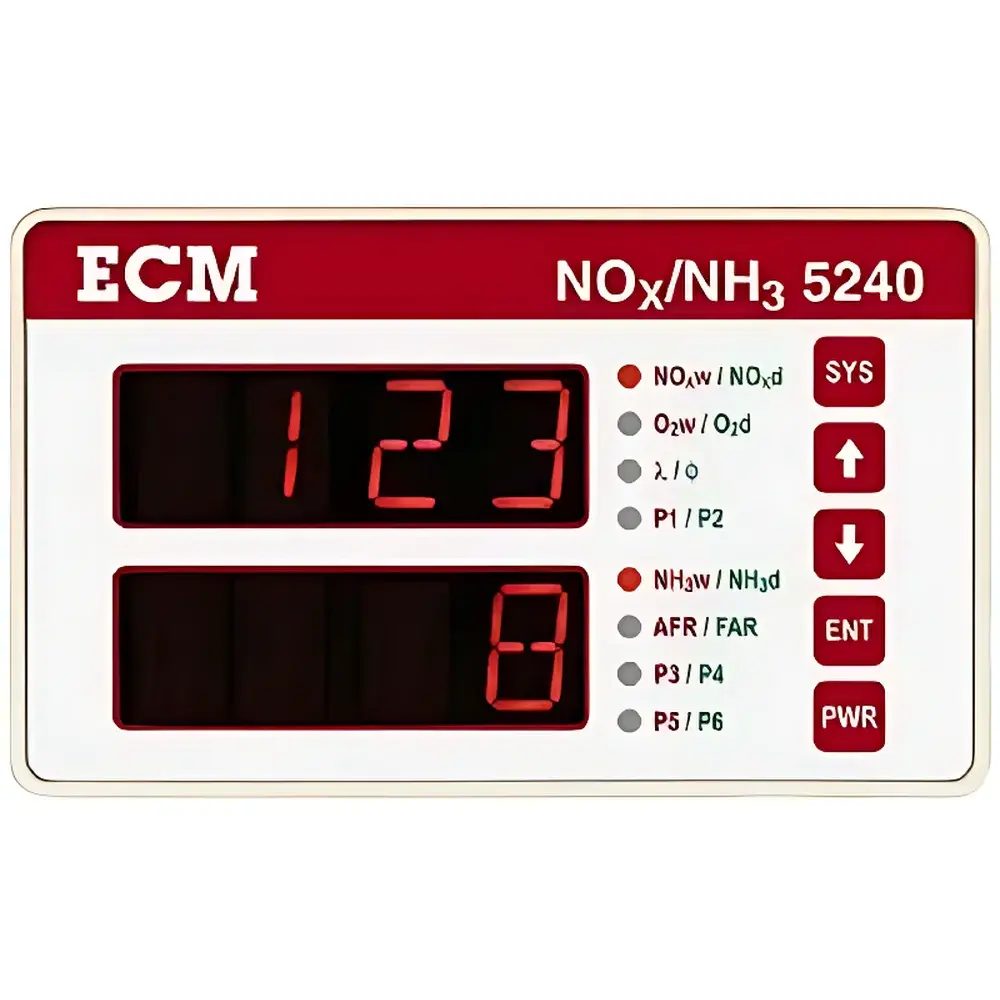
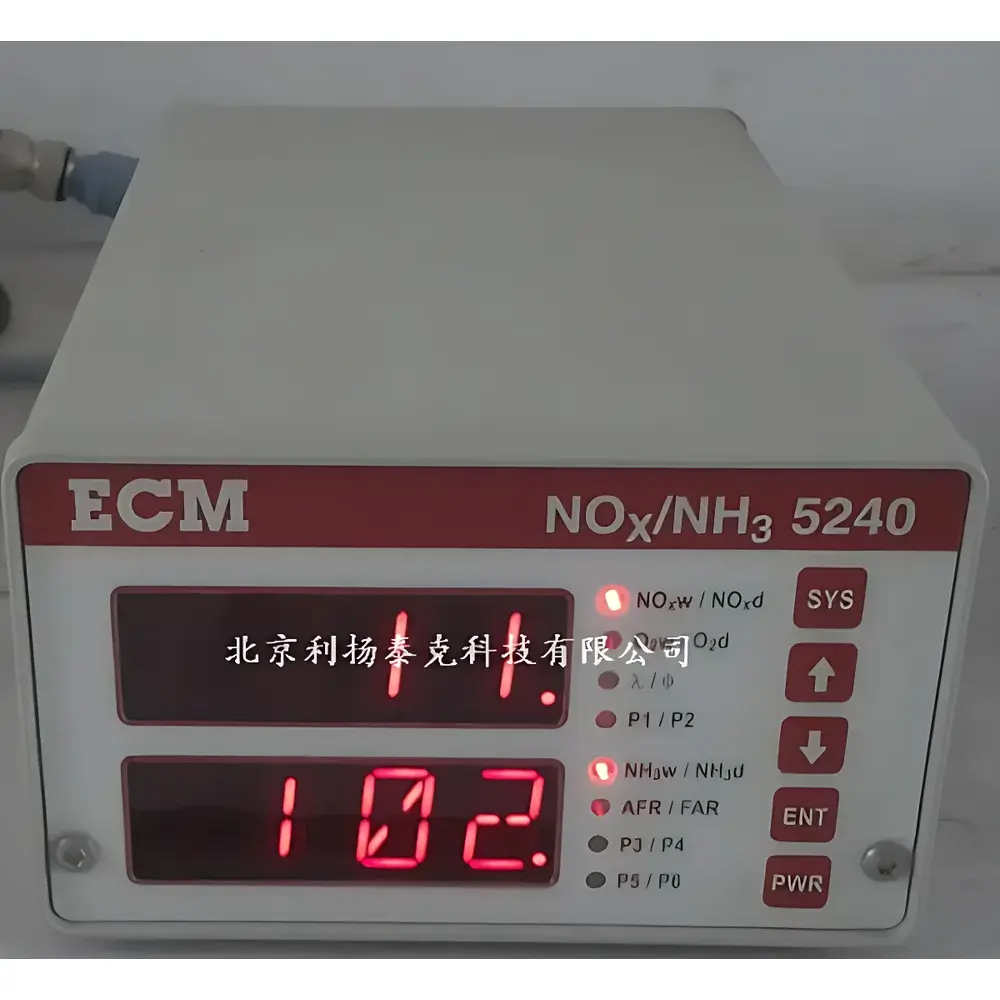
ECM Model 5240 Fast-Response NOx/NH₃ Exhaust Gas Analyzer
| Brand | ECM |
|---|---|
| Origin | USA |
| Model | 5240 |
| Measurement Range | NOx 0–5000 ppm, NH₃ 0–1000 ppm, O₂ 0–25% vol, λ 0.4–25, AFR 6–364, φ 0.04–2.5 |
| Accuracy | NOx ±5 ppm (0–1000 ppm), ±1% FS (other) |
| Response Time | <1 s (NOx/NH₃), <150 ms (O₂/λ/AFR/φ) |
| Output | 6 × 0–5 V analog, CAN 2.0B, USB 2.0 |
| Power | 11–28 VDC |
| Sensor Thread | M20×1.5 or M18×1.5 |
| Dimensions (H×W×D) | 64 × 105 × 165 mm |
| Weight | 676 g (main unit), 244 g (sensor module) |
| Operating Temp. | −40 to +85 °C (electronics), up to 950 °C (sensor tip) |
| Optional | Pressure compensation kit, extended cable (up to 100 m), AC/DC adapter |
Overview
The ECM Model 5240 Fast-Response NOx/NH3 Exhaust Gas Analyzer is an engineered solution for real-time, high-fidelity measurement of nitrogen oxides (NOx), ammonia (NH3), oxygen (O2), air–fuel ratio (AFR), equivalence ratio (φ), and lambda (λ) in diesel and alternative-fuel exhaust streams. Unlike conventional ceramic-based NOx sensors that suffer from NH3 cross-sensitivity—leading to erroneous NOx readings—the Model 5240 employs a dual-sensor electrochemical architecture with integrated signal separation algorithms. This enables independent, simultaneous quantification of NOx and NH3, eliminating analytical ambiguity during selective catalytic reduction (SCR) system development, calibration, and validation. The analyzer operates on the principle of temperature-stabilized amperometric detection with built-in thermal management, ensuring stable baseline performance across wide exhaust temperature gradients (up to 950 °C at the sensor tip). Its design conforms to the physical and temporal demands of engine dynamometer testing, transient vehicle operation, and regulatory emissions certification protocols.
Key Features
- Dual-parameter specificity: True orthogonal measurement of NOx and NH3, with no cross-interference under dynamic SCR operating conditions
- Sub-second response: <1 s for NOx/NH3; <150 ms for O2, λ, AFR, and φ—enabling cycle-resolved analysis per ISO 8178 and SAE J1939-71
- On-sensor calibration memory: EEPROM embedded in the sensor connector stores zero/span coefficients, calibration timestamps, and sensor aging metrics—supporting traceable, GLP-compliant recalibration without host intervention
- Fuel-agnostic configuration: Adjustable H:C, O:C, N:C, and H2 atomic ratios allow accurate λ/AFR/φ calculation across diesel, biodiesel, LNG, CNG, hydrogen-blended, and synthetic fuels
- Extended deployment flexibility: 100-meter maximum sensor-to-analyzer cable length with uncompromised signal integrity and latency—validated per EMC Directive 2014/30/EU
- Embedded power management: Ignition-switch-triggered auto-power-on/off functionality optimized for in-vehicle integration
- Robust mechanical design: IP67-rated enclosure with M20×1.5 or M18×1.5 threaded sensor mount; operational from −40 °C to +85 °C ambient
Sample Compatibility & Compliance
The Model 5240 is validated for direct-in-line measurement of hot, wet, particulate-laden exhaust gases without external conditioning—provided gas velocity remains within 5–30 m/s and condensate accumulation is mitigated via proper probe orientation. It complies with key international standards governing emissions instrumentation, including ISO 16183 (ammonia measurement in exhaust), ISO 20023 (portable NOx analyzers), and ASTM D6584 (NH3 in diesel exhaust). For regulated testing environments, the device supports audit-ready data logging with time-stamped calibration events, user authentication logs, and firmware version tracking—facilitating compliance with EPA 40 CFR Part 1065, EU Regulation (EU) 2017/1151, and UN ECE R49/R83 requirements. Optional pressure compensation maintains accuracy under backpressure conditions up to 500 kPa, meeting heavy-duty transient test cycle (WHTC, WHSC) specifications.
Software & Data Management
Data acquisition and configuration are supported via native USB 2.0 interface (CDC-class virtual COM port) and industry-standard CAN 2.0B bus (programmable baud rates up to 1 Mbps). All six analog outputs (0–5 V) are fully linearized and independently scalable for NOx, NH3, O2, λ, AFR, and φ—enabling seamless integration with dSPACE, NI VeriStand, ETAS INCA, AVL PUMA, and custom DAQ platforms. ECM provides a Windows-based configuration utility (v3.x) supporting real-time parameter monitoring, sensor diagnostics (including internal resistance, reference electrode drift, and heater status), and export of CSV-formatted time-series data with metadata headers. Firmware updates retain full backward compatibility and include cryptographic signature verification. Audit trails meet FDA 21 CFR Part 11 requirements when used with validated third-party data acquisition software supporting electronic signatures and change control.
Applications
- SCR catalyst development and urea dosing optimization
- Real-driving emissions (RDE) testing and PEMS correlation studies
- Engine control unit (ECU) calibration and closed-loop NH3 slip feedback
- Aftertreatment durability assessment under accelerated aging protocols
- Regulatory certification testing per Euro VI, EPA Tier 4, China VI, and Bharat Stage VI
- Hydrogen and ammonia-fueled internal combustion engine research
- Mobile source emissions inventories and roadside monitoring deployments
FAQ
Does the Model 5240 require external gas conditioning (e.g., cooling, drying, filtering)?
No—its high-temperature sensor design enables direct sampling of raw exhaust. However, particulate filtration (e.g., sintered metal filter) upstream of the probe is recommended for long-term reliability in soot-rich applications.
Can calibration be performed in-field without returning the unit to a service center?
Yes—zero and span calibrations are executed via the front-panel interface or configuration software using certified span gases. All calibration parameters are stored in the sensor’s onboard EEPROM.
Is the CAN protocol compatible with SAE J1939?
Yes—J1939-71 message set support is standard, including SPNs for NOx, NH3, O2, and lambda, with configurable PGN assignment.
What is the recommended maintenance interval for the sensor module?
Under typical heavy-duty testing conditions, sensor lifetime exceeds 2,000 hours at ≤600 °C exhaust temperature. ECM recommends quarterly diagnostic checks and annual replacement if exposed to sustained >800 °C operation or chemical poisoning (e.g., phosphorus, sulfur, silicon).







