
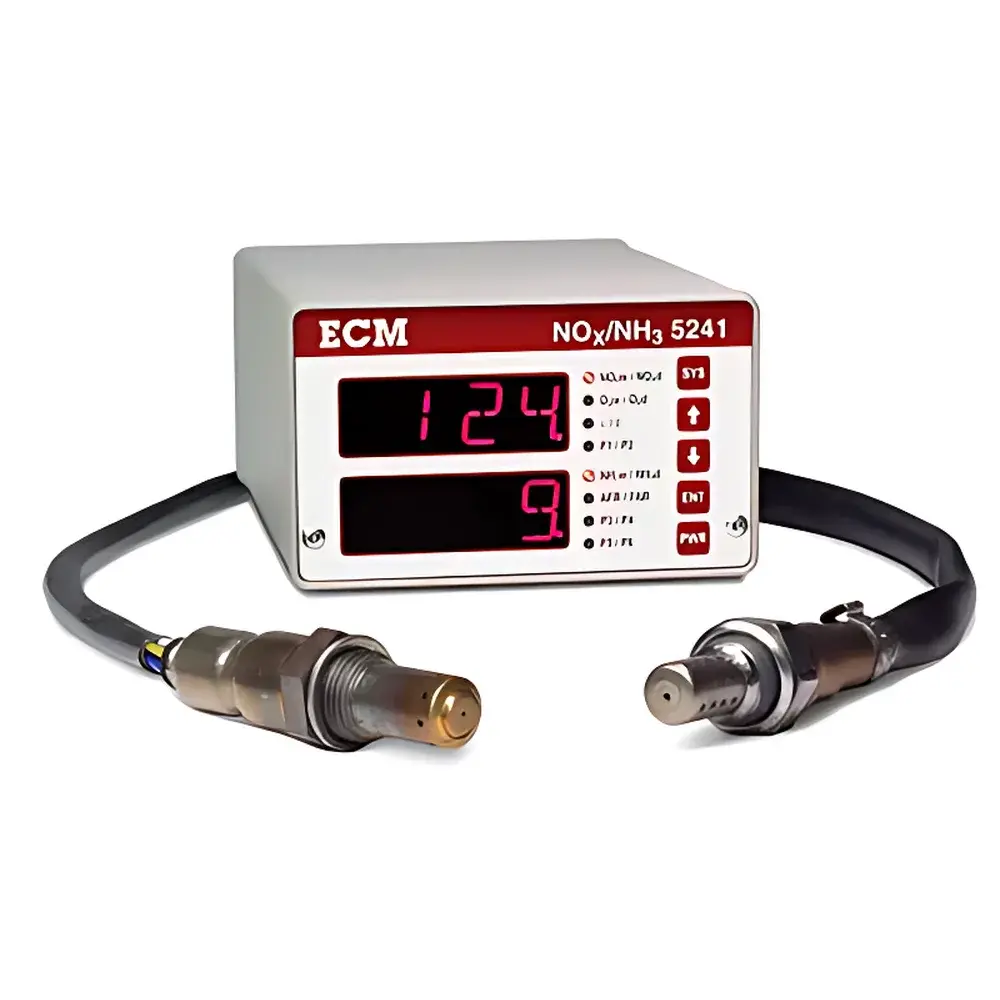
ECM NOx/NH3 5241 Advanced Automotive Exhaust Gas Analyzer
| Brand | ECM |
|---|---|
| Origin | USA |
| Model | NOx/NH3 5241 |
| Detection Principle | Electrochemical Sensing |
| Measurement Range | NOx/NO/NO₂: 0–5000 ppm |
| NH₃ | 0–2000 ppm (λ > 1 only) |
| O₂ | 0–25% vol |
| λ | 0.4–25 |
| AFR | 6–364 |
| φ | 0.04–2.5 |
| Accuracy | NOx/NO/NO₂/NH₃: ±5 ppm (0–1000 ppm), ±1% FS (other) |
| O₂ | ±0.2% abs |
| λ/AFR/φ | ±0.8% at stoichiometric, ±1.8% avg |
| Response Time | <1 s (NOx/NO/NO₂/NH₃), <150 ms (O₂/λ/AFR/φ) |
| Operating Temperature | –40°C to +85°C (electronics), up to 950°C (sensor tip) |
| Power Supply | 11–28 VDC |
| Analog Outputs | Six 0–5 V linearized channels |
| Communication | High-speed CAN (configurable protocol) |
| Sensor Interface | M18×1.5 threaded probe |
| Dimensions (H×W×D) | 64 × 105 × 165 mm |
| Weight | 676 g (main unit), 244 g (sensor module) |
| Cable Length | Standard 4 m, extendable to 100 m |
| Optional Accessories | Pressure compensation kit, mounting bracket, calibration station, NOx/NH₃ sensor simulator, extended cable, AC/DC adapter |
Overview
The ECM NOx/NH3 5241 Advanced Automotive Exhaust Gas Analyzer is an electrochemical-based, real-time in-situ measurement system engineered for high-fidelity characterization of diesel and lean-burn engine exhaust streams. It delivers simultaneous, synchronized quantification of nitrogen oxides (NO, NO₂, total NOx), ammonia (NH₃), oxygen (O₂), air-fuel ratio (AFR), equivalence ratio (φ), and lambda (λ) — all from a single compact analyzer platform. Designed specifically for R&D applications in powertrain development, aftertreatment system validation (e.g., SCR, LNT, GPF), and regulatory compliance testing, the 5241 operates under extreme thermal and dynamic conditions typical of modern exhaust environments. Its core architecture leverages temperature-stabilized, cross-interference-compensated electrochemical sensors with embedded digital calibration memory, enabling field-deployable metrological integrity without recalibration drift. The instrument adheres to fundamental principles of amperometric gas sensing, where target species undergo selective redox reactions at catalytic working electrodes, generating current signals linearly proportional to concentration — rigorously traceable to NIST-traceable reference standards.
Key Features
- Real-time, multi-parameter output: Simultaneous measurement of NO, NO₂, NOx, NH₃, O₂, λ, AFR, and φ — all time-aligned and timestamped.
- Digital sensor calibration memory: All zero/span coefficients and aging factors stored onboard the sensor connector EEPROM; no manual entry or software dependency required for recalibration.
- Extended sensor cabling: Up to 100 m separation between probe and main unit with zero degradation in response time or signal fidelity — enabled by active signal conditioning and noise-immune analog transmission.
- Fuel-agnostic combustion parameter calculation: Configurable H:C, O:C, N:C, and H₂ fuel composition ratios support accurate λ/AFR/φ derivation across gasoline, diesel, biodiesel, CNG, LNG, and hydrogen-blended fuels.
- High-speed dynamic response: <1 s T₉₀ for NOx/NH₃ species; <150 ms for O₂, λ, AFR, and φ — suitable for transient engine cycle analysis (e.g., WLTC, RDE, FTP-75).
- Robust thermal design: Electronics rated for –40°C to +85°C ambient; sensor tip withstands continuous exposure up to 950°C — compatible with turbocharger outlet and catalyst inlet sampling points.
- Integrated power management: Ignition-switch controlled auto-power-on/off functionality for seamless integration into vehicle test fleets and chassis dynamometer setups.
Sample Compatibility & Compliance
The ECM NOx/NH3 5241 is validated for direct insertion into hot, humid, particulate-laden exhaust streams without external dilution or conditioning — provided appropriate probe cooling and filtration (e.g., ceramic filter, heated sample line) are applied per application requirements. It complies with key international test protocols including ISO 8714 (electric vehicle energy consumption), ISO 20027 (engine emissions instrumentation), and SAE J1930 (electrical/electronic systems terminology). While not certified as a type-approved PEMS device under EU Regulation (EU) 2016/427, its metrological performance meets the technical prerequisites for laboratory-grade R&D use supporting EU Stage V, US EPA Tier 4 Final, and China VI emission certification workflows. Data logging and reporting configurations can be aligned with GLP/GMP documentation requirements through optional audit-trail-enabled software modules.
Software & Data Management
The analyzer interfaces natively via high-speed CAN 2.0B (up to 1 Mbps) with configurable message IDs and frame structures — fully compatible with industry-standard DAQ platforms including dSPACE SCALEXIO, NI VeriStand, ETAS INCA, and Vector CANoe. Six isolated, linearized 0–5 V analog outputs provide plug-and-play connectivity to legacy data loggers and control systems. Raw sensor diagnostics (e.g., electrode health, temperature compensation status, zero drift rate) and calculated parameters (including aging factor, sensor lifetime estimate, and pressure-compensated values when equipped) are accessible via CAN or optional USB-to-CAN adapter. Firmware updates and configuration changes are performed using ECM’s Windows-based ECMConfig utility, which supports batch parameter loading, calibration history archiving, and export of CSV-formatted time-series datasets compliant with ASTM E2917 and ISO/IEC 17025 data integrity guidelines.
Applications
- Engine calibration and optimization: Real-time feedback for ECU mapping of injection timing, EGR rate, and SCR dosing strategy.
- Aftertreatment system development: Quantitative NH₃ slip assessment across SCR catalysts; NOx conversion efficiency evaluation under transient thermal gradients.
- On-board diagnostic (OBD) algorithm validation: Correlation of sensor outputs with OEM diagnostic trouble codes (DTCs) related to NOx sensors and urea dosing faults.
- Regulatory test support: Supplemental measurement during chassis dynamometer cycles (e.g., WLTP Part 1 & 2, US FTP, RDE) where fast-response gas analyzers are required for boundary condition monitoring.
- Fuel formulation studies: Combustion stoichiometry analysis across alternative fuels, including renewable diesel, hydrotreated vegetable oil (HVO), and synthetic e-fuels.
- University and government lab research: Fundamental studies on NOx formation mechanisms, NH₃ oxidation kinetics, and low-temperature SCR chemistry.
FAQ
What is the maximum allowable exhaust gas temperature at the sensor tip?
The sensor probe is rated for continuous operation up to 950°C — suitable for pre-turbine and post-turbine sampling locations.
Does the analyzer require external gas conditioning (e.g., drying, filtering)?
Yes — while the sensor itself tolerates high temperature and humidity, particulate filtration (e.g., sintered metal or ceramic filter) and optional heated sample lines are recommended to prevent condensation and fouling.
Can the NOx/NH₃ 5241 be used for ambient air monitoring?
No — it is optimized for high-concentration, high-temperature engine exhaust applications; not designed for ppb-level ambient NO₂ or NH₃ detection.
Is pressure compensation mandatory for accurate measurements?
Not mandatory, but strongly recommended for applications where exhaust backpressure exceeds ±5.2 kPa; the optional pressure compensation kit corrects for density-related deviations in electrochemical response.
How often does the sensor require recalibration?
Calibration interval depends on usage intensity and exhaust chemistry; typical laboratory practice is quarterly zero/span verification using certified gas standards per ISO 12039 and ASTM D6522.







