
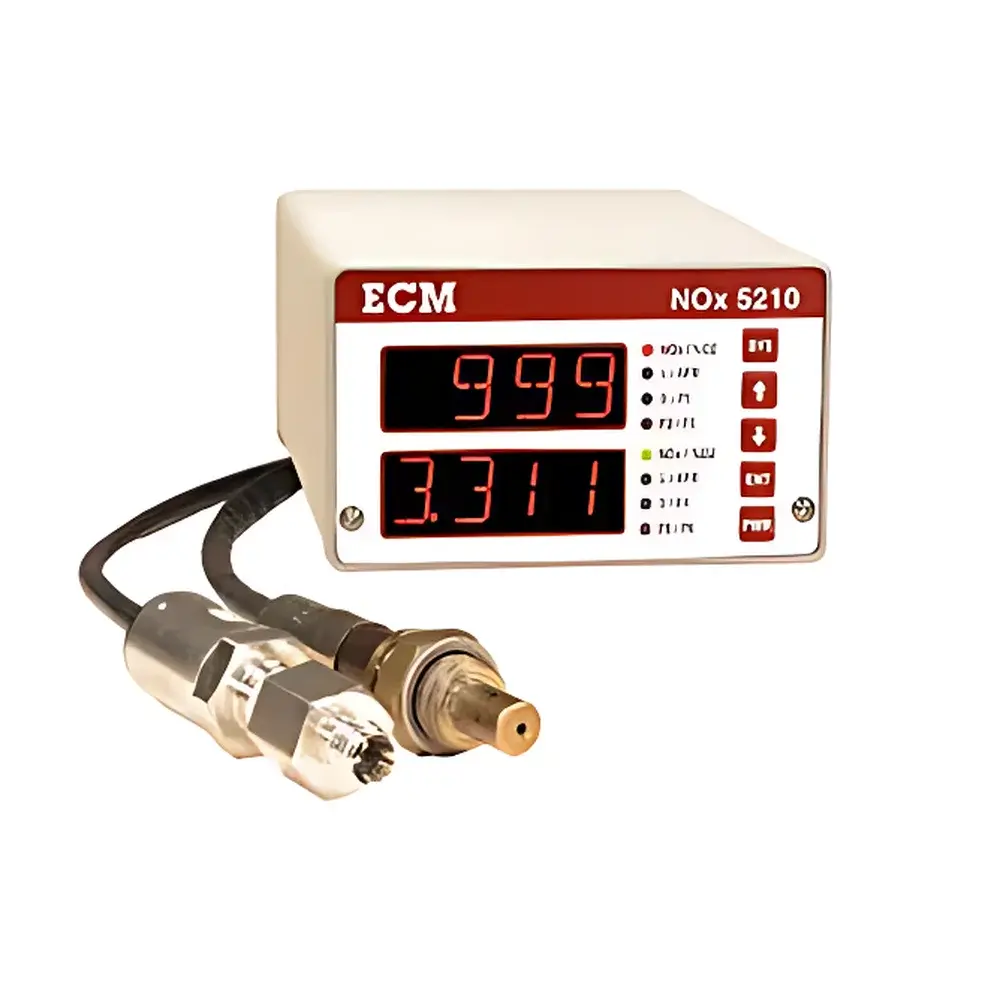
ECM NOx5210t Fast Nitrogen Oxides and Lambda Analyzer
| Brand | ECM |
|---|---|
| Origin | USA |
| Model | NOx5210t |
| Measurement Principle | Electrochemical (Ceramic Zirconia-based Dual-Chamber NOx Sensor) |
| NOx Range | 0–5000 ppm |
| Lambda (λ) Range | 0.4–25 |
| AFR Range | 6–364 |
| Equivalence Ratio (φ) | 0.04–2.5 |
| O₂ Range | 0–25% vol |
| NOx Accuracy | ±15 ppm (0–1000 ppm, NGK), ±20 ppm (0–1000 ppm, NTK Type T), ±30 ppm (0–1000 ppm, NTK) |
| Lambda Accuracy | ±0.008 @ λ=1 |
| Response Time | <1 s (NOx, NGK/NTK-T), 700 ms (NTK), <150 ms (λ/φ/AFR/O₂) |
| Analog Outputs | 6 × 0–5 V (linearized, user-assignable) |
| Digital Interfaces | CAN 2.0B (configurable protocol), USB 2.0, RS-232 |
| Power Supply | 11–28 VDC |
| Operating Temperature | −40 °C to +85 °C |
| Sensor Mounting Thread | 20 mm × 1.5 mm (NGK), 18 mm × 1.5 mm (NTK) |
| Dimensions (H×W×D) | 64 × 105 × 165 mm |
| Weight | 676 g (main unit), 244 g (sensor module) |
| Max Sensor Cable Length | 100 m (standard 4 m included) |
| Fuel Flexibility | Configurable H:C, O:C, N:C, H₂ ratios |
| Optional Features | Dual-channel measurement, pressure compensation, AC/DC adapter |
Overview
The ECM NOx5210t Fast Nitrogen Oxides and Lambda Analyzer is an engineered solution for real-time, in-situ measurement of nitrogen oxides (NO and NO₂), air–fuel ratio (AFR), equivalence ratio (φ), lambda (λ), and oxygen concentration (%O₂) in high-dynamic exhaust streams. Designed specifically for combustion research and aftertreatment development, the analyzer employs dual-chamber electrochemical ceramic zirconia sensor technology—capable of direct insertion into hot exhaust gas lines without sample conditioning. Unlike extractive systems requiring pumps, filters, or heated sample lines, the NOx5210t eliminates transport delay and condensation artifacts by measuring at the source. Its architecture supports both lean-burn (λ > 1) and stoichiometric-to-rich (λ ≥ 1 and λ < 1) operation, accommodating diesel, lean-burn gasoline, HCCI, and turbine applications. The device complies with ISO 8768 and SAE J1930 signal definition conventions for engine parameter reporting and is routinely deployed in laboratories adhering to ISO/IEC 17025-accredited test protocols.
Key Features
- Direct-insertion ceramic NOx sensor with integrated lambda/oxygen sensing—no sampling pump, no heated line, no dilution required
- Field-replaceable sensor modules (NGK or NTK variants) with embedded EEPROM calibration data stored in the sensor connector
- User-performed zero and span calibration via front-panel interface; new calibration coefficients written automatically to sensor EEPROM
- Configurable fuel composition support: adjustable H:C, O:C, N:C, and H₂ mass ratios for accurate AFR/φ calculation across biofuels, synthetic fuels, and hydrogen blends
- Sub-second response: <150 ms for λ/φ/AFR/O₂; <1 s for NOx (NGK/NTK-T); 700 ms for standard NTK NOx sensors
- Six isolated 0–5 V analog outputs—fully assignable to any measured or derived parameter (e.g., NOx, λ, %O₂, aging factor)
- Multi-protocol digital interfaces: CAN 2.0B (with customizable message ID and baud rate), USB 2.0 (CDC class), and RS-232 (38.4 kbps max)
- Ignition-triggered power management—automatically powers on/off via vehicle key-switch signal for seamless onboard integration
- Ruggedized aluminum housing rated IP65; operating ambient range from −40 °C to +85 °C; qualified per MIL-STD-810G for shock/vibration
Sample Compatibility & Compliance
The NOx5210t is validated for continuous exposure to exhaust gases up to 900 °C at the sensor tip (with optional thermal shield). It accommodates variable exhaust backpressure and transient gas composition typical of modern downsized, turbocharged, and aftertreatment-equipped powertrains. Sensor selection is application-dependent: NGK sensors are optimized for lean conditions (λ > 1), while NTK variants (including Type T) support full-range operation including rich stoichiometry and cold-start transients. All calibrations are traceable to NIST-certified gas standards. The analyzer meets electromagnetic compatibility requirements per CISPR 25 Class 5 and EN 55025. For regulatory testing environments, its data logging and output architecture supports GLP-compliant audit trails when integrated with compliant DAQ systems (e.g., dSPACE SCALEXIO, ETAS INCA, or National Instruments VeriStand).
Software & Data Management
No proprietary software runtime is required—the NOx5210t operates as a self-contained embedded instrument. Configuration, calibration, and diagnostics are managed via ASCII command set over USB or RS-232, enabling integration into custom Python, LabVIEW, or MATLAB control environments. CAN output conforms to J1939-71 and ISO 27145-2 message structures for plug-and-play compatibility with OEM diagnostic tools. All analog and digital outputs provide simultaneous access to raw sensor signals, temperature-compensated values, sensor health indicators (e.g., aging factor, reference cell voltage), and calculated parameters (e.g., NOx conversion efficiency across SCR catalysts). Timestamped binary data export (via USB mass storage mode) includes microsecond-resolution hardware timestamps synchronized to internal RTC, facilitating post-test correlation with crank-angle-resolved engine data.
Applications
- Engine development: Real-time NOx feedback for closed-loop EGR control validation and combustion optimization
- Aftertreatment R&D: Ammonia slip monitoring, SCR conversion efficiency mapping, and DPF regeneration profiling
- Fuel flexibility studies: Quantification of NOx formation trends across gasoline, diesel, CNG, LNG, methanol, and hydrogen combustion
- Regulatory compliance testing: Support for WLTC, RDE, and US FTP-75 cycle measurements under transient load conditions
- On-vehicle OBD-II correlation: Cross-validation of production lambda and NOx sensors against reference-grade instrumentation
- Academic research: High-fidelity datasets for kinetic modeling of NOx formation pathways and catalyst surface reaction mechanisms
FAQ
Does the NOx5210t require periodic factory recalibration?
No—users perform full zero and span calibration in situ using certified span gases. Calibration coefficients are retained in the sensor’s onboard EEPROM and remain valid across instrument replacements.
Can the same unit measure both lean and rich exhaust simultaneously?
Yes, provided an NTK (Type T) sensor is installed. NGK sensors are restricted to λ > 1 operation.
Is pressure compensation available for high-altitude or boosted engine testing?
Yes—optional barometric pressure input (0–100 kPa analog or I²C digital) enables real-time correction of lambda and AFR calculations.
What is the maximum allowable exhaust gas temperature at the sensor mounting point?
The sensor body is rated for continuous exposure up to 650 °C; optional high-temp thermal shields extend this to 900 °C at the tip.
How is sensor aging compensated during long-term testing?
The analyzer continuously monitors reference cell voltage, Nernst potential drift, and heater resistance—deriving an aging factor displayed in real time and available via all output interfaces.
Related Products







