
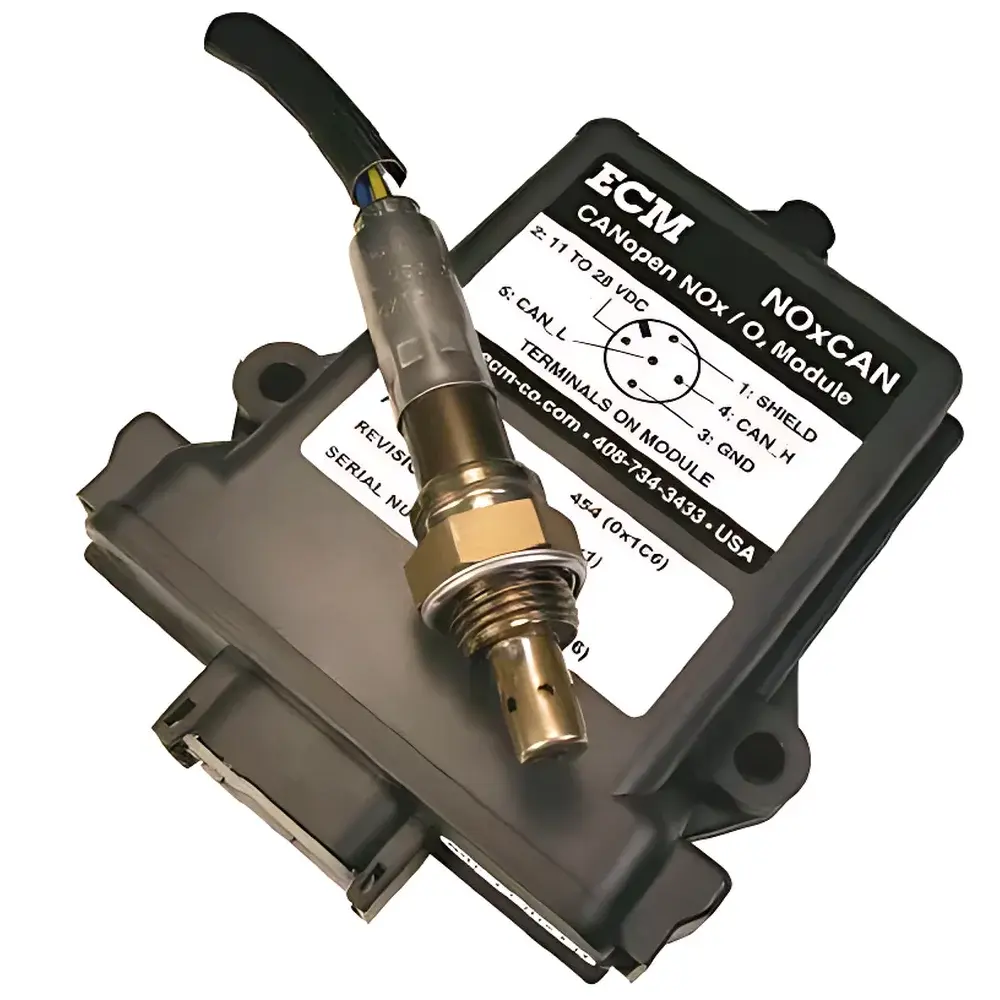
ECM NOxCAN NOx/Lambda/O2 Measurement Module
| Brand | ECM |
|---|---|
| Origin | USA |
| Model | NOxCAN |
| Sensor Type | NTK Ceramic NOx Sensor (1), Optional Pressure Sensor (1) |
| Measurement Range | NOx: 0–5000 ppm (λ ≥ 1) |
| Lambda | 0.40–25 |
| AFR | 6.0–364 |
| O₂ | 0–25% vol |
| Pressure | 0–517 kPa (0–75 psia) |
| Accuracy | NOx: ±30 ppm (0–1000 ppm), ±3% FS (other) |
| Lambda | ±0.008 (λ = 1), ±0.016 (λ = 0.8–1.2), ±0.018 (other) |
| AFR | ±0.15 (14.6), ±0.4 (12–18), ±1.0 (other) |
| O₂ | ±0.4% (0–2% O₂), ±0.8% (other) |
| Pressure | ±5.2 kPa (±0.75 psia) |
| Response Time | <700 ms (NOx), <150 ms (Lambda/AFR/O₂) |
| Fuel Composition Parameters | Configurable H:C, O:C, N:C, and H₂ ratios |
| CAN Interface | High-Speed CAN per ISO 11898, User-Assignable Node ID, Multi-Module Bus Support |
| Operating Temperature | −55 °C to +125 °C |
| Dimensions | 145 mm × 120 mm × 40 mm |
| Power Supply | 11–28 VDC |
| Sensor Mounting | 18 mm × 1.5 mm thread (NOx), 1/4" NPT (pressure) |
| Cable Length | Standard 1 m (2 m optional) |
| Calibration | Onboard EEPROM in sensor connector for zero/span calibration data storage |
| Software | PC-based configuration, real-time control, calibration, and parameter monitoring (CAN adapter required, sold separately) |
| Optional Accessories | Analog-output display head (supports up to two NOxCAN modules) |
Overview
The ECM NOxCAN is a high-integrity, embedded-grade NOx/Lambda/O₂ measurement module engineered for real-time, in-situ exhaust gas analysis in internal combustion engine development, aftertreatment system validation, and regulatory emissions testing. It operates on the principle of electrochemical detection using an NTK-type ceramic zirconia-based NOx sensor, coupled with dual-potentiometric oxygen sensing and stoichiometric lambda calculation derived from wideband air-fuel ratio (AFR) fundamentals. Unlike standalone analyzers, the NOxCAN functions as a distributed sensor node—designed for direct integration into engine control units (ECUs), diesel oxidation catalyst (DOC) or selective catalytic reduction (SCR) system controllers, or benchtop test cell data acquisition architectures. Its core architecture supports deterministic, low-latency data streaming via high-speed Controller Area Network (CAN), compliant with ISO 11898-2, enabling synchronized multi-parameter feedback for closed-loop combustion optimization and aftertreatment diagnostics.
Key Features
- Single-board integration of NOx, Lambda, O₂, and optional absolute exhaust pressure measurement in a compact 145 × 120 × 40 mm housing rated for −55 °C to +125 °C ambient operation.
- NTK ceramic NOx sensor with integrated reference electrode and thermal management—optimized for stability under transient exhaust conditions including rich-lean cycling and thermal shock.
- On-sensor EEPROM stores full calibration metadata (zero point, span coefficients, temperature compensation tables), eliminating manual recalibration logging and ensuring traceable metrology across sensor swaps.
- Configurable fuel composition parameters (H:C, O:C, N:C, H₂ content) enable accurate lambda and AFR computation across gasoline, diesel, biodiesel, ethanol blends, hydrogen-enriched, and synthetic fuels without hardware modification.
- Multi-node CAN bus support with user-assignable Node IDs allows daisy-chaining of up to 32 NOxCAN modules on a single physical bus—ideal for multi-cylinder engine mapping or dual-exhaust aftertreatment monitoring.
- Sub-700 ms NOx response time and <150 ms latency for Lambda/O₂ ensures fidelity in dynamic engine cycles such as WLTC, RDE, and transient FTP-75 protocols.
Sample Compatibility & Compliance
The NOxCAN is validated for direct insertion into hot, humid, particulate-laden exhaust streams downstream of turbochargers and upstream of aftertreatment devices. Its NTK sensor tolerates short-term exposure to condensate, hydrocarbons, and sulfur compounds typical of modern low-SULFUR diesel and gasoline exhaust. While not certified as a type-approved portable emissions measurement system (PEMS) under EU 2016/427 or US EPA 40 CFR Part 1065, the module meets the underlying metrological requirements for laboratory-grade development instrumentation—including linearity, repeatability, and thermal drift performance aligned with ISO 16183 (exhaust gas analysis for engine testing) and SAE J1149 (oxygen sensor performance criteria). All firmware and calibration procedures are structured to support GLP-compliant audit trails when used with validated CAN interface hardware and timestamped data logging systems.
Software & Data Management
Configuration, real-time monitoring, and sensor calibration are performed via ECM’s Windows-based NOxCAN Configuration Suite—a deterministic application supporting CAN frame decoding, parameter visualization (including live NOx vs. Lambda scatter plots), and non-volatile memory write operations to both module and sensor EEPROM. The software exports time-stamped CSV datasets compatible with MATLAB, Python (pandas), and NI DIAdem for post-processing. For production environments requiring 21 CFR Part 11 compliance, the suite supports role-based access control and electronic signature logging when deployed with validated IT infrastructure. Note: A certified ISO 11898-compliant CAN interface adapter (e.g., PEAK PCAN-USB FD or Vector VN1640A) is mandatory and sold separately.
Applications
- Real-time NOx model validation during ECU calibration—especially for lean-burn gasoline and stoichiometric CNG engines.
- In-line lambda monitoring upstream/downstream of three-way catalysts (TWC), DOCs, and SCR reactors to quantify conversion efficiency and ammonia slip risk.
- Development of model-based aftertreatment control strategies requiring fast, synchronized NOx and O₂ feedback.
- Engine dynamometer testing per ISO 8178, ISO 10054, and EPA Tier 4 standards where modular, CAN-native sensors reduce wiring complexity and improve signal integrity.
- Field-deployable RDE testing support when integrated with ruggedized data loggers and GPS-synchronized timing modules.
FAQ
Is the NOxCAN module suitable for continuous emissions monitoring (CEMS) in regulatory reporting?
No—the NOxCAN is designed for engineering development and diagnostic applications, not certified continuous emission monitoring systems. It lacks the redundancy, automated validation routines, and QA/QC documentation required for stack compliance under EPA 40 CFR Part 60 or EN 14181.
Can I use the NOxCAN with non-NTK NOx sensors?
No—hardware and firmware are tightly coupled to NTK’s proprietary ceramic sensor architecture, including its analog front-end conditioning and EEPROM calibration schema.
Does the module support CAN FD or only classical CAN?
It implements high-speed classical CAN (ISO 11898-2, up to 1 Mbps), not CAN FD. All message identifiers, data lengths, and timing constraints conform to ECM’s published CAN database (DBC file v3.2).
What is the recommended calibration interval?
ECM recommends functional verification every 250 engine operating hours or 6 months—whichever occurs first—with full zero/span calibration performed using certified span gases traceable to NIST standards.
Is pressure measurement required for accurate lambda calculation?
No—lambda is calculated from O₂ partial pressure and fuel composition; however, absolute pressure input improves accuracy under high-altitude or boosted engine conditions where barometric correction is critical.
Related Products







