
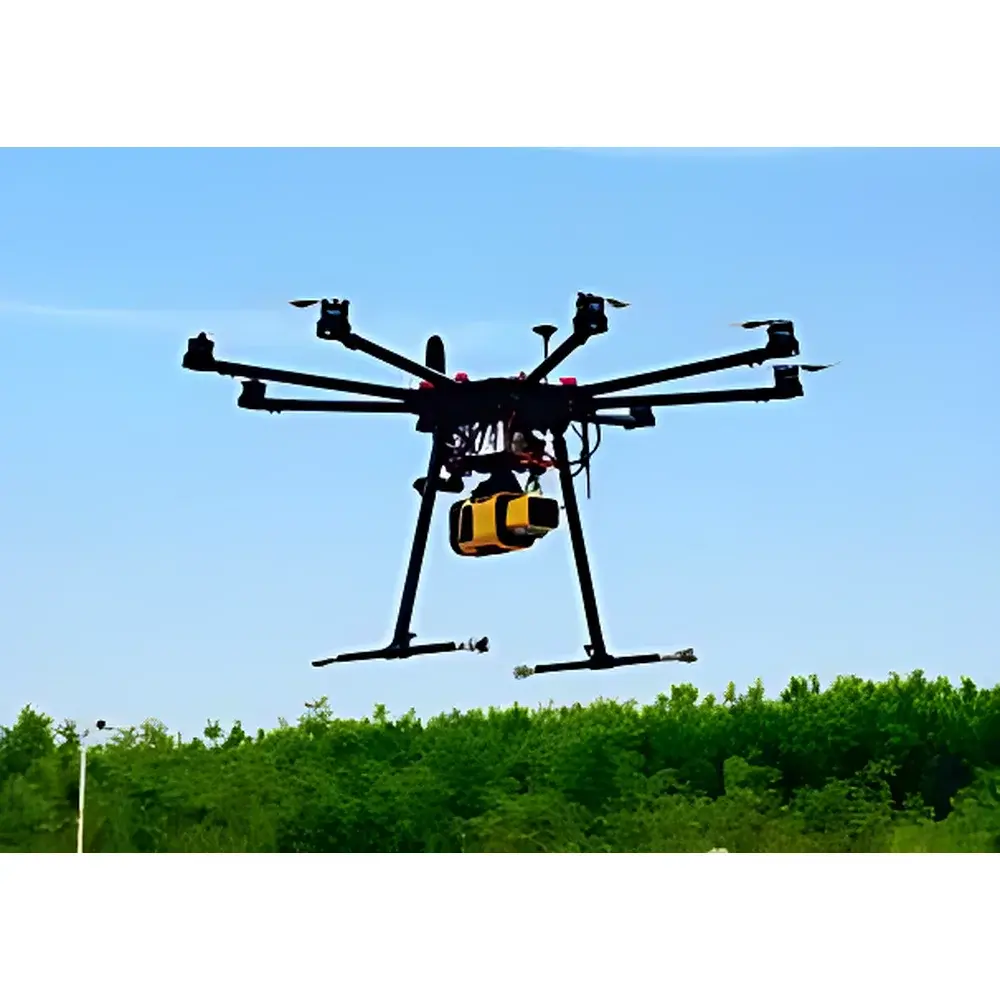
Ecodrone® UAS-8 Pro Hyperspectral-LiDAR Remote Sensing System
| Origin | Beijing, China |
|---|---|
| Manufacturer Type | Authorized Distributor |
| Regional Origin | Domestic (PRC) |
| Model | Ecodrone® UAS-8 Pro |
| Pricing | Upon Request |
Overview
The Ecodrone® UAS-8 Pro Hyperspectral-LiDAR Remote Sensing System is a high-payload, long-endurance unmanned aerial platform engineered for integrated multi-sensor Earth observation. It operates on the principle of active and passive remote sensing fusion—combining time-of-flight LiDAR for precise 3D topographic and structural profiling with push-broom hyperspectral imaging for quantitative spectral analysis across VNIR (400–1000 nm) and SWIR (900–1700 nm) bands. Complemented by synchronized Thermo-RGB thermal-infrared and visible imaging, the system enables simultaneous acquisition of geometric, biochemical, and thermal signatures at sub-decimeter spatial resolution. Designed for scientific-grade environmental monitoring, it supports repeatable, calibrated data collection under field conditions compliant with ISO 17025-aligned measurement traceability frameworks and adheres to FAO/UNEP remote sensing best practices for ecological inventory and change detection.
Key Features
- Modular dual-band hyperspectral payload: Interchangeable Specim FX10 (VNIR, f/1.7, 1024 px spatial resolution, 330 fps) and FX17 (SWIR) sensors with radiometric calibration traceable to NIST standards.
- High-accuracy airborne LiDAR: YellowScan Mapper integration delivering ≤2.5 cm vertical accuracy (RMSE), 3-return capability, and 70.4° field-of-view; supports point cloud density ≥100 pts/m² at 60 m AGL.
- Thermo-RGB co-registration: WorksWell thermal core with 30 mK thermal sensitivity (NETD), 640 × 512 IR resolution, fused pixel-accurate alignment with 20 MP Sony APS-C RGB sensor (83° FOV).
- UAS-8 Pro airframe: Octocopter architecture with >40 min endurance, 6 kg max payload capacity, IP43 environmental rating, and redundant IMU/GNSS (RTK + PPK support) for centimeter-level georeferencing.
- Integrated multispectral option: 5-band + panchromatic (5+1) sensor suite with onboard radiometric correction and automatic exposure synchronization across all channels.
- Ground-truth interoperability: Seamless data alignment with terrestrial instruments including portable photosynthesis systems (LI-6400XT-compatible protocols), leaf-clip spectrometers (350–2500 nm), and canopy-level vegetation index analyzers (NDVI, PRI, CIred-edge).
Sample Compatibility & Compliance
The system is validated for operational deployment across terrestrial ecosystems—including croplands, forest stands, wetlands, coastal zones, and semi-arid rangelands. Sensor configurations meet ASTM E2938-22 (Standard Practice for Airborne Hyperspectral Imaging) and ISO 19130-2:2020 (Geographic information — Imagery sensor models). LiDAR-derived digital surface models (DSMs) and canopy height models (CHMs) are compatible with USGS 3DEP Level 2 specifications. All firmware and data pipelines support metadata embedding per ISO 19115-2:2019, enabling full auditability in GLP-compliant research environments. Thermal imaging modules comply with IEC 62906-5-2 for infrared camera performance testing.
Software & Data Management
Data acquisition and preprocessing are managed via Ecodrone® Ground Control Station (GCS) v4.2, supporting mission planning with terrain-aware waypoint optimization, real-time telemetry overlay, and automated sensor trigger synchronization. Raw hyperspectral cubes undergo atmospheric correction using QUAC (Quick Atmospheric Correction) and ENVI-based FLAASH workflows. LiDAR point clouds are processed in LAStools and CloudCompare for noise filtering, ground classification (LAS Class 2), and CHM generation. Integrated Python API (ecodrone-sdk) enables batch processing, spectral library matching (USGS, ECOSTRESS), and export to GDAL-compatible formats (GeoTIFF, LAS/LAZ, BIL). Full audit trail logging meets FDA 21 CFR Part 11 requirements for electronic records and signatures in regulated environmental studies.
Applications
- Agricultural phenotyping: High-throughput estimation of biomass, nitrogen status, water stress (via PRI, NDWI), and yield potential across sorghum, maize, and rice trials—validated in peer-reviewed studies (e.g., Masjedi et al., Remote Sensing, 2020).
- Forest structure analysis: Canopy height modeling, understory penetration mapping, and individual tree crown delineation using fused LiDAR-CHM and hyperspectral texture features.
- Ecological restoration monitoring: Temporal tracking of vegetation succession, invasive species detection (e.g., Prosopis juliflora via SWIR absorption features), and soil moisture estimation from thermal inertia metrics.
- Coastal and wetland assessment: Mangrove species discrimination (using red-edge slope and SWIR water absorption bands), intertidal elevation modeling, and methane flux proxy mapping via thermal anomalies.
- Geological survey support: Lithological mapping through diagnostic mineral absorption features (e.g., Al-OH at 2200 nm, Fe³⁺ at 860 nm) and topographic change detection over mine spoil heaps or landslide-prone slopes.
FAQ
What spectral ranges does the hyperspectral sensor cover?
The system supports two interchangeable sensors: Specim FX10 (400–1000 nm, VNIR) and FX17 (900–1700 nm, SWIR), both with factory radiometric calibration certificates.
Is RTK/PPK geotagging supported for LiDAR and hyperspectral data?
Yes—dual-frequency GNSS (GPS + GLONASS + Galileo) with integrated RTK base station compatibility ensures absolute horizontal accuracy ≤2 cm and vertical accuracy ≤3 cm (CEP95) under open-sky conditions.
Can the system generate orthomosaics and DSMs directly onboard?
No—raw sensor data are recorded for post-processing; however, GCS v4.2 provides automated flight log synchronization and EXIF/XMP metadata embedding required for Agisoft Metashape, Pix4Dmapper, and ENVI’s Photogrammetry Module.
How is thermal data calibrated for quantitative surface temperature retrieval?
WorksWell thermal modules include shutter-based NUC (non-uniformity correction) and ambient reference compensation; emissivity correction is applied during post-processing using in-situ emissivity measurements or literature values (e.g., 0.97 for green vegetation).
Does the platform support third-party sensor integration beyond the listed payloads?
Yes—the UAS-8 Pro features standardized CAN bus, RS-232, and GPIO interfaces, and mechanical mounting conforms to UAVCAN v1.0 and MAVLink 2.0 specifications for certified peripheral integration.







