HY-779 Anti-Static Resistance Tester for Footwear and Conductive Coatings
| Key | Origin: Tianjin, China |
|---|---|
| Manufacturer Type | Authorized Distributor |
| Model | HY-779 |
| Pricing | Upon Request |
| Resistance Range | 100 Ω to 1.99 × 10¹³ Ω |
| Accuracy | ±3% |
| Test Voltages | 10 V, 50 V, 100 V, 500 V |
| Inner Electrode | Stainless Steel Beads (Ø5 mm, Total Mass: 4 kg) |
| Outer Electrode | Conductive Contact Plate |
| Conductive Coating Probe Assembly | Three Metallic Probes (Radius: 3.0 ± 0.2 mm) |
| Calibration Certificate | CNAS-Accredited Laboratory Report |
Overview
The HY-779 Anti-Static Resistance Tester is a precision-engineered instrument designed specifically for evaluating the electrical resistance characteristics of personal protective equipment (PPE), particularly safety footwear, and conductive or dissipative surface coatings used in controlled environments. It operates on the principle of direct-current (DC) two- and four-terminal resistance measurement under standardized electrode configurations, enabling quantification of surface and volume resistivity in accordance with international electrostatic discharge (ESD) safety requirements. The device supports compliance verification for occupational safety standards governing footwear used in explosive atmospheres, cleanrooms, electronics manufacturing, pharmaceutical production, and other static-sensitive industrial settings. Its architecture integrates stable high-voltage sourcing, low-noise current sensing, and configurable electrode fixtures to ensure repeatable, traceable measurements across an exceptionally wide resistance range—from near-conductive (10² Ω) to highly insulative (10¹³ Ω) materials.
Key Features
- Four selectable DC test voltages (10 V, 50 V, 100 V, and 500 V) to accommodate varying material conductivity profiles and standard-specific test conditions.
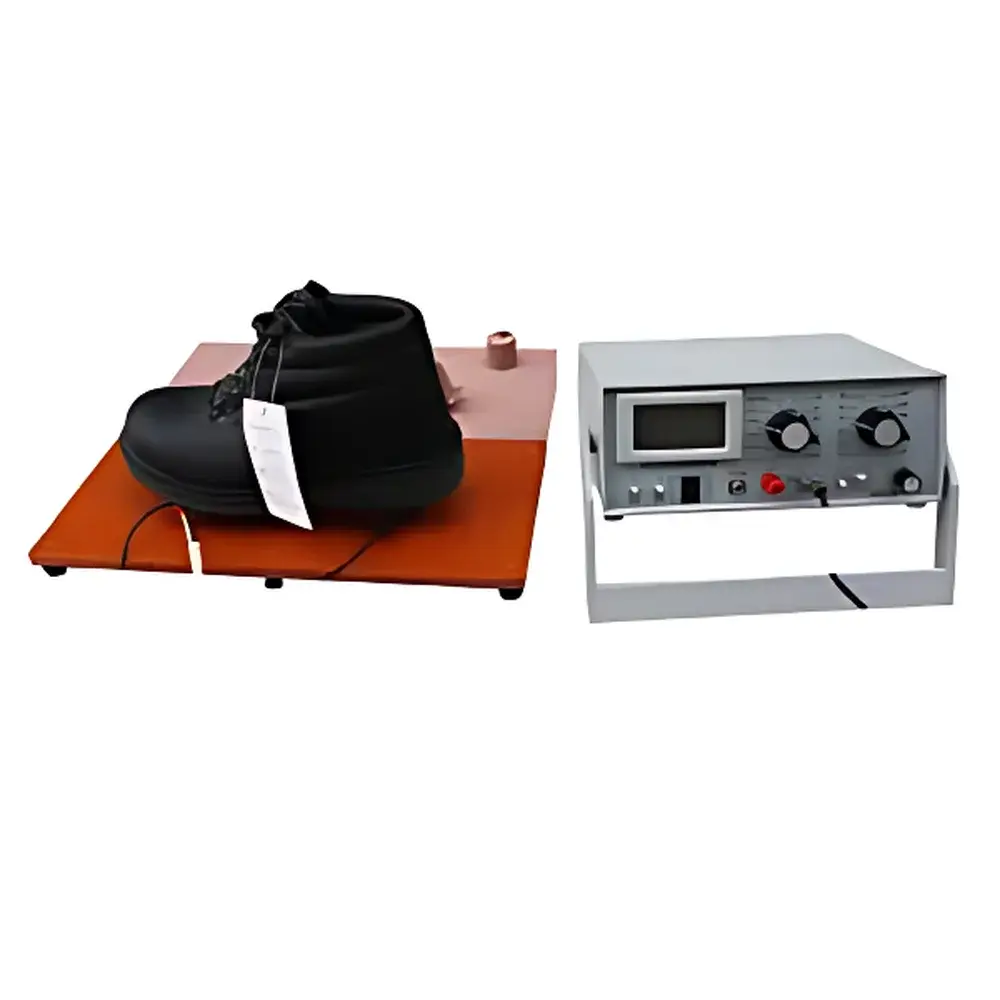
- Dual-electrode system for footwear testing: inner electrode composed of calibrated stainless steel beads (diameter 5 mm, total mass 4 kg) simulating foot contact pressure; outer electrode configured as a grounded conductive plate meeting EN 20345 mechanical interface requirements.
- Dedicated conductive coating probe assembly compliant with ISO 20344 Annex B and GB/T 20991 Clause 6.3: three precisely spaced metallic probes mounted on a non-conductive base—two adjacent probes (45 ± 2 mm separation, electrically linked) and one isolated probe positioned 180 ± 5 mm from their midpoint—to enable three-point resistivity mapping without edge effects.
- Measurement accuracy of ±3% across the full 100 Ω – 1.99 × 10¹³ Ω range, verified under controlled environmental conditions (23 ± 2 °C, 50 ± 5% RH).
- Full traceability via included CNAS-accredited calibration certificate (ISO/IEC 17025 compliant), documenting as-found/as-left values, uncertainty budgets, and metrological chain to national standards.
Sample Compatibility & Compliance
The HY-779 is validated for use with safety footwear complying with EN 20345 (personal protective equipment — safety footwear), ISO 20344 (test methods for safety footwear), ISO 8782 (electrical resistance of footwear), and Chinese national standards GB/T 20991 (test methods for protective footwear) and GB 4385 (anti-static shoes). It also supports evaluation of ESD-safe floorings, workbench surfaces, and conformal coatings per IEC 61340-2-3 and ANSI/ESD STM11.11. All test configurations adhere to defined electrode geometry, applied voltage duration (typically 60 s per measurement), and environmental conditioning protocols required for GLP-compliant reporting. Instrument design incorporates galvanic isolation between measurement circuits and mains supply to prevent ground-loop interference during low-current (<1 pA) high-resistance readings.
Software & Data Management
While the HY-779 operates as a standalone benchtop instrument with analog/digital hybrid readout, it supports manual data logging compatible with laboratory information management systems (LIMS) and electronic quality records. Measurement parameters—including applied voltage, measured resistance, test date/time, operator ID, and sample ID—can be recorded in structured CSV format for audit-ready documentation. For regulated environments operating under FDA 21 CFR Part 11 or EU Annex 11 requirements, users may integrate the instrument into validated workflows using external timestamped loggers with electronic signature capability. All calibration records, including CNAS report metadata (certificate number, issue date, accredited scope), are retained for minimum 5-year archival per ISO 9001:2015 clause 7.1.5.2.
Applications
- Verification of electrical resistance in safety footwear prior to deployment in ATEX Zone 0/1/2 or IECEx-certified hazardous locations.
- Quality control of anti-static soles and insoles during footwear manufacturing and incoming inspection.
- Resistivity profiling of conductive epoxy coatings, carbon-loaded vinyl flooring, and static-dissipative work surfaces in semiconductor fabrication facilities.
- Periodic requalification of ESD control elements in ISO Class 5–8 cleanrooms per ISO 14644-1 and IEST-RP-CC003.3.
- Supporting root-cause analysis of electrostatic-related product defects in medical device packaging lines and battery assembly operations.
FAQ
What standards does the HY-779 explicitly support for footwear testing?
EN 20345, ISO 20344, ISO 8782, GB/T 20991, and GB 4385.
Is the instrument suitable for measuring surface resistivity of flat materials like mats or tiles?
Yes—when used with the optional conductive coating probe assembly per ISO 20344 Annex B and IEC 61340-2-3.
Does the CNAS calibration certificate cover all four test voltage levels?
Yes—the accredited report includes verification at 10 V, 50 V, 100 V, and 500 V across the full resistance range.
Can the HY-779 be integrated into automated test systems?
It features analog output (0–5 V proportional to log₁₀(resistance)) and RS-232 interface for external control and data capture in semi-automated QC stations.
What environmental conditions are required for valid measurements?
Testing must occur in a temperature-controlled environment (23 ± 2 °C) with relative humidity maintained at 50 ± 5% RH, as specified in ISO 20344 Clause 6.2 and GB/T 20991 Section 5.1.