
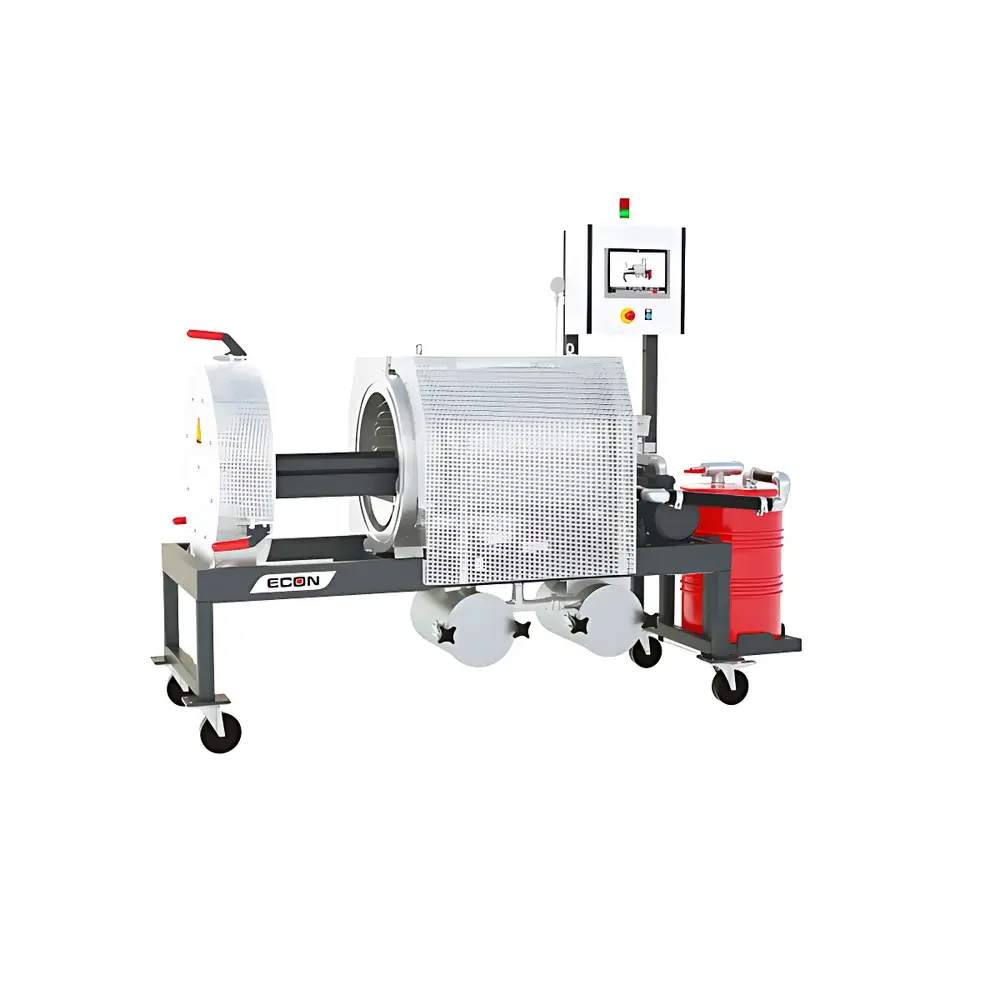
ECON EPO Pyrolysis Furnace
| Brand | ECON |
|---|---|
| Origin | Austria |
| Manufacturer Type | Authorized Distributor |
| Origin Category | Imported |
| Model | EPO |
| Pricing | Available Upon Request |
Overview
The ECON EPO Pyrolysis Furnace is an engineered thermal cleaning system designed specifically for the rubber and plastics industry to remove thermoplastic and multi-polymer residues from extrusion screws, dies, screens, filters, and other high-value process components. It operates on the principle of controlled vacuum pyrolysis—thermal decomposition in an oxygen-limited environment—enabling residue removal without solvents, abrasive media, or mechanical stress. Unlike conventional burn-off ovens or chemical baths, the EPO maintains precise temperature ramping profiles under vacuum conditions, ensuring polymer volatilization occurs selectively and predictably. This process preserves metallurgical integrity, dimensional stability, and surface finish of sensitive tooling—critical for maintaining tight tolerances in precision extrusion systems. The furnace is certified by TÜV for operational safety and environmental compliance, reflecting adherence to EU Machinery Directive 2006/42/EC and EN 61000-6-3 electromagnetic compatibility standards.
Key Features
- Vacuum-assisted pyrolysis cycle with dual-stage temperature control: Stage 1 (soft depolymerization) at 250–450 °C; Stage 2 (complete carbonaceous residue conversion) at 450–550 °C
- Integrated oil-lubricated vacuum pump system—eliminates need for process water, cooling towers, or wastewater treatment infrastructure
- Activated carbon absorption module captures volatile organic compounds (VOCs) and condensable pyrolysis gases, enabling direct atmospheric venting per EU Directive 2010/75/EU (IED)
- Top-loading chamber with ergonomic drip grid and optional stainless-steel cleaning baskets for rapid part loading/unloading
- Programmable thermal profile memory supporting up to 10 user-defined cleaning protocols with timestamped execution logs
- Post-cycle compressed-air purge (≤0.7 MPa) cools and removes fine ash residues without thermal shock or surface oxidation
- Robust insulation architecture minimizing heat loss and ensuring uniform chamber temperature distribution (±3 °C across working volume)
Sample Compatibility & Compliance
The EPO accommodates a broad range of polymer-contaminated components used in compounding, extrusion, and pelletizing lines—including twin-screw elements, breaker plates, screen changers, and filtration housings—up to Ø600 mm × H800 mm. It is validated for residues from polyolefins (PP, PE), engineering thermoplastics (PA6, PC, PBT), elastomers (TPE, TPU), and filled compounds (CaCO₃, glass fiber, flame retardants). All operational parameters comply with ISO 14001 environmental management requirements and support GLP-aligned documentation for regulated manufacturing environments. The absence of aqueous effluent or hazardous waste streams eliminates classification under EU Waste Framework Directive 2008/98/EC for process waste disposal.
Software & Data Management
The embedded PLC-based control interface provides real-time monitoring of chamber pressure (0.1–10 mbar range), temperature gradients (Type K thermocouples, Class 1 accuracy), and cycle progression. Data logging records all critical parameters—including ramp rates, dwell times, vacuum levels, and final purge duration—with automatic export to CSV format via USB port. Audit trail functionality meets FDA 21 CFR Part 11 requirements for electronic records when paired with optional network-enabled firmware (ECON SecureLink™). Remote diagnostics and firmware updates are supported via secure TLS-encrypted connection.
Applications
- Cleaning extruder screws and barrels after grade changeovers in high-mix production facilities
- Regenerating stainless-steel filter packs and sintered metal screens without compromising porosity or fatigue life
- Maintenance of hot-runner systems and die lips where dimensional distortion must be avoided
- Preventive maintenance cycles for recycled-material processing lines subject to carbon buildup
- Validation of cleaning efficacy in GMP-compliant polymer compounding for medical device or food-contact applications
FAQ
Does the EPO require external cooling water or scrubber systems?
No. Its oil-sealed vacuum pump and activated carbon absorption unit eliminate dependency on process water, wet scrubbers, or secondary gas treatment equipment.
Can the EPO handle flame-retarded or halogenated polymer residues safely?
Yes—provided feedstock composition is declared prior to operation. The absorption module is rated for HBr and HCl capture at ≤200 ppm concentration; optional catalytic oxidizer upgrade available for higher halogen loads.
What is the typical cycle time for a full-size extrusion screw?
Standard cleaning cycles range from 4.5 to 7.5 hours depending on residue thickness, polymer type, and selected thermal profile.
Is operator training provided with installation?
Yes. ECON-certified technicians conduct on-site commissioning, SOP development, and hands-on operation training aligned with ISO 9001 internal audit readiness.
How is maintenance scheduled and documented?
The system generates automated service alerts based on vacuum pump oil life (monitored via runtime and temperature history) and carbon filter saturation indicators; all logs integrate into CMMS platforms via Modbus TCP.





