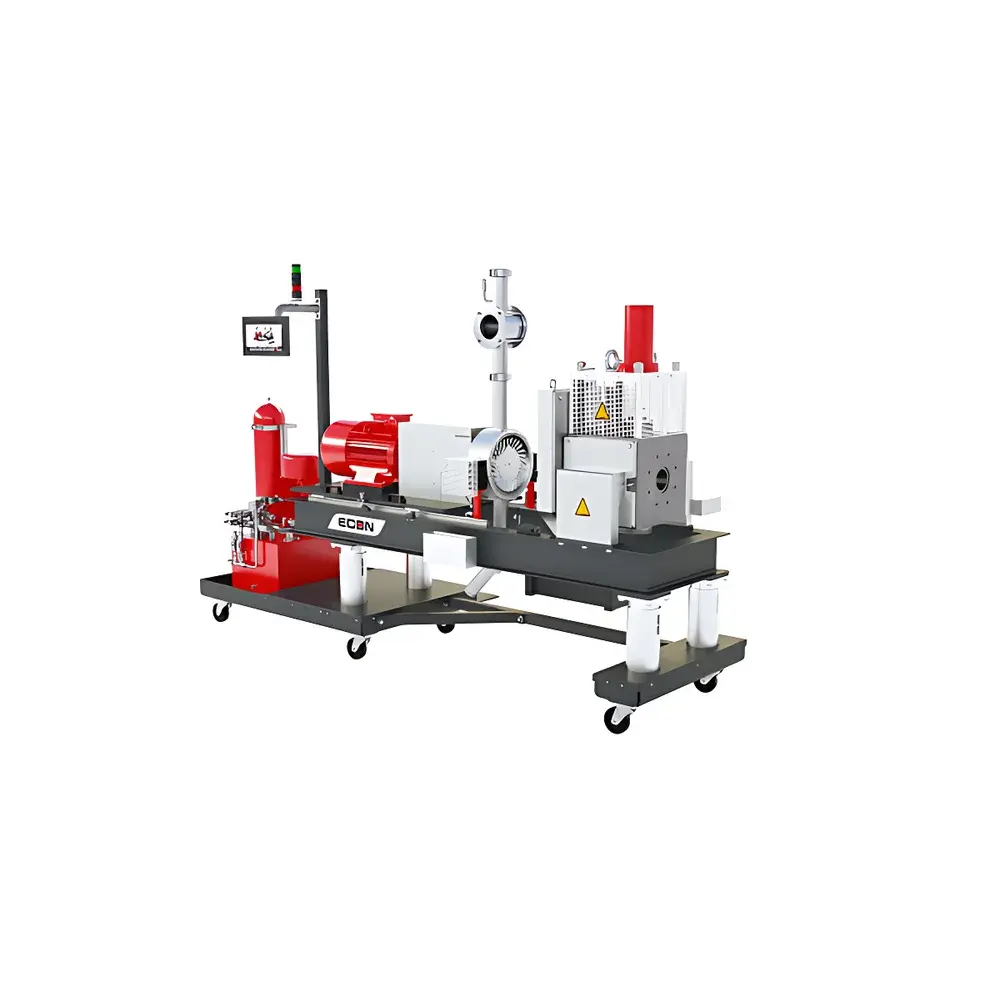
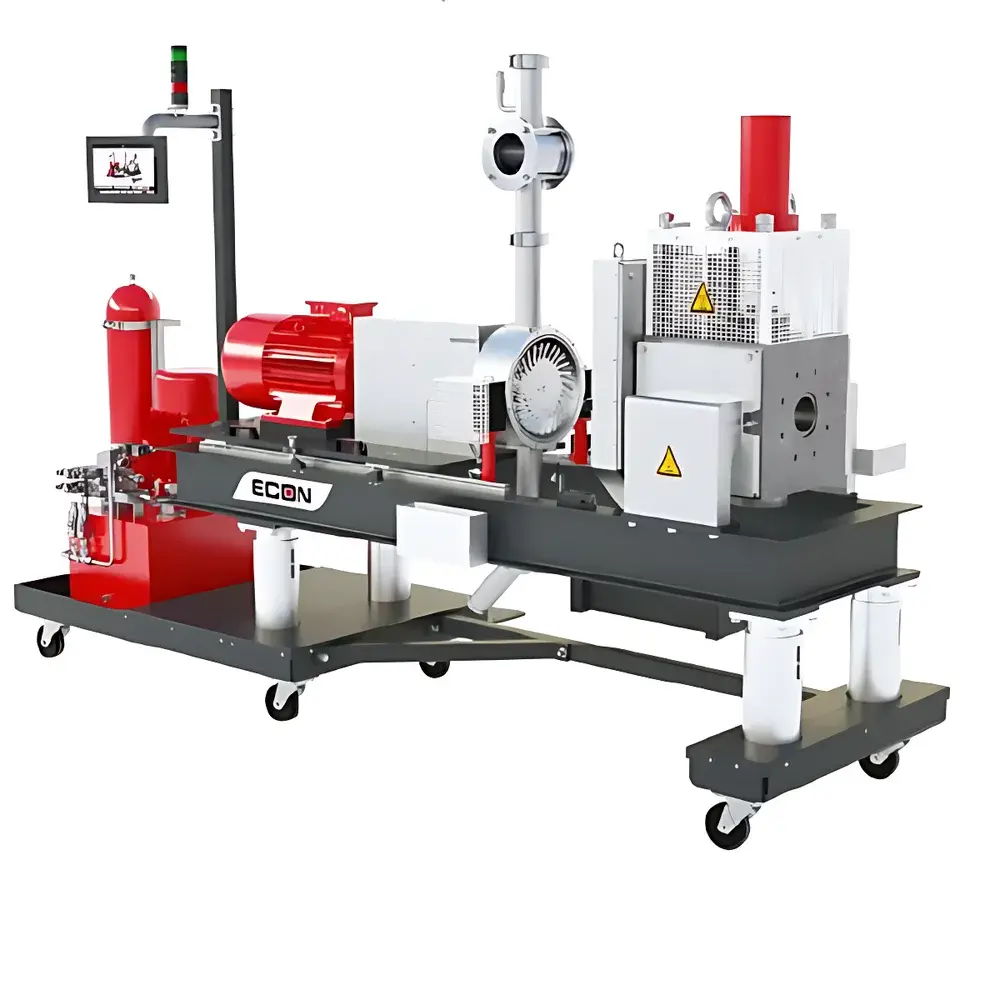
ECON EUP Underwater Pelletizing System
| Brand | ECON |
|---|---|
| Origin | Austria |
| Model | EUP |
| Category | Industrial Underwater Pelletizing System for Thermoplastics |
| Application | Extrusion Line Integration |
| Thermal Insulation Technology | Patented Die Plate Insulation |
| Automation Level | Fully Automatic, One-Touch Start |
| Water Management | Closed-Loop Process Water Filtration |
| Drying System | Integrated EWT Dryer |
| Footprint | Compact Design |
| Compliance | Designed for ISO 9001-compliant production environments |
| Power Efficiency | Optimized for low specific energy consumption per kg of pellets |
Overview
The ECON EUP Underwater Pelletizing System is a fully integrated, high-reliability solution engineered for continuous pellet production from thermoplastic extrudates in industrial compounding and masterbatch lines. Operating on the principle of underwater cutting—where molten polymer strands are cut directly at the die face submerged in temperature-controlled process water—the EUP system ensures immediate solidification, precise sphericity, and minimal thermal stress. Its core innovation lies in the patented thermally insulated die plate assembly: the die is mounted on a heated carrier while actively isolated from the surrounding water chamber via multi-layer insulation, preventing localized cooling at the orifice zone. This eliminates die-face “freeze-off” (or “die lip freezing”), a common cause of strand breakage, inconsistent pellet size, and unplanned line stoppages. Unlike conventional underwater systems requiring water bypass loops or external cooling towers, the EUP operates within a closed-loop water circuit, significantly reducing water consumption and eliminating the need for auxiliary piping infrastructure.
Key Features
- Patented thermally insulated die plate: Prevents orifice chilling, ensuring stable strand formation across wide throughput ranges (from 50 to 2,500 kg/h, depending on polymer viscosity and strand count)
- Fully automatic operation: One-touch start sequence initiates synchronized startup of extruder, cutter drive, water circulation, filtration, and dryer—minimizing operator intervention and training requirements
- Integrated EWT drying system: Utilizes low-turbulence, adjustable airflow with stainless-steel product contact surfaces; designed for rapid moisture removal (<0.05% residual moisture) without particle attrition
- Compact modular footprint: Total system width ≤ 2.4 m; optimized for retrofitting into existing extrusion halls with space constraints
- Closed-loop process water management: Includes automatic backflushing band filter (optional ECON BF-300 series) capable of retaining particles down to 25 µm, maintaining turbidity <5 NTU over 72-hour continuous operation
- Energy-efficient design: Motor drives comply with IE3 efficiency class; heat recovery options available for warm process water recirculation
- Maintenance accessibility: All critical components—including cutter shaft, knife holder, die plate, and dryer rotor—are reachable without disassembly of structural frames or water tanks
Sample Compatibility & Compliance
The EUP system is validated for processing a broad spectrum of thermoplastics, including polyolefins (PP, HDPE, LDPE), engineering resins (PA6, PA66, PBT), thermoplastic elastomers (TPE-S, TPE-O), and filled compounds (CaCO₃-, talc-, glass-fiber–reinforced). It supports pellet diameters from 1.0 mm to 3.5 mm, with length-to-diameter ratios consistently maintained between 1.0 and 1.3. The system meets mechanical safety requirements per EN ISO 13857 and electrical compliance per EN 61800-5-1. Its control architecture supports audit-ready data logging aligned with GLP and GMP principles, including timestamped event records, parameter setpoint history, and user-access logs—fully traceable for FDA 21 CFR Part 11 readiness when paired with ECON’s optional validated software package.
Software & Data Management
The EUP is controlled via ECON’s proprietary HMI-based PLC platform (Siemens S7-1500 series), featuring a 10.1″ capacitive touchscreen interface with multilingual support (English, German, Chinese, Spanish). Process parameters—including cutter speed (100–2,000 rpm), water temperature (45–85 °C), flow rate (8–60 m³/h), and dryer inlet air temperature (60–120 °C)—are programmable in recipe format. All operational data are stored locally on an industrial SSD with ≥12-month retention capacity. Optional OPC UA server integration enables real-time data exchange with MES/SCADA platforms (e.g., Siemens MindSphere, Rockwell FactoryTalk). Firmware updates are performed via encrypted USB stick with SHA-256 signature verification to ensure integrity.
Applications
The EUP system serves demanding applications across compounders, recyclers, and specialty polymer producers. Typical use cases include: high-viscosity filler-loaded PP compounds for automotive interiors; hygroscopic engineering plastics requiring ultra-low moisture pellets prior to injection molding; conductive carbon-black–filled PE for antistatic pipe grades; and biodegradable PLA/PBAT blends where thermal degradation must be minimized during pelletization. Its stability under variable throughput makes it especially suitable for toll compounders handling frequent grade changes and R&D facilities requiring reproducible small-batch pellet production (≥5 kg/batch).
FAQ
What polymers are compatible with the EUP system?
Polyolefins, polyamides, polyesters, thermoplastic elastomers, and filled or reinforced thermoplastics—with melt flow rates ranging from 0.5 to 50 g/10 min (ASTM D1238, 2.16 kg load).
Does the system require external water treatment or cooling towers?
No. The EUP operates as a self-contained closed-loop system; optional integrated band filtration eliminates need for side-stream filtration or blowdown.
Can the EUP be retrofitted onto an existing extrusion line?
Yes—modular design allows mechanical and electrical integration with standard DIN-flanged extruders (typically 90–200 mm screw diameter); ECON provides detailed civil and utility interface specifications pre-order.
Is validation documentation available for regulated industries?
Factory acceptance test (FAT) reports, IQ/OQ templates, and material traceability dossiers (EN 10204 3.1) are provided; full PQ support available upon request.
What maintenance intervals are recommended?
Daily visual inspection; cutter knife replacement every 400–800 operating hours depending on filler content; full die plate cleaning and insulation integrity check every 6 months.