
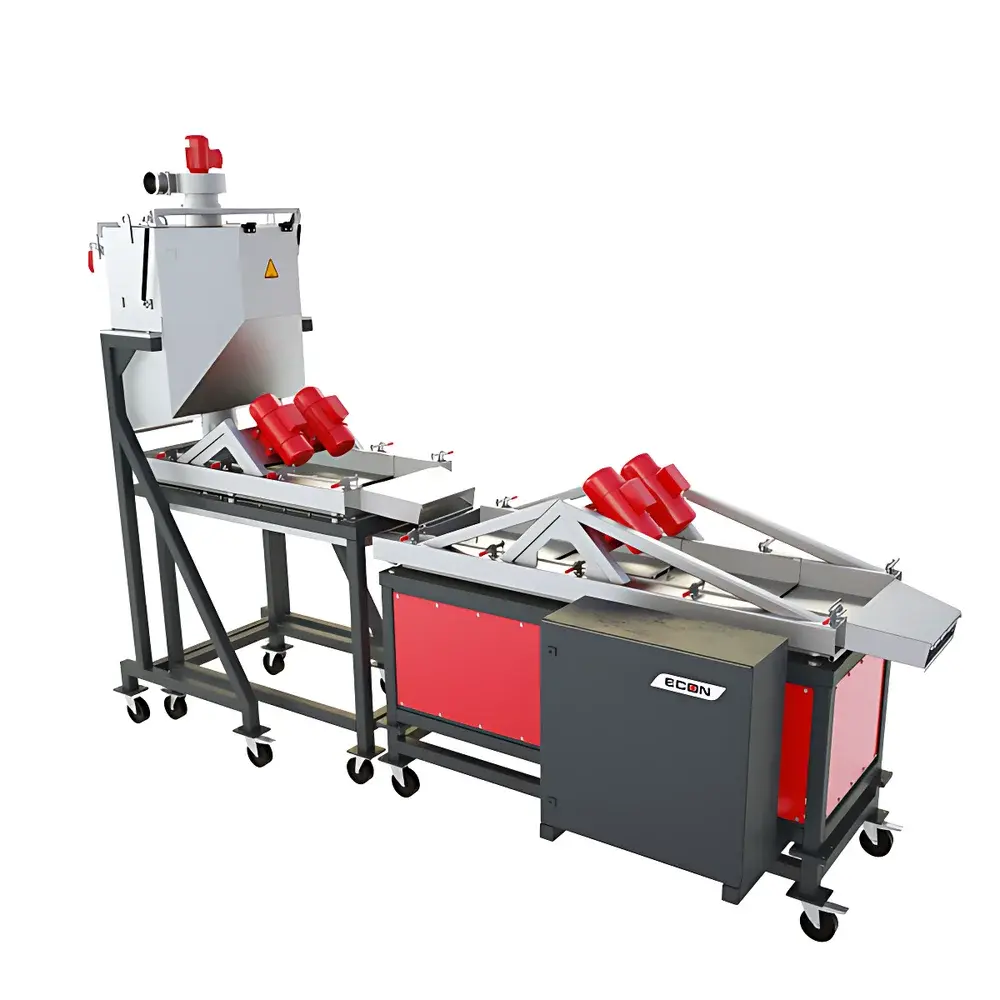
ECON EVS Vibratory Drying System
| Brand | ECON |
|---|---|
| Origin | Austria |
| Model | EVS |
| Equipment Type | Vibratory Dryer for Polymer Granules |
| Throughput Capacity | Up to 3,000 kg/h |
| Residual Moisture | As low as 0.05% w/w |
| Configuration | 2- or 3-stage modular vibratory sieve system |
| Process Water Management | Integrated automatic belt filter with closed-loop recirculation |
| Air Heating & Flow Control | Electronically damped air registers beneath vibrating sieves |
| Compliance Context | Designed for GLP-compliant polymer processing labs and industrial R&D environments |
Overview
The ECON EVS Vibratory Drying System is an engineered solution for the gentle, high-throughput drying of thermoplastic granules—particularly those with high filler loadings such as glass fiber–reinforced or mineral-filled compounds. Unlike conventional centrifugal dryers that rely on mechanical shear and high rotational forces, the EVS employs controlled vibratory motion across precision-tuned sieve decks to separate moisture while minimizing particle attrition, fines generation, and thermal degradation. Its operating principle is based on resonant mechanical vibration coupled with directed, temperature-regulated airflow—enabling efficient surface water removal followed by deep moisture evaporation in a single continuous process. This architecture delivers consistent residual moisture levels down to 0.05% w/w, meeting stringent specifications required for subsequent compounding, extrusion, or injection molding steps where hygroscopic sensitivity directly impacts melt stability and final part integrity.
Key Features
- Modular 2- or 3-stage configuration: Stage 1 performs primary dewatering via vibratory separation; Stage 2 applies warm-air drying using electronically damped air registers positioned beneath the sieve; Stage 3 (optional) adds extended residence time and enhanced airflow control for highly hygroscopic resins such as PA6, PA66, PET, or PC.
- Gentle handling mechanism: Low-acceleration vibratory motion preserves granule morphology and reduces fines formation—critical for filled systems where dust generation compromises downstream filtration, feeding accuracy, and operator exposure limits.
- Closed-loop process water management: Integrated automatic belt filter continuously cleans and recirculates process water, reducing freshwater consumption and wastewater discharge in line with ISO 14001-aligned lab and pilot-scale operations.
- Stainless steel construction (AISI 304/316 options): Fully compliant with FDA-relevant material contact standards for polymer processing equipment used in regulated development workflows.
- Adjustable amplitude and frequency control: Enables optimization for varying granule size distributions (typically 2–8 mm), bulk density (0.4–0.9 g/cm³), and moisture content profiles (1–15% initial).
Sample Compatibility & Compliance
The EVS is validated for use with engineering thermoplastics, biopolymers, and specialty elastomers—including but not limited to polypropylene (PP), polyethylene (PE), acrylonitrile butadiene styrene (ABS), polybutylene terephthalate (PBT), and thermoplastic polyurethane (TPU). It accommodates both virgin and regrind streams with fillers up to 40 wt% (e.g., CaCO₃, talc, mica, short glass fibers). The system meets mechanical safety requirements per EN 60204-1 and carries CE marking for operation within the European Economic Area. While not a GMP-certified production unit, its design supports audit readiness for GLP-compliant polymer characterization laboratories under ISO/IEC 17025 frameworks—particularly when paired with calibrated moisture analyzers (e.g., METTLER TOLEDO HR83) for traceable residual moisture verification.
Software & Data Management
The EVS operates via a programmable logic controller (PLC) interface with local HMI panel for setpoint adjustment (vibration frequency, air temperature, dwell time per stage). No proprietary cloud platform is included; however, analog 4–20 mA outputs and Modbus RTU support enable integration into existing laboratory data acquisition systems (e.g., LabVIEW, DeltaV, or Siemens Desigo CC). All operational parameters—including runtime, temperature logs, and vibration amplitude—are timestamped and stored locally for ≥30 days, satisfying basic electronic record retention expectations under FDA 21 CFR Part 11 Annex 11 guidelines when deployed in qualified environments.
Applications
- R&D-scale drying validation prior to extrusion trials or rheological testing
- Pre-drying of hygroscopic polymer granules for DSC, TGA, or MFR analysis
- Pilot-line conditioning of recycled feedstock requiring low-fines output
- Process development for medical-grade compound formulations subject to ISO 10993 biocompatibility screening
- Moisture-sensitive additive manufacturing filament prep (e.g., PEEK, PEKK)
FAQ
What granule sizes are compatible with the EVS system?
The standard configuration handles granules ranging from 2 mm to 8 mm in nominal diameter. Custom sieve mesh options are available for sub-millimeter or oversized fractions upon request.
Can the EVS be integrated into an automated lab workflow?
Yes—via Modbus RTU or analog I/O, it interfaces with central SCADA or LIMS platforms for batch-level parameter logging and alarm triggering.
Is explosion protection available for solvent-laden granules?
ATEX Zone 22 certification (gas/dust) can be added as a factory option for applications involving flammable solvents or combustible polymer dusts.
Does ECON provide IQ/OQ documentation packages?
Factory-verified Installation Qualification (IQ) and Operational Qualification (OQ) protocols are available as optional deliverables for users operating under pharmaceutical or aerospace quality systems.



