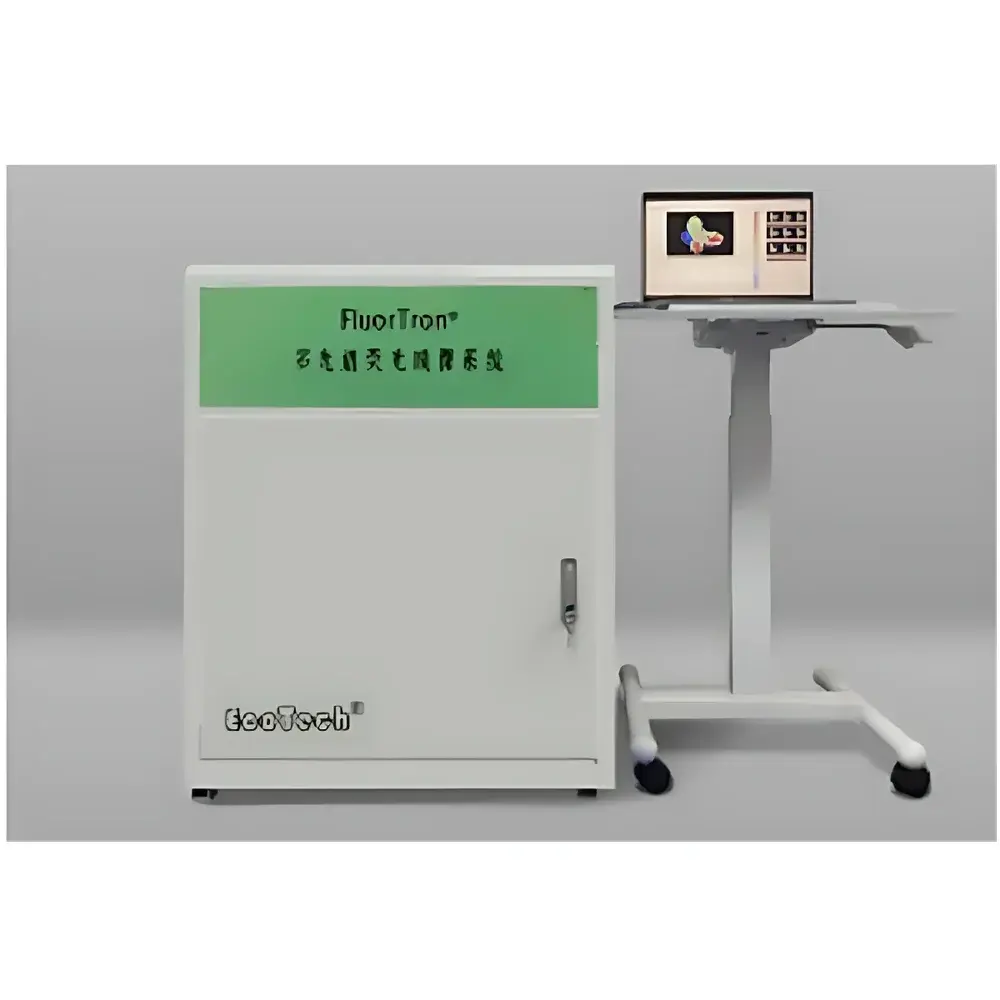
EcoTech FluorTron-MCF Multispectral Chlorophyll Fluorescence Imaging System
| Brand | EcoTech |
|---|---|
| Origin | Beijing, China |
| Model | FluorTron-MCF |
| Imaging Area | 20 cm × 20 cm (customizable) |
| Sensor | 2/3″ CMOS, 5 MP (2448 × 2048), pixel size 3.45 µm × 3.45 µm |
| Frame Rate | up to 60 fps |
| Exposure Time | 15 µs – 9 s |
| Bit Depth | 8-bit and 16-bit selectable |
| Excitation Sources | Dual-channel tunable blue + UV LED array (30 cm × 30 cm panel) |
| Saturating Pulse Intensity | up to 4000 µmol·m⁻²·s⁻¹ |
| Actinic Light Intensity | up to 2000 µmol·m⁻²·s⁻¹ |
| Sample Height Adjustment | 30 cm range, max plant height 30 cm |
| Dark/Light Adaptation Chamber | Integrated, lined with non-fluorescent, non-reflective material |
| Software | Protocol-driven acquisition & analysis platform with ROI tools, pseudocolor mapping (21 LUTs), noise filtering, path profiling, morphometric quantification, and export-ready reporting |
Overview
The EcoTech FluorTron-MCF Multispectral Chlorophyll Fluorescence Imaging System is a laboratory-grade phenotyping instrument engineered for quantitative, non-invasive assessment of plant photosynthetic performance and stress-induced metabolic responses. It operates on the physical principles of modulated chlorophyll fluorescence kinetics and ultraviolet-excited multispectral fluorescence (UV-MCF), enabling simultaneous capture of both primary photochemical activity (via PSII quantum yield parameters) and secondary metabolite dynamics (e.g., flavonoids, alkaloids, phenylpropanoids) under controlled illumination conditions. Unlike conventional single-wavelength fluorometers, the FluorTron-MCF integrates spatially resolved fluorescence imaging with programmable light regimes—including saturating pulses, actinic illumination, and dark adaptation cycles—to generate high-fidelity kinetic datasets compliant with established photobiological standards (e.g., ASTM E2927-13, ISO 10211:2021). Its dual-imaging architecture supports parallel acquisition of chlorophyll fluorescence (Fv/Fm, Y(II), NPQ) and UV-MCF spectral ratios (Fb/Fr, Fg/Ffr, etc.), facilitating correlative analysis between photosynthetic integrity and biochemical defense status across whole leaves or small intact plants.
Key Features
- Simultaneous dual-mode imaging: High-resolution chlorophyll fluorescence (5 MP sensor, 3.45 µm pixels) and UV-MCF multispectral fluorescence (Fg, Fr, Ffr, optional Fb) with independent excitation control
- Programmable LED illumination system: Tunable blue (450 nm) and UV-A (365 nm) sources with precise intensity modulation (0–4000 µmol·m⁻²·s⁻¹ saturating pulse; 0–2000 µmol·m⁻²·s⁻¹ actinic light)
- Integrated dark/light adaptation chamber: Lined with certified non-fluorescent, matte-black material to eliminate stray light and background emission
- Full-protocol automation: Preloaded standardized assays including Kautsky induction kinetics, rapid light curves (RLC), fluorescence quenching analysis (qP, NPQ, Y(NO)), and UV-MCF spectral ratio mapping
- Morphometric quantification suite: Automated extraction of projected area (proxy for relative biomass), convex hull area/perimeter, length, width, circularity, and aspect ratio from grayscale or fluorescence overlays
- Path profiling module: Line-based cross-sectional analysis of fluorescence parameters along user-defined trajectories—critical for visualizing lesion progression, vascular pathogen spread, or herbivory damage gradients
- Flexible ROI handling: Supports rectangular, circular, polygonal, and freehand region selection with erasure, batch processing, and dual analysis modes (average-then-calculate vs. calculate-then-average)
Sample Compatibility & Compliance
The FluorTron-MCF accommodates detached leaves, excised tissue sections, seedlings, rosettes, and small potted plants up to 30 cm in height via motorized Z-axis stage adjustment (30 cm travel range). Its 20 cm × 20 cm standard field-of-view is scalable per application requirements without optical recalibration. All internal surfaces comply with ISO 14644-1 Class 8 cleanroom-compatible material specifications—non-outgassing, low-autofluorescence polymers minimize spectral interference. The system meets electromagnetic compatibility (EMC) requirements per IEC 61326-1 and operates within environmental limits of +5 °C to +50 °C ambient temperature. Data acquisition workflows support audit-trail generation and user-access logging, aligning with GLP documentation practices for regulated phenotyping studies.
Software & Data Management
The native EcoTech FluorImager™ software provides a unified interface for hardware orchestration, experimental protocol definition, real-time preview, and post-acquisition analytics. It implements FDA 21 CFR Part 11–compatible features including electronic signatures, version-controlled protocol libraries, and immutable raw-data archiving (TIFF/CSV/HDF5 formats). Quantitative outputs include >20 chlorophyll fluorescence parameters (Fo, Fm, ∆F/Fm′, Rfd, EXC, Vi) and >12 UV-MCF spectral ratios (Fb/Fr, Fg/Ffr, Fb/Fchl). Pseudocolor visualization employs 21 calibrated lookup tables (LUTs); noise suppression utilizes adaptive median filtering with adjustable kernel size. Export functions deliver publication-ready figures (PNG/SVG), statistical summaries (mean ± SD per ROI), time-series plots, and video exports (MP4, AVI) at full temporal resolution.
Applications
- Early-stage abiotic stress detection (drought, salinity, heavy metals, temperature extremes) via NPQ kinetics and Fv/Fm decline prior to visible symptom onset
- Screening for genetic variation in photosynthetic efficiency and stress resilience in crop breeding programs
- Quantifying pathogen- or herbivore-induced shifts in UV-absorbing secondary metabolites through Fb/Fr and Fg/Ffr ratio dynamics
- Phenotypic validation of CRISPR/Cas9-edited lines affecting chloroplast development or flavonoid biosynthesis pathways
- Time-lapse monitoring of recovery kinetics following stress relief or treatment application
- Correlative analysis linking morphometric traits (e.g., convex hull area reduction) with localized fluorescence quenching patterns
FAQ
What is the minimum detectable change in Fv/Fm that the FluorTron-MCF can resolve?
The system achieves a measurement repeatability of ±0.008 Fv/Fm units under controlled conditions (n = 12 repeated measurements on Arabidopsis thaliana Col-0 wild type), limited primarily by photon shot noise and sensor readout stability.
Can the system be integrated into a growth chamber or greenhouse environment?
Yes—the FluorTron-MCF is designed for ambient-light-suppressed operation; optional light-tight enclosures and vibration-isolation mounts are available for integration into controlled-environment facilities.
Does the software support batch processing of time-series experiments across multiple genotypes?
Yes—FluorImager™ includes a project-based workflow manager that enables parameter-matched batch analysis across hundreds of image stacks, with automated group statistics and ANOVA-ready output tables.
Is third-party software integration possible (e.g., MATLAB, Python, R)?
Raw TIFF sequences and metadata-rich CSV exports are fully compatible with open-source analysis pipelines; Python API documentation and sample Jupyter notebooks are provided upon request.
How is calibration maintained across long-term deployments?
The system includes daily automated dark-current and flat-field correction routines; NIST-traceable reference standards for fluorescence quantum yield are available as optional accessories for inter-laboratory validation.