
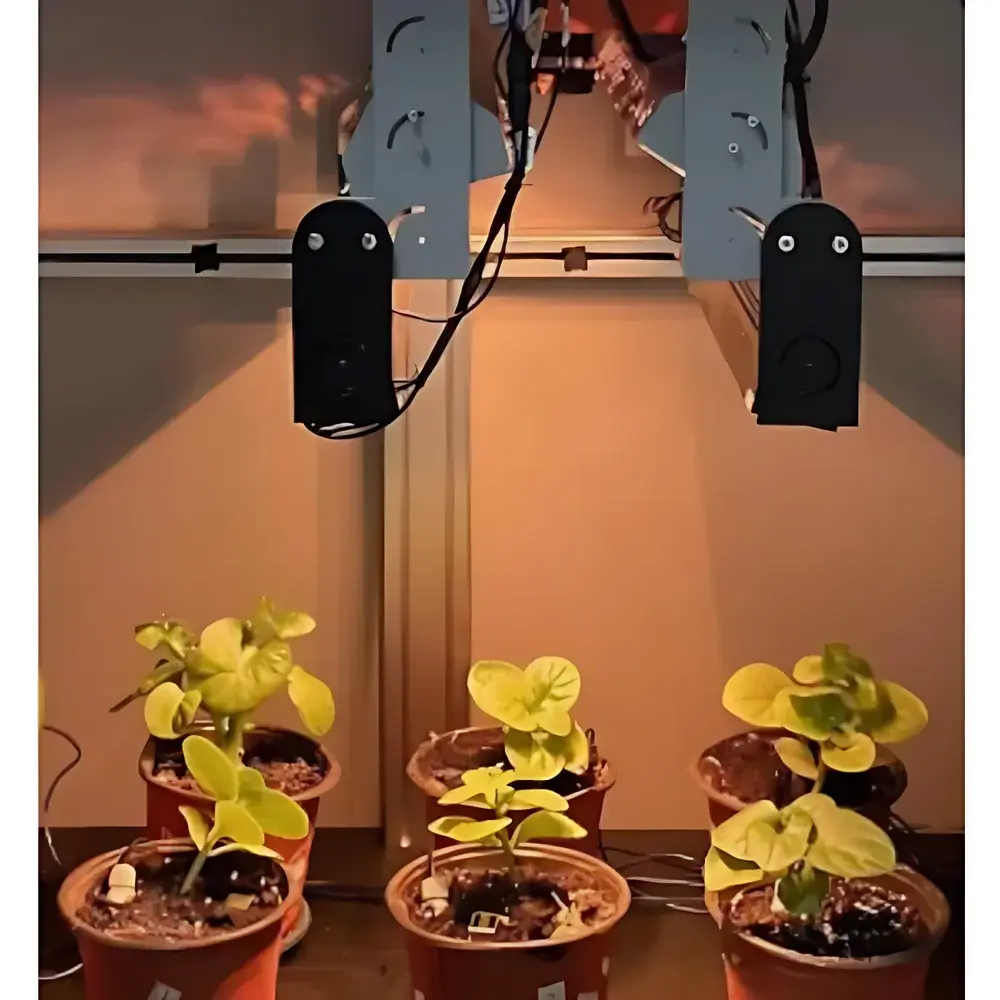
EcoTech Phenotron-iPOT Crop Functional Phenotyping System
| Brand | EcoTech |
|---|---|
| Origin | Beijing, China |
| Manufacturer Type | Authorized Distributor |
| Country of Origin | China |
| Model | Crop Functional Phenotyping |
| Pricing | Available Upon Request |
Overview
The EcoTech Phenotron-iPOT Crop Functional Phenotyping System is a modular, research-grade platform engineered for high-throughput, non-invasive functional phenotyping of plants under controlled or semi-controlled environments. It operates on the principle of integrated SPAC (Soil–Plant–Atmosphere Continuum) monitoring—capturing dynamic physiological responses across environmental gradients through synchronized, multi-sensor acquisition. Unlike static morphological imaging systems, the Phenotron-iPOT quantifies real-time functional traits—including water flux, stomatal conductance proxies, photosynthetic efficiency, and stress-responsive spectral signatures—enabling mechanistic interpretation of genotype-by-environment interactions. Designed for translational plant science, it supports hypothesis-driven experimentation in drought resilience, nutrient use efficiency, abiotic stress physiology, and crop ideotype development.
Key Features
- iPOT Matrix Digital Cultivation Monitoring System (Patent ZL 2020 2 1886467.8): Scalable array of instrumented cultivation units enabling concurrent, individual-plant monitoring of pot weight (±0.1 g), soil volumetric water content (via TDR or capacitance sensors), soil temperature (±0.2 °C), and soil electrical conductivity (EC, 0–5 dS/m).
- SPAC-Integrated Sensor Network: Simultaneous acquisition of atmospheric parameters (air temperature, relative humidity, PAR, barometric pressure; optional CO₂), plant-level metrics (via imaging and fluorescence), and soil biophysical variables—ensuring continuity across compartments.
- SpectrAPP Hyperspectral Imaging Module: Standard-configured push-broom hyperspectral camera (400–1000 nm, 2.5 nm spectral resolution, 1–3 mm spatial resolution at 1 m working distance) with automated calibration and reflectance normalization for robust vegetation index derivation.
- Thermo-RGB Fusion Imaging Unit (optional): Co-registered thermal infrared (7.5–13.5 µm, NETD < 50 mK) and high-resolution RGB (≥12 MP) imaging for combined transpiration estimation, canopy temperature mapping, and structural segmentation.
- Fluorescence Imaging Capability (optional): Configurable modules for chlorophyll fluorescence (Fv/Fm, ΦPSII, NPQ) or multispectral fluorescence (UV-induced, red/far-red emission bands) to assess photochemical efficiency and stress-induced metabolic shifts.
- Automated Irrigation & Nutrient Delivery Control: Closed-loop feedback system integrating soil moisture, weight change, and user-defined thresholds to deliver precise, plant-specific irrigation events with logging of volume, timing, and solute concentration.
Sample Compatibility & Compliance
The system accommodates a broad range of plant species—from Arabidopsis thaliana and rice seedlings to mature maize, wheat, soybean, and perennial horticultural crops—within standardized iPOT vessels (diameters: 10–30 cm). All sensor hardware complies with IEC 61326-1 (EMC for laboratory equipment) and IP54 ingress protection ratings for operational reliability in growth chamber and greenhouse settings. Data acquisition workflows support ALCOA+ principles (Attributable, Legible, Contemporaneous, Original, Accurate, Complete, Consistent, Enduring, Available) and are compatible with GLP/GMP-aligned audit trails when deployed with validated software configurations. While not pre-certified for FDA 21 CFR Part 11, the system architecture permits integration with Part 11-compliant electronic lab notebooks (ELNs) and LIMS via standardized APIs (RESTful JSON, CSV export).
Software & Data Management
PhenoStudio™ software (v4.2+) provides unified control, real-time visualization, and batch processing for all sensor modalities. It includes embedded algorithms for calculating VPD, daily transpiration (PDT), instantaneous root hydraulic conductance (Kr), whole-plant water-use efficiency (WUEplant), canopy conductance (gc), and drought resistance indices (e.g., relative water content decay rate, stomatal delay index). Hyperspectral data undergoes radiometric correction, geometric alignment, and spectral unmixing prior to index computation (NDVI, PRI, MCARI, WI, NDI, AnthoRed, etc.). Morphometric analysis leverages machine learning–enhanced segmentation (U-Net backbone) to extract convex hull area, projected leaf area, canopy width/length ratios, and daily growth increments—all time-stamped and cross-referenced with physiological time series. Raw and processed datasets export in FAIR-compliant formats (NetCDF4, HDF5, MIAME-aligned metadata).
Applications
- Drought tolerance screening across breeding populations using integrated Kr–WUE–thermal response correlations.
- Dynamic assessment of nitrogen assimilation efficiency via NDI–chlorophyll fluorescence co-variation under variable fertilization regimes.
- Quantification of stomatal kinetics under rapid VPD shifts using high-temporal-resolution weight + thermal + PAR fusion.
- Phenological profiling of photoperiod-sensitive crops using time-series canopy greenness, PRI, and photochemical quenching trajectories.
- Root–shoot signaling studies enabled by simultaneous soil EC dynamics, xylem sap tension proxies, and foliar spectral stress markers.
- Validation of crop model parameters (e.g., DSSAT, APSIM) with empirically derived transpiration curves and WUE gradients.
FAQ
What is the maximum number of iPOT units supported in a single Phenotron-iPOT configuration?
Standard configurations support up to 96 iPOT units per controller node; larger deployments utilize distributed Ethernet-based master–slave architecture with centralized PhenoStudio orchestration.
Can SpectrAPP data be exported for third-party spectral analysis (e.g., Python scikit-learn or R chemometrics)?
Yes—hyperspectral cubes are exported as calibrated reflectance matrices (CSV/ENVI format) with full wavelength and spatial metadata, fully compatible with open-source spectral analysis toolchains.
Is remote monitoring and control possible outside the local network?
PhenoStudio supports secure TLS-encrypted remote access via configurable VPN or cloud relay gateway (optional add-on), subject to institutional IT policy compliance.
How is calibration traceability maintained for soil moisture and thermal sensors?
Soil moisture sensors are factory-calibrated against gravimetric standards (ASTM D5550); thermal cameras include NIST-traceable blackbody validation reports. On-site recalibration protocols are documented in the Instrument Qualification Package.
Does the system support integration with existing greenhouse environmental control systems (e.g., Priva, Hoogendoorn)?
Yes—via Modbus TCP or BACnet/IP gateways; bidirectional communication enables synchronized actuation of lighting, HVAC, and fogging systems based on real-time phenotypic feedback signals.




