
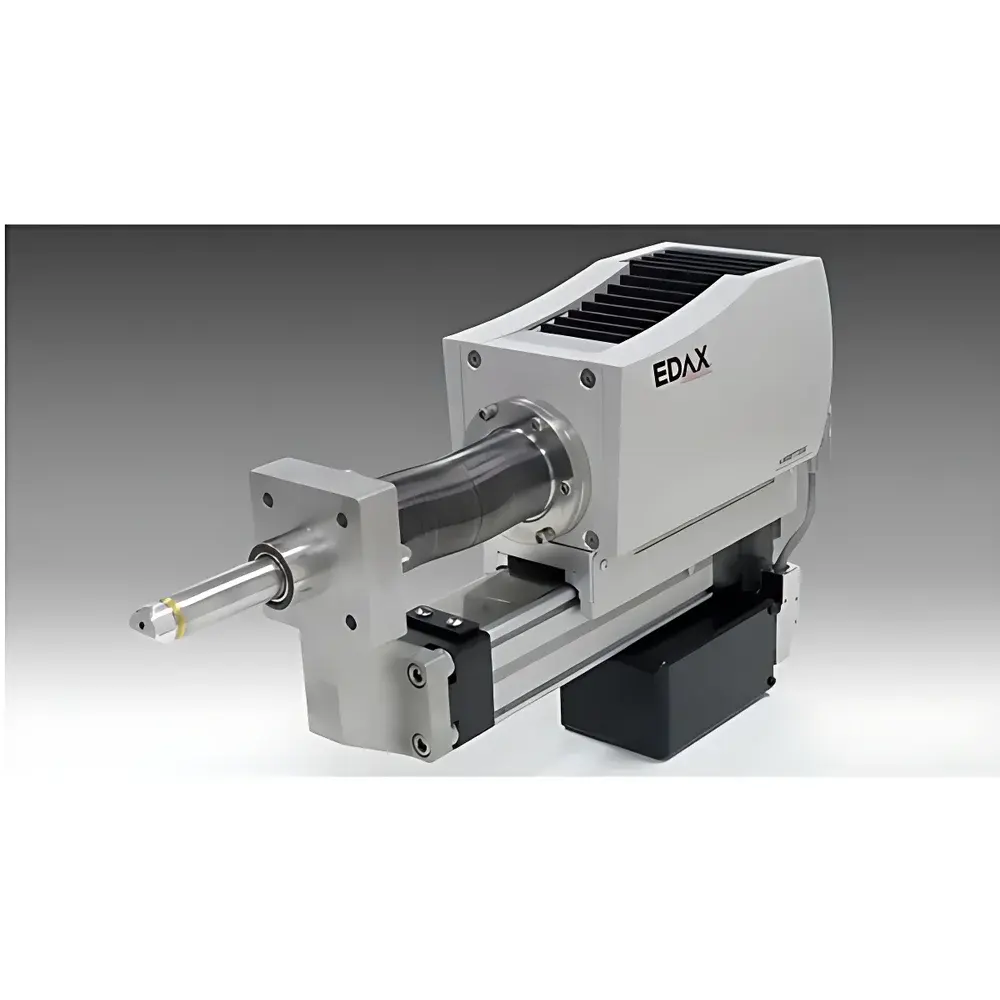
EDAX TEM Octane Silicon Drift Detector (SDD) for Transmission Electron Microscopy
| Brand | EDAX |
|---|---|
| Origin | USA |
| Model | TEM Octane |
| Energy Resolution | 129 eV (Mn Kα) |
| Maximum Count Rate | 250 kcps |
| Detector Active Area | 30–100 mm² |
| Window Options | Ultrathin Window (SUTW) and Windowless Configurations |
| Solid Angle | Up to 1.1 sr |
| Light Element Performance | Optimized for C, N, O, F with >500% sensitivity gain vs. SUTW in windowless mode |
| Resolution Stability | <1 eV up to 100 kcps |
| Pulse Processing Time | Adjustable from 120 ns to 7.65 µs |
| Interface | Gigabit Ethernet |
| Safety | Motorized retraction upon BSE overload detection |
Overview
The EDAX TEM Octane is a high-performance silicon drift detector (SDD) system engineered exclusively for integration with transmission electron microscopes (TEM). Unlike conventional EDS detectors requiring external electronics cabinets, the TEM Octane embeds all signal processing, pulse shaping, and data acquisition circuitry directly within the detector housing—enabling true plug-and-play deployment and eliminating signal degradation associated with long analog cabling. Its architecture leverages advanced SDD technology combined with real-time digital pulse processing to deliver exceptional energy resolution (129 eV at Mn Kα), high count-rate capability (up to 250 kcps), and robust stability across dynamic beam conditions. The system operates on the fundamental principle of X-ray photon energy discrimination: incident characteristic X-rays generated by electron-sample interaction are converted into charge pulses proportional to photon energy; these pulses are processed digitally to construct high-fidelity spectra with minimal dead time and precise peak identification. Designed for nanoscale compositional analysis in thin-section TEM specimens, the TEM Octane supports quantitative elemental mapping, line scans, and point analysis under low-dose and high-resolution imaging conditions.
Key Features
- Fully integrated detector electronics—including preamplifier, shaping amplifier, ADC, and FPGA-based pulse processor—eliminating need for external data acquisition hardware
- Motorized, software-controlled detector retraction triggered automatically upon detection of excessive backscattered electron (BSE) flux, protecting the SDD from damage during high-angle scattering or misaligned beam conditions
- Two optical configurations: ultrathin polymer window (SUTW) for general-purpose use and windowless design for optimal light-element sensitivity (C, N, O, F), delivering >500% improved detection efficiency versus SUTW for low-energy X-rays
- Adjustable pulse processing time (120 ns – 7.65 µs) enables optimization for either high-resolution spectroscopy or high-throughput mapping
- Gigabit Ethernet interface supports remote operation up to 100 meters from the TEM column without performance loss or latency penalty
- On-detector calibration storage ensures consistent spectral response across instruments and sessions; no recalibration required after remote access or detector relocation
- Compact mechanical footprint and modular mounting design ensure compatibility with major TEM platforms including JEOL, Thermo Fisher Scientific (FEI), and Hitachi systems
Sample Compatibility & Compliance
The TEM Octane is optimized for electron-transparent specimens ≤100 nm thick, commonly prepared via FIB lift-out or ultramicrotomy. Its high solid angle (up to 1.1 sr in the Octane T Ultra configuration) maximizes X-ray collection efficiency while maintaining spatial resolution critical for nanoscale phase identification. The detector complies with international standards governing analytical electron microscopy, including ASTM E1508 (Standard Guide for Quantitative Analysis by Energy-Dispersive Spectroscopy) and ISO 16700 (Electron probe microanalysis — Quantitative analysis using wavelength- and energy-dispersive X-ray spectrometry). TEAM™ EDS software includes audit-trail logging and user-access controls aligned with GLP and GMP requirements, supporting FDA 21 CFR Part 11 compliance when deployed in regulated environments such as pharmaceutical development or materials certification labs.
Software & Data Management
TEAM™ EDS software provides a unified platform for acquisition, quantification, and visualization. It features automated element identification, live spectrum overlay, and intelligent background subtraction algorithms based on physical modeling of continuum radiation. Quantitative analysis employs thin-film ZAF correction routines specifically validated for TEM geometry, incorporating absorption corrections derived from specimen thickness maps obtained via electron energy-loss spectroscopy (EELS) or convergent-beam electron diffraction (CBED). All spectral data are stored in vendor-neutral HDF5 format, enabling interoperability with third-party tools such as HyperSpy and DigitalMicrograph. The software maintains full traceability: every spectrum is tagged with metadata including beam voltage, probe current, dwell time, stage position, and detector operating parameters. Remote diagnostics and firmware updates are supported via secure SSH tunneling, and detector health metrics—including resolution drift, count-rate saturation history, and vacuum integrity logs—are accessible through the TEAM™ web dashboard.
Applications
- Phase identification and stoichiometry determination in intermetallic compounds, battery cathode materials, and catalyst nanoparticles
- Light-element distribution mapping in oxides, nitrides, and carbon-based nanomaterials (e.g., graphene heterostructures, SiOx/SiC interfaces)
- In-situ compositional evolution studies during heating, cooling, or electrical biasing experiments in specialized TEM holders
- Correlative analysis combining EDS with EELS for comprehensive chemical and electronic structure characterization
- Failure analysis of semiconductor devices, including dopant profiling at p-n junctions and contamination tracing in gate dielectrics
- Geological sample analysis for trace-element partitioning in mineral grains at sub-10 nm scale
FAQ
What distinguishes the TEM Octane from conventional EDS detectors for TEM?
The TEM Octane integrates all electronics inside the detector head, removes external cabling constraints, and introduces motorized safety retraction—features not found in legacy TEM-EDS systems.
Is windowless operation compatible with standard TEM vacuum conditions?
Yes—the windowless configuration requires ultra-high vacuum (UHV) column conditions (<1×10⁻⁷ Torr), which are standard on modern field-emission TEMs equipped with ion pumps and cryo-shrouds.
How does TEAM™ software handle spectral artifacts from overlapping peaks (e.g., S Kα and Pb Mα)?
It applies iterative least-squares deconvolution using physically constrained peak shape models and known transition energies from the IUPAC X-ray database.
Can the TEM Octane be retrofitted onto older TEM models?
Compatibility depends on available port geometry, vacuum feedthrough size, and control interface availability; EDAX provides mechanical integration kits and custom flange adapters for JEOL 2000/2100, FEI Tecnai, and Hitachi HF series instruments.
Does the system support automated drift correction during long-duration mapping?
Yes—TEAM™ synchronizes stage position feedback with real-time image correlation to compensate for thermal and mechanical drift during acquisitions exceeding 30 minutes.



