
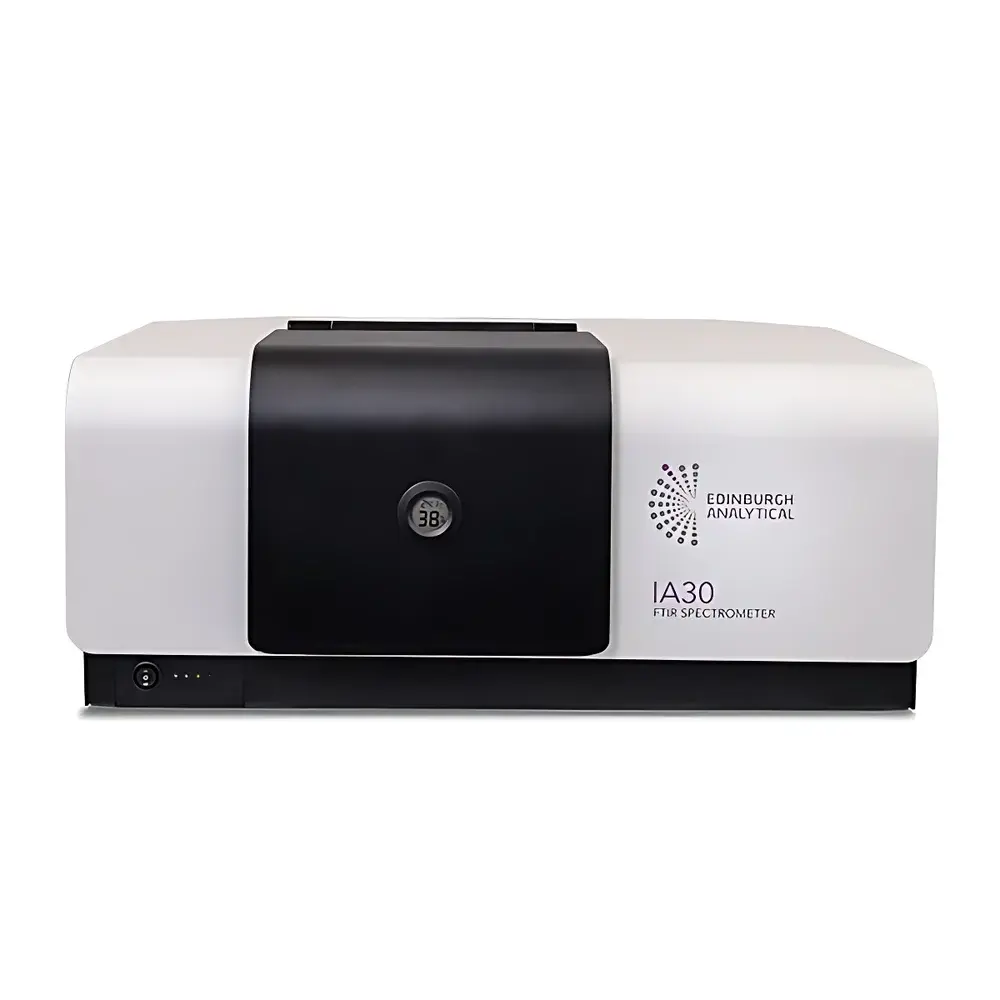
Edinburgh Analytical IA30 Compact High-Precision Fourier Transform Infrared (FTIR) Spectrometer
| Brand | Edinburgh Analytical |
|---|---|
| Origin | Shanghai, China |
| Manufacturer Type | Authorized Distributor |
| Instrument Type | Laboratory Benchtop FTIR Spectrometer |
| Wavenumber Range | 350–8000 cm⁻¹ |
| Spectral Resolution | 0.5 cm⁻¹ |
| Signal-to-Noise Ratio (SNR) | 20,000:1 (at 4 cm⁻¹, 1 min scan, MCT detector) |
| Wavenumber Accuracy | ±0.05 cm⁻¹ |
| Optical Design | Michelson Interferometer with KBr Beamsplitter and Dynamically Aligned Mirror Drive |
Overview
The Edinburgh Analytical IA30 is a compact, benchtop Fourier Transform Infrared (FTIR) spectrometer engineered for high-fidelity molecular identification and quantitative analysis in regulated and research laboratory environments. Based on the Michelson interferometer architecture, the IA30 acquires interferograms via a dynamically aligned mirror drive system, ensuring long-term optical path stability and minimal phase error. Its spectral acquisition adheres to the principles of time-domain modulation and Fourier transformation, delivering consistent, reproducible spectra across the full mid-infrared range (350–8000 cm⁻¹). Designed for routine use without compromising metrological integrity, the IA30 integrates a high-stability KBr beamsplitter, a thermoelectrically cooled mercury cadmium telluride (MCT) detector, and an internal He–Ne laser reference for real-time interferogram sampling synchronization. The instrument meets core performance benchmarks required for compliance-driven workflows—including ASTM E1421, ISO 18387, and USP —and supports traceable calibration protocols essential for GLP and GMP-aligned laboratories.
Key Features
- Compact benchtop footprint (≤380 × 320 × 220 mm) optimized for space-constrained labs while maintaining full spectral capability
- 0.5 cm⁻¹ unapodized resolution, enabling clear separation of closely spaced vibrational bands in complex matrices (e.g., polymer blends or active pharmaceutical ingredients)
- Signal-to-noise ratio of 20,000:1 (measured at 4 cm⁻¹ resolution, 60-second co-added scan, MCT detector), supporting low-concentration detection and high-precision baseline correction
- Wavenumber accuracy of ±0.05 cm⁻¹, verified against NIST-traceable polystyrene film standards, ensuring inter-laboratory comparability
- Hermetically sealed, desiccant-free optical compartment with passive humidity control—eliminates routine purge requirements and reduces operational downtime
- Motorized, software-controlled sample compartment with standardized 13 mm diameter aperture and optional ATR, transmission, and reflectance accessories
Sample Compatibility & Compliance
The IA30 accommodates solid, liquid, and thin-film samples via interchangeable sampling modules—including single-bounce diamond ATR, KBr pellet press compatibility, and variable-pathlength transmission cells (0.1–100 µm). It supports ASTM D5236 (polymer characterization), ISO 17270 (pharmaceutical excipient ID), and IEC 62471 (optical material screening). All spectral acquisitions include embedded metadata (date/time, operator ID, instrument serial, calibration status) compliant with 21 CFR Part 11 audit trail requirements when used with validated Miracle software configurations. Routine qualification includes Performance Qualification (PQ) templates aligned with IQ/OQ documentation frameworks.
Software & Data Management
The IA30 operates exclusively with Miracle—a modular, Windows-based spectroscopy platform developed for analytical traceability and method portability. Miracle provides real-time spectral preview, automated atmospheric compensation (H₂O/CO₂ subtraction), peak integration with customizable baselines, and library search against commercial (Sadtler, KnowItAll) and user-defined spectral databases. Its scriptable processing engine supports Python-based macro development for batch normalization, derivative calculation, or multivariate preprocessing (PCA, PLS). Raw interferogram (.ifg) and processed spectrum (.spa, .jdx) files are stored with SHA-256 checksums; all user actions—including parameter edits and report generation—are logged with timestamps and operator credentials in immutable audit trails.
Applications
- Pharmaceutical QC: Identification of polymorphic forms, excipient compatibility studies, and raw material verification per ICH Q5A and USP guidelines
- Polymer science: Quantitative analysis of copolymer composition, oxidation index determination (carbonyl band at ~1710 cm⁻¹), and degradation profiling
- Semiconductor materials: Detection of surface contaminants (silicon hydrides, hydrocarbons) and thin-film thickness estimation via interference fringe analysis
- Academic research: Reaction monitoring via time-resolved FTIR, hydrogen-bonding dynamics in solvated systems, and microplastic fingerprinting in environmental samples
- Forensics & regulatory testing: Non-destructive analysis of paint chips, adhesives, and counterfeit goods using spectral library matching and statistical classification
FAQ
Is the IA30 compatible with third-party ATR accessories?
Yes—the sample compartment accepts standard 13 mm diameter ATR crystals from major vendors (e.g., Harrick, Pike Technologies) via threaded mounting interface.
Does the instrument require continuous dry air or nitrogen purge?
No—the optical bench features passive humidity management; purge is optional only for ultra-high-resolution (<0.25 cm⁻¹) or ultra-low-wavenumber (<400 cm⁻¹) applications.
Can Miracle software be validated for 21 CFR Part 11 compliance?
Yes—validated installation packages, electronic signature workflows, and audit trail export modules are available under Edinburgh Analytical’s GxP Support Program.
What calibration standards are supplied with the IA30?
NIST-traceable polystyrene film (for wavenumber accuracy), polyethylene film (for resolution verification), and water vapor reference spectrum (for atmospheric correction validation).





