
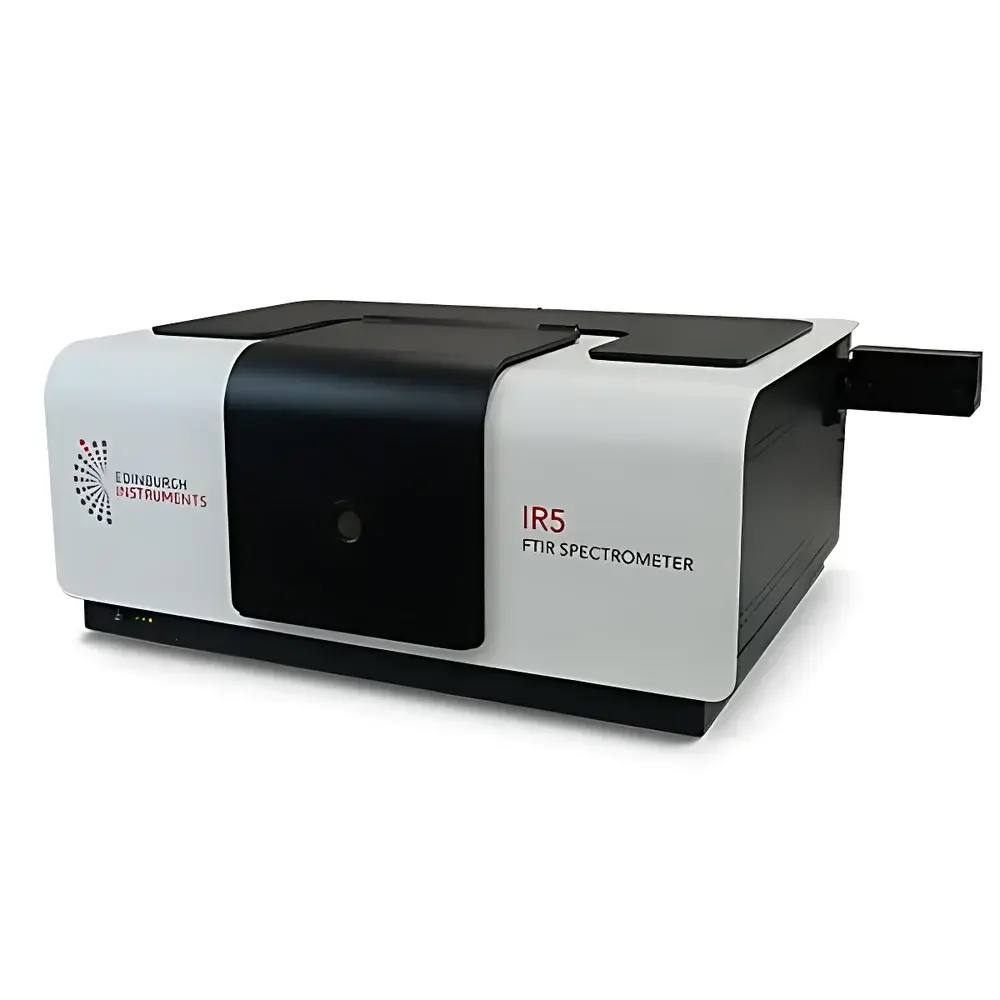
Edinburgh Instruments IR5 Fourier Transform Infrared (FTIR) Spectrometer
| Brand | Edinburgh Instruments |
|---|---|
| Origin | United Kingdom |
| Manufacturer Type | Original Equipment Manufacturer (OEM) |
| Product Category | Imported Instrument |
| Model | IR5 |
| Instrument Type | Benchtop Laboratory FTIR Spectrometer |
| Wavenumber Range | 350–8000 cm⁻¹ |
| Spectral Resolution | 0.01 cm⁻¹ |
| Signal-to-Noise Ratio (S/N) | 20,000:1 (at 4 cm⁻¹, 1 min scan, MCT detector) |
| Wavenumber Accuracy | ±0.5 cm⁻¹ |
| Detector Options | Standard DTGS |
| Software Platform | Miracle™ v5.x |
| Optional Module | FT-PL (Fourier Transform Photoluminescence) with Integrated Laser Excitation Source |
Overview
The Edinburgh Instruments IR5 is a high-performance, research-grade Fourier Transform Infrared (FTIR) spectrometer engineered for precision molecular vibrational spectroscopy in academic, pharmaceutical, materials science, and industrial quality control laboratories. Built upon over five decades of optical design heritage and interferometer engineering expertise, the IR5 implements a permanently aligned, dynamically balanced Michelson interferometer with laser-referenced path-length control—ensuring long-term spectral stability, minimal phase error, and intrinsic wavenumber accuracy compliant with ISO 17025 traceability requirements. Its core optical architecture supports rapid-scanning acquisition (up to 10 spectra/sec at 4 cm⁻¹), real-time phase correction, and robust thermal management—critical for reproducible quantitative analysis across extended measurement sessions. Unlike modular or retrofit systems, the IR5 integrates source, interferometer, sample compartment, and detector into a single monolithic optical bench, minimizing alignment drift and environmental sensitivity.
Key Features
- Ultra-high spectral resolution: Adjustable down to 0.01 cm⁻¹—enabling fine-structure analysis of rotational-vibrational bands in gases, isotopic shifts in polymers, and hydrogen-bonding signatures in biomolecules.
- Exceptional signal fidelity: 20,000:1 S/N ratio (measured per ASTM E1421–22 under standard conditions using a mercury-cadmium-telluride detector and 64 co-added scans at 4 cm⁻¹ resolution) ensures reliable detection of low-abundance functional groups and thin-film interfacial species.
- Dual-detector capability: Optional concurrent installation of DTGS (room-temperature) and liquid-nitrogen-cooled MCT detectors permits seamless switching between broad dynamic range and high-sensitivity mid-IR measurements without realignment.
- Integrated humidity control: Hermetically sealed, continuously purged optical path eliminates desiccant replacement and prevents hygroscopic degradation of KBr beamsplitters or detector window coatings—reducing scheduled maintenance to zero under normal lab conditions.
- Modular FT-PL expansion: The IR5 platform supports factory-installed FT-PL functionality, including fiber-coupled tunable diode lasers (785 nm, 830 nm, or custom wavelengths), time-resolved delay stages, and synchronized lock-in detection for correlated absorption/emission mapping.
Sample Compatibility & Compliance
The IR5 accommodates standard FTIR sampling techniques—including transmission (KBr pellets, solution cells), attenuated total reflectance (ATR) with diamond, ZnSe, or Ge crystals, specular reflection, diffuse reflectance (DRIFTS), and gas-phase flow cells (up to 10 atm). All optical interfaces comply with ISO 18323:2022 (FTIR performance verification) and support GLP/GMP documentation workflows via audit-trail-enabled software logging. Data files adhere to JCAMP-DX v6.00 format, ensuring interoperability with third-party chemometric platforms (e.g., Unscrambler®, MATLAB® PLS Toolbox). The system meets electromagnetic compatibility (EMC) requirements per EN 61326-1:2013 and carries CE marking for laboratory use within the European Economic Area.
Software & Data Management
Miracle™ software—developed exclusively for the IR5—provides a validated, role-based interface compliant with FDA 21 CFR Part 11 (electronic records/signatures) when deployed with optional server authentication and electronic signature modules. It features real-time spectral preview, automated atmospheric compensation (H₂O/CO₂ subtraction), baseline correction algorithms (Asymmetric Least Squares, Rubberband), peak integration with uncertainty propagation, and multivariate analysis (PCA, PLS-R) directly embedded in the acquisition environment. Raw interferograms and processed spectra are stored in encrypted SQLite databases with immutable metadata (operator ID, instrument serial, calibration timestamp, environmental logs), supporting full traceability for regulatory submissions.
Applications
The IR5 delivers quantitative and qualitative analysis across diverse domains: polymer crystallinity and degradation kinetics (ASTM D3418); active pharmaceutical ingredient (API) polymorph identification (ICH Q5A); semiconductor surface oxide thickness via Si–O stretching band deconvolution; microplastic identification in environmental samples (ISO 24007:2023); and in situ monitoring of catalytic reactions in high-pressure ATR cells. Its FT-PL configuration enables time-resolved photoluminescence decay profiling of quantum dots, perovskite thin films, and rare-earth-doped phosphors—correlating electronic transitions with vibrational modes at sub-millisecond resolution.
FAQ
Is the IR5 compatible with existing FTIR accessories from other manufacturers?
Yes—standard 25 mm optical mounts, 12.5 mm sample ports, and industry-standard electrical interfaces (USB 3.2 Gen 2, Ethernet TCP/IP) ensure mechanical and protocol-level compatibility with most commercial ATR stages, gas cells, and temperature-controlled stages.
Does the Miracle™ software support automated method validation per USP & EP guidelines?
Yes—Miracle™ includes preconfigured validation templates for USP , EP 2.2.24, and ISO 17025 method verification, including linearity, LOD/LOQ, repeatability, and intermediate precision reporting.
Can the IR5 be operated in a regulated GMP environment?
Yes—the system supports 21 CFR Part 11-compliant user access tiers, electronic audit trails, and data integrity controls when configured with network authentication and encrypted database archiving.
What is the typical calibration interval for wavenumber accuracy?
Under stable ambient conditions (±1°C/hour), the internal HeNe laser reference maintains wavenumber accuracy within ±0.5 cm⁻¹ for ≥12 months; annual verification against NIST-traceable polystyrene film is recommended.
Is remote diagnostics and firmware updates supported?
Yes—secure TLS 1.3-enabled remote access allows authorized service engineers to perform health checks, log analysis, and over-the-air firmware updates without physical intervention.




