
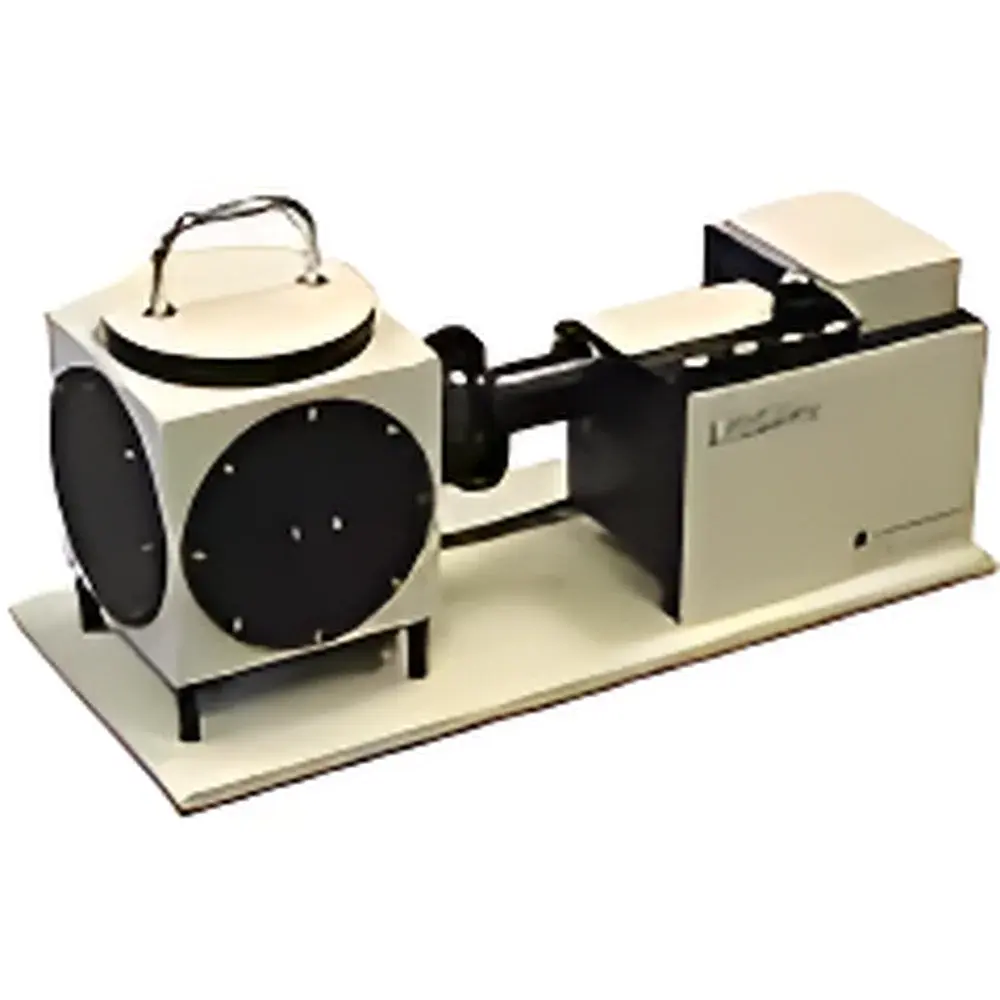
Edinburgh Instruments LifeSpec II Ultrafast Fluorescence Lifetime Spectrometer
| Origin | UK |
|---|---|
| Manufacturer Type | Authorized Distributor |
| Origin Category | Imported |
| Model | LifeSpec II Series |
| Price | Upon Request |
Overview
The Edinburgh Instruments LifeSpec II Ultrafast Fluorescence Lifetime Spectrometer is a high-performance, modular time-resolved fluorescence system engineered for precision measurement of ultra-short excited-state lifetimes—from picosecond to microsecond timescales. Built upon the principle of Time-Correlated Single Photon Counting (TCSPC), the LifeSpec II employs a rigorously optimized optical architecture to eliminate temporal pulse broadening and chromatic dispersion—critical limitations in conventional fluorescence lifetime setups. Its orthogonal excitation–emission geometry, combined with a dual-monochromator design delivering zero time dispersion, ensures sub-picosecond timing fidelity and exceptional signal integrity across UV–Vis–NIR spectral ranges (185–1700 nm). The system is purpose-built for fundamental photophysics research, materials characterization, and advanced molecular probe development where quantitative decay kinetics and multi-exponential lifetime resolution are essential.
Key Features
- TCSPC-based detection with <10 ps instrument response function (IRF) capability, scalable to sub-5 ps with optimized laser/detector pairing
- Orthogonal excitation–emission optical layout minimizing scattered light interference and enabling high dynamic range (>10⁵)
- Dual monochromator configuration providing zero time dispersion and tunable spectral bandwidth (1–40 nm)
- Computer-controlled variable optical attenuator for precise photon flux management without mechanical re-alignment
- Modular excitation source compatibility: picosecond diode lasers (265–1060 nm), ps-LEDs, solid-state ps lasers, and OEM-integrated femtosecond laser systems (e.g., Ti:Sapphire, Yb-fiber)
- Multi-channel detector options: blue-sensitive PMT (185–650 nm), red-sensitive PMT (185–870 nm), MCP-PMT (200–850 nm), and NIR-enhanced PMT (300–1400/1700 nm)
- Large-access sample chamber accommodating cryostats, temperature-controlled stages (−196 °C to +200 °C), motorized polarizers, and fiber-coupled accessories
- Compact, vibration-damped benchtop chassis designed for integration into shared laboratory environments
Sample Compatibility & Compliance
The LifeSpec II supports liquid, solid, thin-film, and powder samples in standard cuvettes, quartz capillaries, or custom holders. Its flexible excitation/detection pathways accommodate both front-face and right-angle geometries per ISO 17025-compliant fluorescence measurement protocols. System calibration adheres to NIST-traceable standards for wavelength accuracy (±0.1 nm) and timing linearity (<0.1% deviation over full decay window). Data acquisition and processing workflows comply with GLP/GMP requirements through optional audit-trail-enabled software modules meeting FDA 21 CFR Part 11 criteria. All optical components meet RoHS directives; laser safety interlocks conform to IEC 60825-1 Class 1/Class 3B configurations depending on source selection.
Software & Data Management
Control and analysis are executed via Edinburgh Instruments’ proprietary Fluoracle® software—a validated, Windows-based platform supporting real-time TCSPC histogramming, global multi-exponential decay fitting (up to 5 components), anisotropy deconvolution, spectral moment analysis, and kinetic modeling (e.g., Förster resonance energy transfer, FRET). Raw photon arrival timestamps are stored in binary .ptu format (PicoQuant standard), ensuring long-term data integrity and third-party interoperability (e.g., with MATLAB, Python-based Lifetimes.jl, or commercial kinetics packages). Automated batch processing, script-driven experiment sequencing, and metadata-rich project archiving enable reproducible workflows across multi-user laboratories. Optional cloud-sync and LIMS integration modules support centralized instrument resource management.
Applications
- Ultrafast photodynamics of organic semiconductors, perovskites, and quantum dots
- Protein folding/unfolding kinetics and ligand-binding dynamics via tryptophan lifetime mapping
- Time-resolved emission spectra (TRES) of fluorescent dyes, lanthanide complexes, and phosphorescent emitters
- Temperature-dependent lifetime thermometry using ratiometric or decay-time referencing
- Fluorescence anisotropy decay for rotational diffusion studies in viscous media or macromolecular assemblies
- Validation of computational excited-state models (TD-DFT, CASPT2) against experimental decay profiles
- Quality control of luminescent nanomaterials in LED phosphor development and bioimaging probe synthesis
FAQ
What is the minimum measurable fluorescence lifetime with the LifeSpec II?
The system achieves effective lifetime resolution down to ~5 ps, limited primarily by the IRF of the selected excitation source and detector combination—not by the spectrometer’s intrinsic architecture.
Can the LifeSpec II be upgraded to support femtosecond excitation sources?
Yes—via OEM-compatible optical interfaces and synchronization electronics, the platform integrates commercial fs-laser systems (e.g., Coherent Chameleon, Light Conversion Pharos) with programmable delay lines for pump–probe extensions.
Is spectral calibration traceable to national standards?
Wavelength calibration uses Hg/Ne/Ar lamp references with NIST-traceable line positions; timing calibration employs precision electronic delay generators verified against atomic clock references.
Does Fluoracle® support automated temperature-dependent lifetime mapping?
Yes—when paired with a cryogenic or Peltier-controlled sample stage, Fluoracle® executes scheduled thermal ramps with synchronized decay acquisition, spectral binning, and Arrhenius parameter extraction.
How is data security handled for regulated environments?
Optional Fluoracle® GxP Edition provides electronic signatures, role-based access control, full audit trails, and 21 CFR Part 11-compliant electronic records retention.
Related Products




