
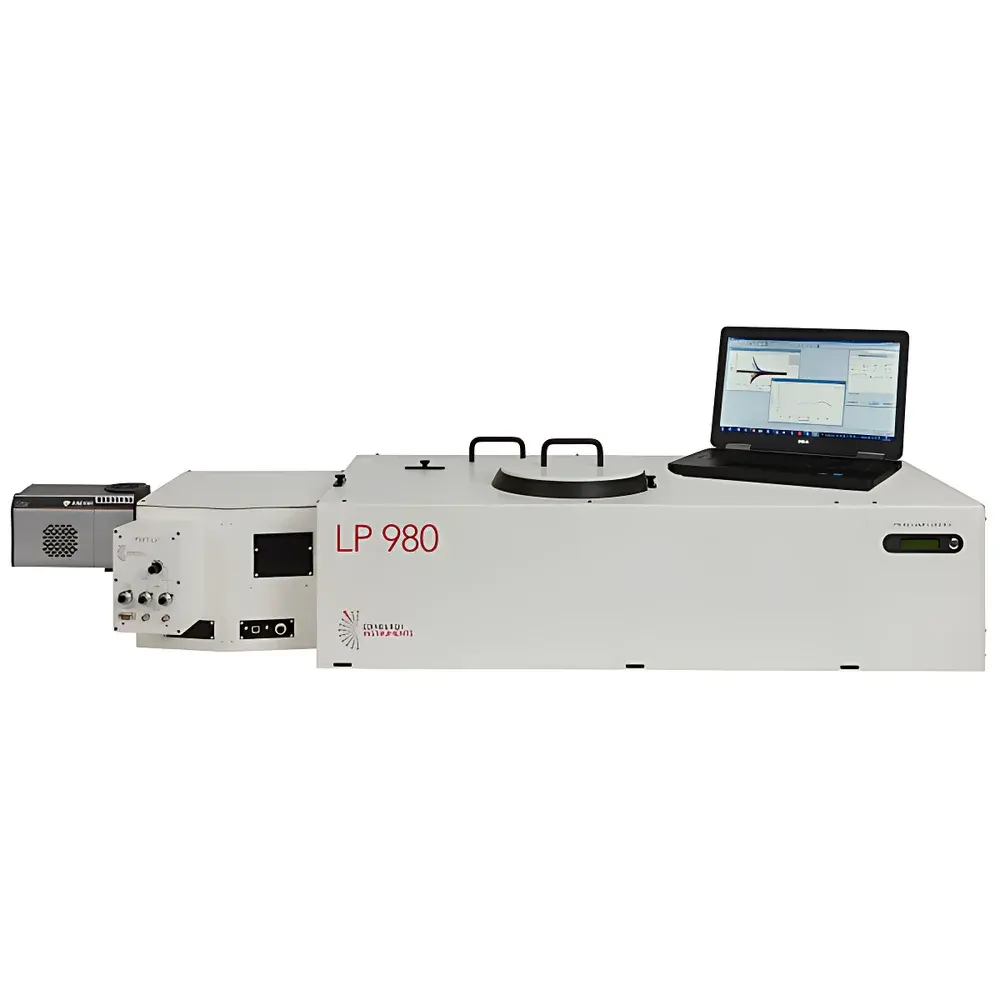
Edinburgh Instruments LP980 Transient Absorption Spectrometer
| Brand | Edinburgh Instruments |
|---|---|
| Origin | United Kingdom |
| Manufacturer Type | Original Equipment Manufacturer (OEM) |
| Product Origin | Imported |
| Model | LP980 |
| Pricing | Available Upon Request |
Overview
The Edinburgh Instruments LP980 Transient Absorption Spectrometer is a high-performance, time-resolved spectroscopic platform engineered for the quantitative detection and kinetic analysis of short-lived photogenerated species. Operating on the principle of laser flash photolysis (LFP), the system employs a pulsed excitation source to initiate photochemical reactions, followed by broadband probe light monitoring of transient absorption changes across UV-Vis-NIR spectral ranges (typically 200–1700 nm). With temporal resolution spanning from nanoseconds to seconds—configurable via detector selection and data acquisition strategy—the LP980 supports both single-shot and multi-scan kinetic profiling. Its architecture integrates synchronized laser excitation, gated detection, and spectrally resolved signal collection to deliver high-fidelity, wavelength-resolved decay traces essential for mechanistic studies in photochemistry, photocatalysis, and biological electron transfer.
Key Features
- Dual-sample compartment design enabling pump-probe differential measurements for enhanced signal-to-noise ratio and artifact suppression in complex matrices.
- Integrated 150 W xenon arc lamp with 100 A pulsed current capability—engineered for high-intensity, stable continuum output over extended acquisition periods, minimizing baseline drift during long-timescale kinetics (up to seconds).
- Automated filter turret with motorized position control to suppress second-order diffraction artifacts across the full spectral range, ensuring spectral fidelity without manual intervention.
- Internal beam alignment mechanism for pump and probe paths—eliminates sensitivity to external vibration or thermal drift, maintaining optical overlap stability over multi-hour experiments.
- Configurable detection modes: fast-gated ICCD or PMT-based detection (down to ~2 ns instrument response function) for nanosecond-resolved transients; slow-scanning CCD mode for high-sensitivity, millisecond-to-second kinetics with optical density (OD) detection limits as low as 5 × 10⁻⁴.
- Modular expansion support for complementary techniques including laser-induced fluorescence (LIF), phosphorescence lifetime imaging, and time-resolved Raman spectroscopy (LIR) via optional optical interfaces.
Sample Compatibility & Compliance
The LP980 accommodates liquid, solid, thin-film, and gas-phase samples using standard quartz cuvettes, custom flow cells, cryostat-compatible holders, and vacuum-compatible sample chambers. Its optical design conforms to ISO/IEC 17025 calibration traceability requirements when operated with NIST-traceable reference standards. The system supports GLP-compliant workflows through audit-trail-enabled software logging, user-access controls, and electronic signature functionality aligned with FDA 21 CFR Part 11 expectations. All optical components meet RoHS directives, and electrical subsystems comply with CE and UKCA safety standards (EN 61010-1).
Software & Data Management
Control and analysis are managed via Edinburgh Instruments’ proprietary LifSpec software suite—designed for cross-platform compatibility (Windows 10/11, 64-bit). The software provides real-time spectral preview, automated wavelength calibration, kinetic trace extraction at user-defined wavelengths, global fitting routines (including singular value decomposition and target model analysis), and export to industry-standard formats (ASCII, CSV, HDF5). Data integrity is maintained through hierarchical project archiving, metadata tagging (instrument parameters, sample ID, environmental conditions), and version-controlled processing scripts. Optional integration with MATLAB and Python APIs enables custom algorithm deployment and batch-processing pipelines for high-throughput transient analysis.
Applications
The LP980 serves core research functions across academic and industrial laboratories engaged in photoinduced reaction dynamics. Key application domains include: elucidation of charge-transfer intermediates in organic photovoltaic materials; identification of triplet-state lifetimes in metal–organic frameworks (MOFs); kinetic mapping of radical pair formation in enzymatic photocycles; time-resolved characterization of photocatalytic hole/electron trapping in TiO2 and g-C3N4; and mechanistic validation of singlet oxygen generation pathways in photosensitizer development. Its dual-compartment architecture further enables comparative studies—for instance, parallel monitoring of solvent-caged vs. diffusive radical recombination under identical irradiation conditions.
FAQ
What is the minimum detectable optical density (OD) in slow-scan mode?
The system achieves an OD detection limit of 5 × 10⁻⁴ under optimized slow-scan CCD acquisition with signal averaging.
Can the LP980 be upgraded for mid-IR transient absorption measurements?
Yes—via optional InSb or MCT detector modules and compatible broadband IR sources, extending spectral coverage to ~5500 nm with appropriate optical path modifications.
Is remote operation supported for unattended long-duration experiments?
Yes—LifSpec includes secure TCP/IP-based remote control, scheduled run execution, and real-time email/SMS alerts upon completion or error conditions.
Does the software support kinetic modeling with constrained global analysis?
Yes—LifSpec includes built-in target analysis (TA) and sequential model fitting with parameter sharing, penalty constraints, and residual mapping across multiple datasets.
What maintenance intervals are recommended for the xenon lamp and optical filters?
Xenon lamp replacement is advised every 500 hours of pulsed operation; filter turret calibration is recommended annually or after 10,000 actuations, per manufacturer service guidelines.






