
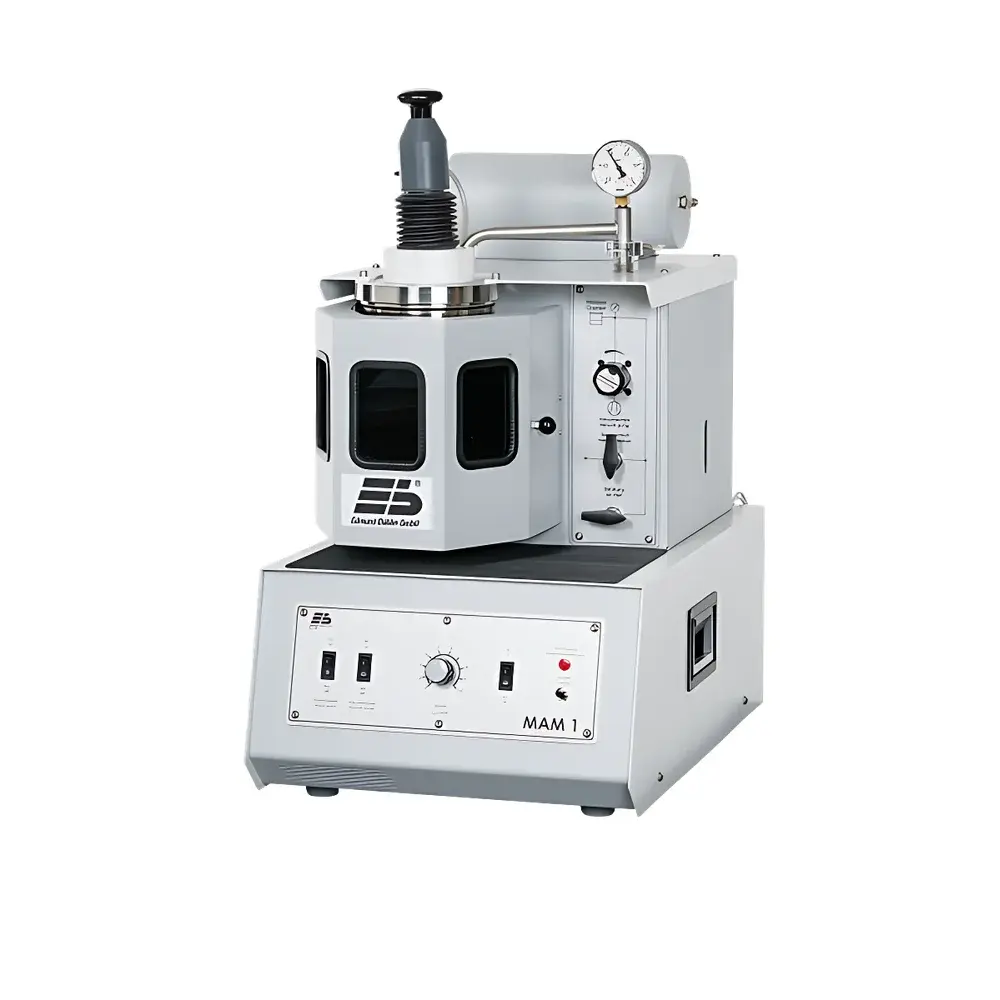
Edmund Bühler MAM-1 High-Temperature Arc Melting Furnace
| Brand | Edmund Bühler |
|---|---|
| Origin | Germany |
| Model | MAM-1 |
| Furnace Type | Crucible Arc Melter |
| Max Operating Temperature | 3500 °C |
| Power Supply | 230 V / 50–60 Hz, single-phase |
| Melting Capacity | 5–20 g |
| Arc Current Range | 5–200 A |
| Vacuum System | Integrated primary pump or turbomolecular pump (external) |
| Chamber Absolute Pressure | ≤1300 mbar abs. |
| Internal Chamber Dimensions (W×D×H) | 430 × 650 × 750 mm |
| Standard Crucibles | 1×Ø25 mm, 3×Ø8 mm, 1×8×30 mm |
| Optional Suction Casting Mold Diameters | Ø0.5, 1.0, 1.5, 2.0, 3.0, 4.0, 5.0, 8×1.5 mm |
| Suction Casting Max Temp | 1600 °C |
| Cooling | Water-cooled copper crucible & movable electrode |
| Atmosphere Control | High-purity argon (low-consumption design) |
| Safety Systems | Overtemperature protection, optical eye shielding, interlocked vacuum/argon valves, non-contact arc ignition |
Overview
The Edmund Bühler MAM-1 is a high-precision, laboratory-scale arc melting furnace engineered for the controlled synthesis and purification of refractory metals, intermetallics, and advanced alloys under inert or vacuum conditions. Operating on the principle of direct-current (DC) arc discharge between a water-cooled tungsten electrode and a water-cooled copper crucible, the MAM-1 achieves localized heating exceeding 3500 °C—sufficient to melt tungsten (melting point: 3422 °C), molybdenum, niobium, and ceramic-grade carbides and borides. Its compact chamber design enables rapid evacuation (<60 s to 10−2 mbar with turbomolecular pumping) and efficient argon backfilling with minimal gas consumption—critical for reproducible stoichiometry in oxygen-sensitive systems such as rare-earth permanent magnets or MAX-phase precursors. Unlike conventional resistance-heated furnaces, the MAM-1 delivers ultra-high thermal gradients and near-instantaneous energy input, minimizing segregation and promoting homogeneous solidification during drop-casting or suction casting.
Key Features
- Modular vacuum chamber architecture with front-access double-door configuration for safe, tool-free crucible exchange and electrode alignment.
- Water-cooled copper crucible with interchangeable, custom-machined inserts—including standard Ø25 mm and Ø8 mm cylindrical molds, 8×30 mm rectangular boats, and user-defined geometries (e.g., stepped, tapered, or multi-cavity).
- Movable, precision-positioned tungsten electrode with fine-thread micrometer adjustment (±5 µm resolution) for repeatable arc gap control and stable plasma initiation.
- Non-contact arc ignition system using high-voltage pulse triggering—eliminating electrode wear during startup and ensuring consistent first-melt reproducibility.
- Dual-stage pressure management: integrated Pirani + capacitance manometer for accurate absolute pressure monitoring (10−3–1300 mbar abs.), coupled with pneumatically actuated, leak-tight stainless-steel isolation valves for argon/vacuum sequencing.
- Comprehensive safety suite compliant with EN 61000-6-4 (EMC) and EN 61000-6-2 (immunity), including Class 1 laser-rated optical shielding, dual redundant overtemperature cutoffs (thermocouple + IR sensor), and interlocked door switches that disable power upon chamber access.
Sample Compatibility & Compliance
The MAM-1 accommodates diverse sample forms—powders, chips, foils, and pre-alloyed buttons—with minimal mass requirement (5–20 g typical). Its low-thermal-mass crucible design supports rapid quenching for metastable phase retention (e.g., amorphous ribbons or Laves phases). The system meets ISO/IEC 17025 requirements for calibration traceability when paired with NIST-traceable thermocouples (Type C or B) and certified pressure transducers. For regulated environments, optional audit-trail logging (timestamped vacuum cycles, current profiles, temperature ramps) satisfies FDA 21 CFR Part 11 data integrity criteria when used with validated software modules. All wetted components are electropolished 316L stainless steel or oxygen-free high-conductivity (OFHC) copper, ensuring compatibility with ASTM F2885 (high-purity metal processing) and USP particulate matter control protocols.
Software & Data Management
The MAM-1 operates via a dedicated embedded controller with a 7-inch resistive touchscreen HMI, supporting real-time visualization of arc current (0.1 A resolution), chamber pressure (0.1 mbar resolution), and water-cooling flow rate. Process parameters—including ramp rates, hold times, and gas flow sequences—are programmable via intuitive step-based recipes. Raw data (CSV export) includes synchronized timestamps, analog inputs from up to four thermocouples, and digital I/O states for external integration. Optional Ethernet/IP or Modbus TCP connectivity enables centralized monitoring within LabVantage or Thermo Fisher SampleManager LIMS platforms. Firmware updates are performed via secure USB key with SHA-256 signature verification—ensuring integrity per IEC 62443-3-3 cybersecurity guidelines.
Applications
- Synthesis of ultra-high-melting-point alloys (e.g., W–Re, Mo–Si–B, Nb–Ti–Hf–C) for aerospace turbine components.
- Preparation of master alloys for subsequent directional solidification or additive manufacturing feedstock qualification.
- Reductive purification of transition metal oxides (e.g., TiO2 → Ti) under Ar/H2 mixtures.
- Small-batch production of intermetallic compounds (NiAl, FeAl, CoSn) with precise stoichiometric control.
- Rapid prototyping of compositionally graded samples via sequential layer-wise melting in segmented crucibles.
- Calibration reference material preparation for XRD, EPMA, and SIMS analysis—where phase purity and absence of crucible contamination are essential.
FAQ
What vacuum level is required before initiating arc melting?
A base pressure ≤5×10⁻² mbar is recommended prior to argon backfill; turbomolecular pumping achieves this in <45 seconds. Residual gas analysis (RGA) optional for O2/H2O partial pressure validation.
Can the MAM-1 be integrated into a glovebox environment?
Yes—the MAM-1 Glovebox Variant (MAM-1-GX) features a flanged chamber interface, external generator cabinet, and feedthroughs for power, cooling, and signal lines, enabling seamless operation inside argon- or nitrogen-filled inert-atmosphere enclosures.
Is suction casting limited to cylindrical specimens?
No—custom mold inserts (including square, hexagonal, or stepped cross-sections) can be fabricated from OFHC copper or graphite upon request; dimensional tolerances held to ±0.05 mm.
How is electrode erosion managed during extended operation?
Tungsten electrodes are consumable; typical lifetime exceeds 200 melts at 150 A. A calibrated wear-compensation algorithm adjusts arc gap automatically across successive runs to maintain consistent power density.
Does the system support reactive gas addition (e.g., N2, CH4) during melting?
Yes—optional mass flow controllers (MFCs) for up to three gases enable programmed partial-pressure blending (e.g., Ar–N2 for nitride synthesis), with real-time feedback via residual gas analyzer integration.



