
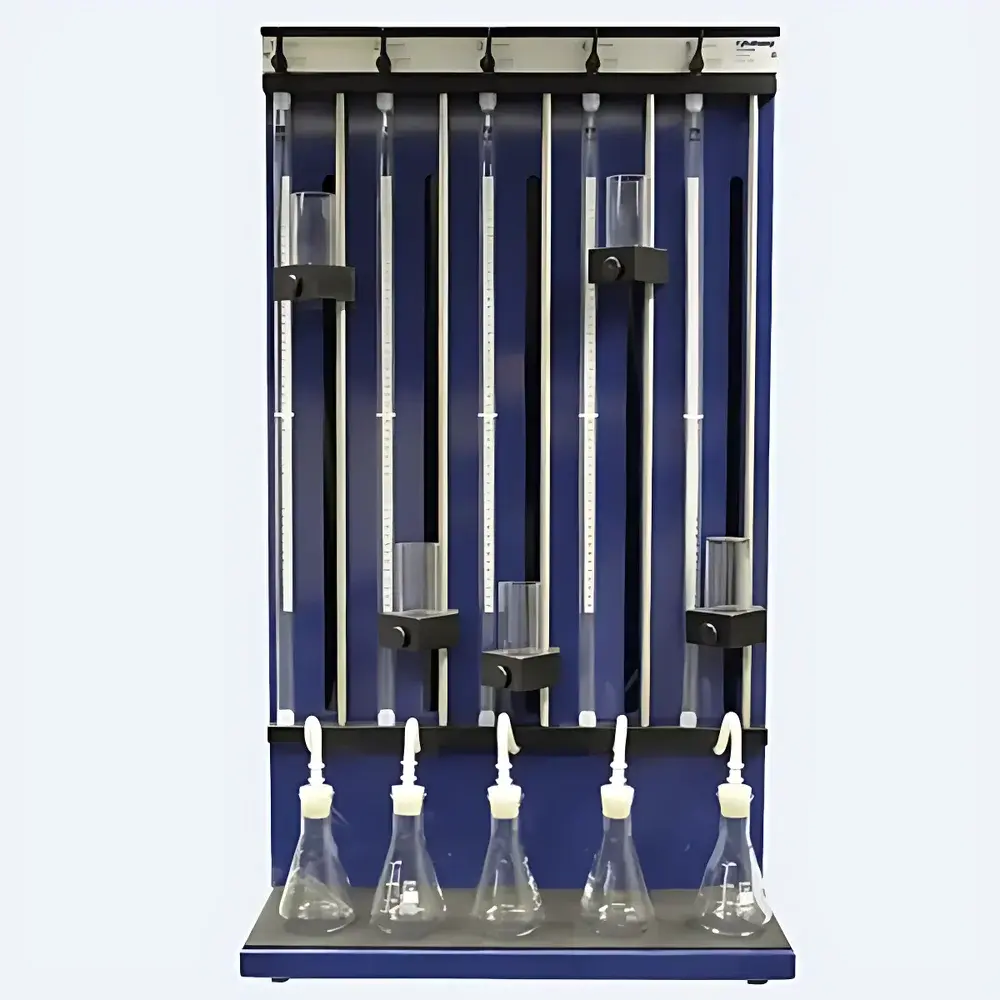
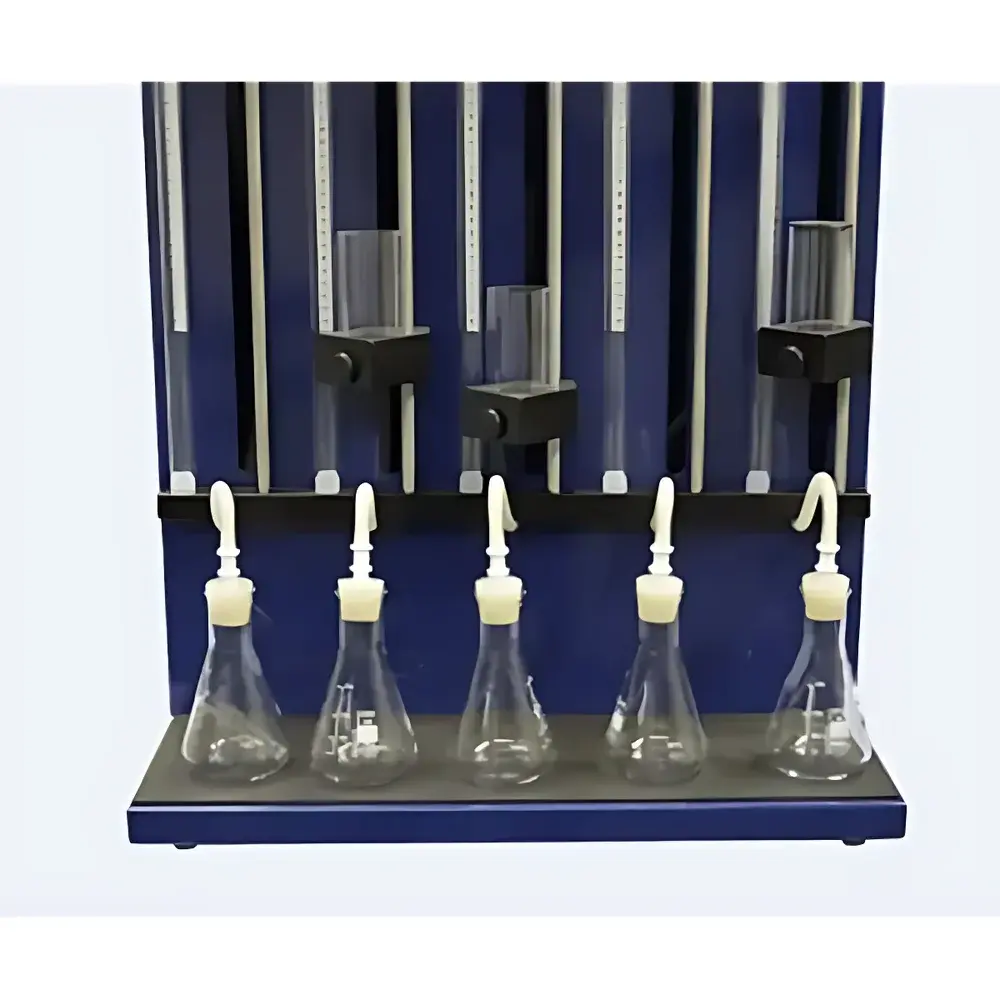
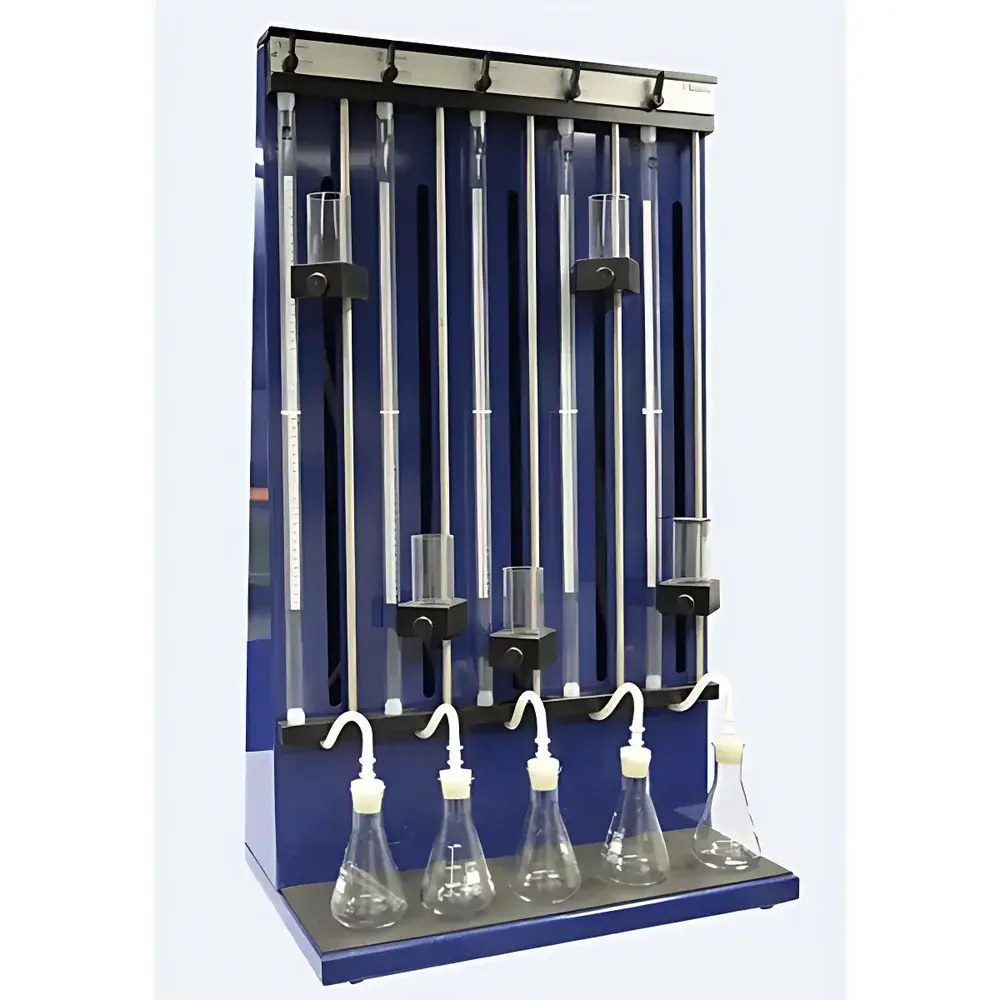
Eijkelkamp 08.53 Calcium Carbonate Analyzer for Soil
| Brand | Eijkelkamp |
|---|---|
| Origin | Netherlands |
| Model | 08.53 |
| Measurement Range | 0 – >200 g/kg CaCO₃ |
| Resolution | Not specified |
| Power Supply | 220 V AC |
| Dimensions | 146 × 62 × 59 cm |
| Sample Capacity | 5 parallel determinations |
| Compliance | EN 5757, DIN 19682 & DIN 19684 |
| Principle | Scheibler volumetric acid–carbonate reaction |
Overview
The Eijkelkamp 08.53 Calcium Carbonate Analyzer is a dedicated volumetric instrument engineered for the quantitative determination of total carbonate content—expressed as calcium carbonate (CaCO₃) equivalent—in soil, sediment, and geological samples. It operates on the classical Scheibler principle: a precisely weighed sample is reacted with standardized hydrochloric acid (HCl), liberating carbon dioxide (CO₂) stoichiometrically from carbonate minerals (e.g., calcite, dolomite, aragonite). The evolved CO₂ gas displaces water in a calibrated eudiometer tube, and the volume of displaced water—measured at known temperature and atmospheric pressure—is directly proportional to the carbonate mass fraction. Unlike manometric or gas-chromatographic alternatives, this method requires no carrier gas, gas scrubbing, or electronic transducers, offering inherent simplicity, high reproducibility, and traceability to fundamental chemical stoichiometry. Designed for routine environmental laboratories, agricultural testing facilities, and geotechnical assessment units, the 08.53 delivers robust, operator-independent results without reliance on complex calibration curves or proprietary software algorithms.
Key Features
- Simultaneous analysis of up to five samples per run, improving throughput in high-volume soil testing workflows.
- Fully mechanical, non-electronic gas displacement measurement—eliminates drift, sensor aging, and electronic interference.
- Replacement of all fragile glass components (e.g., reaction flasks, eudiometer tubes) with chemically resistant synthetic materials (e.g., borosilicate-reinforced polymers), enhancing durability and safety during HCl handling.
- Ergonomically optimized benchtop layout with stable base, inclined reaction vessel mount, and zero-reference adjustment mechanism to minimize parallax error during water-level reading.
- No gas bladder or membrane separation required—CO₂ is measured directly in aqueous displacement, avoiding solubility artifacts and ensuring higher accuracy versus sealed-bag methods.
- Compliant with internationally recognized standard test methods: EN 5757 (soil analysis — determination of carbonate content), DIN 19682 (water quality — carbonate determination in sediments), and DIN 19684 (determination of acid-soluble carbonates in soils).
Sample Compatibility & Compliance
The analyzer accommodates air-dried, homogenized soil samples with particle sizes ≤2 mm. It is validated for use with mineral soils, loams, clays, marls, and calcareous sediments—including those containing slow-reacting carbonates such as mollusk shell fragments or dolomitic residues (extended reaction time ≥60 min recommended). Samples with high organic matter (>15 %) or sulfide content require pre-oxidation to prevent interfering gas evolution (e.g., H₂S, CH₄). For contaminated or industrial site soils, optional CO₂-selective gas washing (e.g., KOH scrubbers) may be integrated upstream of the eudiometer to isolate carbonate-derived CO₂. All procedures align with ISO 14253-1 (geometrical product specifications), GLP documentation requirements, and QA/QC protocols mandated under EU Soil Thematic Strategy reporting frameworks.
Software & Data Management
The 08.53 is a standalone, analog instrument with no embedded firmware or digital interface. However, it integrates seamlessly into modern laboratory information management systems (LIMS) via manual entry or spreadsheet-based data capture. Users are advised to record raw displacement volumes, ambient temperature, barometric pressure, HCl normality, and sample mass in accordance with ISO/IEC 17025:2017 documentation guidelines. Optional Excel-based calculation templates—validated against NIST SRM 2710a reference material—are available from Eijkelkamp’s technical support portal to automate conversion of volume readings to g/kg CaCO₃, including temperature/pressure correction factors and stoichiometric coefficients. Full audit trails, analyst signatures, and revision-controlled worksheets satisfy FDA 21 CFR Part 11 compliance when implemented within validated electronic lab notebook (ELN) environments.
Applications
- Agricultural land evaluation: Quantifying lime requirement and buffering capacity prior to pH correction.
- Environmental site assessment: Screening for carbonate-rich strata affecting contaminant mobility (e.g., heavy metal adsorption, radionuclide retardation).
- Archaeological and paleopedological studies: Reconstructing past pedogenic conditions through carbonate accumulation profiles.
- Construction material testing: Assessing carbonate impurities in aggregates per EN 1744-1.
- Regulatory reporting: Generating data for national soil monitoring networks (e.g., Dutch National Soil Survey, EU LUCAS Topsoil project).
FAQ
What is the minimum detectable carbonate concentration?
The practical lower limit is ~1 g/kg CaCO₃, dependent on eudiometer resolution (typically ±0.1 mL), sample mass (recommended 1–5 g), and ambient thermal stability.
Can the instrument measure magnesium carbonate separately?
No—the Scheibler method reports total acid-soluble carbonate as CaCO₃ equivalent; MgCO₃ contributes fully to the result but cannot be differentiated without supplementary titration or ICP-OES validation.
Is temperature control mandatory during analysis?
Yes. Displacement volume is temperature-sensitive; measurements must be performed in a climate-controlled room (≤4 °C) or corrected using the ideal gas law with recorded T and P values.
Are reagents included with the system?
No. Only the mechanical analyzer, reaction vessels, and calibrated eudiometer tubes are supplied. Standardized 1 M HCl and deionized water must be procured separately per ISO 648 and ISO 3696 Grade 2 specifications.
How often should the eudiometer scale be verified?
Calibration verification using certified volume standards (e.g., Class A volumetric pipettes) is recommended before each analytical batch and documented per ISO/IEC 17025 clause 6.5.







