
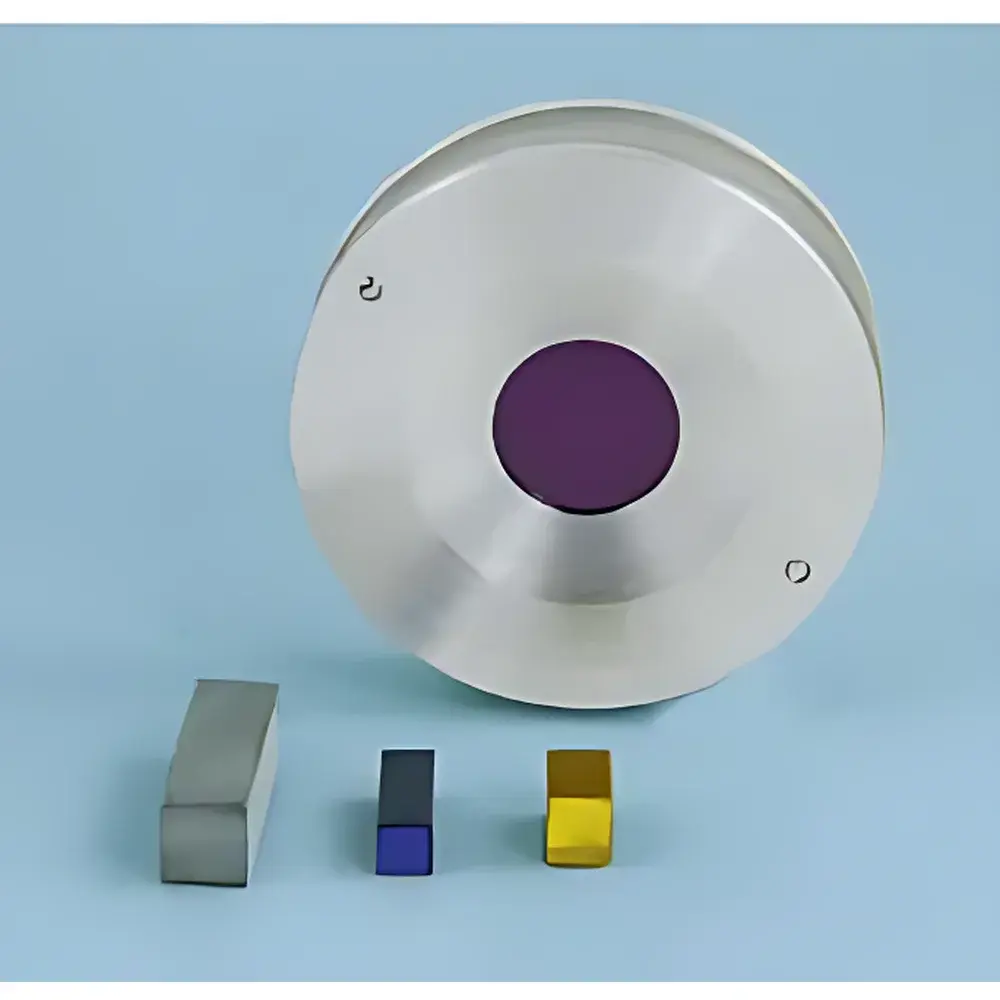
EKSMA Infrared Nonlinear Crystals (AgGaS₂, AgGaSe₂, GaSe, ZnGeP₂)
| Brand | EKSMA |
|---|---|
| Origin | Lithuania |
| Manufacturer Type | Authorized Distributor |
| Origin Category | Imported |
| Model | Infrared Nonlinear Crystals |
| Price Range | USD 1,500–7,500 (per piece, depending on size, orientation, coating) |
| Component Category | Nonlinear Optical Crystals |
| Coating Options | High-Laser-Damage BBAR (Broadband Anti-Reflection), R < 0.2% per surface (2.05–2.1 µm & 2.5–8.2 µm bands) |
| Absorption Coefficient | α < 0.05 cm⁻¹ @ 2.05–2.1 µm |
Overview
EKSMA Infrared Nonlinear Crystals are high-purity, orientation-optimized bulk crystals engineered for efficient wavelength conversion in the mid-infrared (MIR) and long-wave infrared (LWIR) spectral regions (1.9–18 µm). These materials operate on the principle of second-order nonlinear optical processes—including second-harmonic generation (SHG), sum- and difference-frequency generation (SFG/DFG), and optical parametric oscillation/amplification (OPO/OPA)—enabled by their large effective nonlinear susceptibility (deff) and broad phase-matching bandwidths. Unlike near-IR crystals such as BBO or LBO, EKSMA’s IR-grade AgGaS₂, AgGaSe₂, GaSe, and ZnGeP₂ (ZGP) exhibit extended transparency ranges, low group-velocity mismatch, and relaxed thermal and mechanical stability requirements—making them indispensable for solid-state and gas-laser-based MIR source development in both laboratory and industrial settings.
Key Features
- Four material platforms optimized for distinct IR spectral windows: ZnGeP₂ (1.9–8.6 µm & 9.6–10.2 µm), AgGaSe₂ (0.9–16 µm), AgGaS₂ (0.53–12 µm), and GaSe (0.65–18 µm)
- High laser-induced damage threshold (LIDT): >500 MW/cm² (10 ns, 10 Hz, 2.05 µm pump) for BBAR-coated ZGP and AgGaSe₂
- Precision crystallographic orientation: X-, Y-, or Z-cut configurations with angular tolerance ≤ ±0.25° for critical phase-matching applications
- Standard and custom dimensions available: thicknesses from 0.5 mm to 5 mm; aperture sizes up to 10 × 10 mm²; polished surfaces with λ/10 surface flatness and 10–5 scratch-dig
- Broadband anti-reflection (BBAR) coatings optimized for common pump wavelengths (e.g., 2.05 µm Ho:YLF, 2.94 µm Er:YAG, 3.39 µm HeNe, 10.6 µm CO₂), achieving R < 0.2% per surface
- Low intrinsic absorption: α < 0.05 cm⁻¹ at 2.05–2.1 µm; α < 0.03 cm⁻¹ across 2.5–8.2 µm (verified via FTIR spectroscopy per ISO 11146)
Sample Compatibility & Compliance
EKSMA IR nonlinear crystals are compatible with pulsed and CW laser systems operating in nanosecond, picosecond, and femtosecond regimes. They support standard beam geometries (collimated, focused, walk-off compensated) and integrate seamlessly into OPO cavities, external SHG stages, and DFG mixing setups. All crystals are manufactured and tested in accordance with ISO 9001-certified cleanroom protocols. Material traceability includes full certification of crystal growth method (Bridgman for ZGP and AgGaSe₂; vapor transport for GaSe; flux-grown for AgGaS₂), orientation verification (X-ray Laue diffraction per ASTM F1227), and post-polish surface quality inspection (per MIL-PRF-13830B). Crystals intended for regulated environments (e.g., defense, medical laser development) may be supplied with full GLP-compliant documentation packages including batch-specific absorption spectra, LIDT test reports, and coating spectral reflectance curves.
Software & Data Management
While EKSMA IR crystals are passive optical components, their integration into tunable laser systems benefits from compatibility with industry-standard modeling and alignment tools. EKSMA provides downloadable Sellmeier coefficient datasets (valid for λ = 0.5–18 µm) and phase-matching angle calculators (for Type-I and Type-II interactions) in MATLAB and Python formats. These resources support predictive design of OPO tuning curves, acceptance angle estimation, and walk-off compensation planning—fully interoperable with commercial simulation suites such as SNLO (ASD Inc.) and WinSpall (LightMachinery). For traceability-critical applications, optional digital certificates (PDF + CSV) include serial-numbered metrology logs aligned to NIST-traceable reference standards.
Applications
- Mid-IR OPO pumping: Ho:YLF (2.05 µm), Tm:fiber (1.9–2.1 µm), and Er:YAG (2.94 µm) lasers driving tunable output from 2.5–12 µm (AgGaSe₂) or 3.5–10 µm (ZGP)
- CO₂ laser (10.6 µm) frequency doubling to 5.3 µm (GaSe, AgGaS₂) and DFG-based generation of 7–12 µm radiation for molecular spectroscopy
- Ultrafast MIR pulse generation: AgGaS₂ thin plates (< 0.5 mm) used in collinear DFG between Ti:sapphire and Nd:YAG pulses for sub-100-fs broadband MIR continuum
- Infrared countermeasure (IRCM) systems: High-average-power SHG of 2.7–3.0 µm quantum cascade lasers using ZGP for directed-energy testbeds
- Terahertz generation: GaSe exfoliated flakes and bulk plates employed in optical rectification setups with femtosecond Er:fiber lasers (1550 nm)
- Environmental monitoring: Compact DFG sources based on AgGaSe₂ for open-path detection of CH₄, N₂O, and CO at atmospheric absorption lines near 3.3 µm and 4.5 µm
FAQ
What is the maximum average power these crystals can handle?
Depends on cooling configuration and beam size. With active conductive cooling and >1 mm beam diameter, ZGP and AgGaSe₂ tolerate >5 W average power at 2.05 µm; GaSe requires lower fluence due to lower thermal conductivity.
Do you supply crystals with custom phase-matching angles?
Yes—EKSMA offers non-standard cut angles (e.g., non-critical phase matching at 45° or temperature-tuned configurations) with full angular tolerance specification and verification report.
Are these crystals suitable for ultrafast applications?
AgGaS₂ and GaSe are widely used in fs-DFG and optical rectification; ZGP is limited to ps–ns due to two-photon absorption above ~10 GW/cm² at 2 µm.
How is crystal damage threshold validated?
Per ISO 21254-2:2018, using raster-scan methodology at 1064 nm, 2.05 µm, and 10.6 µm with 10 ns pulses, 10 Hz repetition rate, and calibrated energy meters traceable to NIST.
Can I request a certificate of conformance with EU RoHS or REACH compliance?
Yes—RoHS-compliant material declarations and SVHC screening reports are included with all export shipments to EEA countries.




