
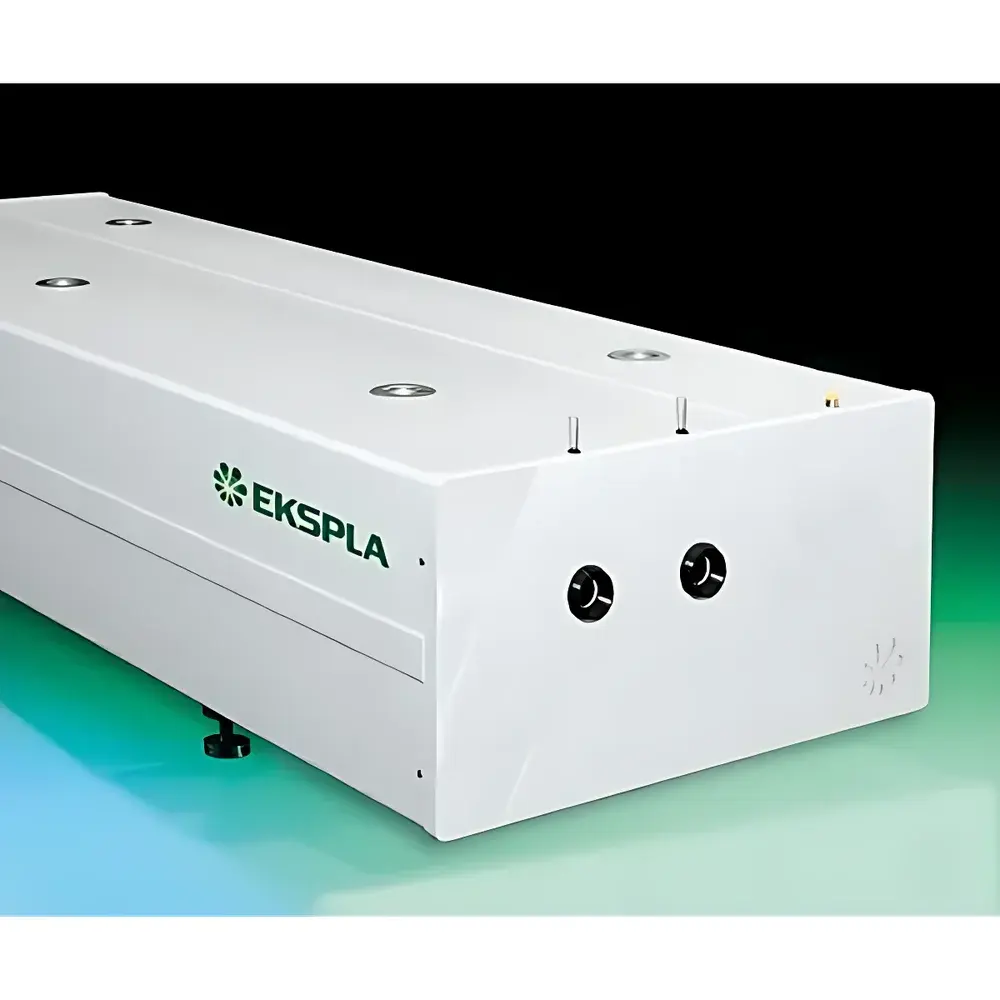
Ekspla ANL MM High-Energy Q-Switched Nd:YAG Laser
| Brand | Ekspla |
|---|---|
| Origin | Lithuania |
| Manufacturer Type | OEM Manufacturer (not distributor) |
| Product Type | Solid-State Q-Switched Nd:YAG Laser System |
| Model | ANL MM |
| Output Pulse Energy | Up to 1 J @ 1064 nm |
| Repetition Rate | Up to 1 kHz |
| Pulse Duration | 2–4 ns or 5 ns (selectable) |
| Beam Profile | Spatially uniform flat-top |
| Harmonics Options | Optional internal 532 nm (2ω) and 355 nm (3ω) generation |
| Pumping | High-efficiency diode-pumped laser chambers |
| Footprint | 1000 × 2000 mm |
| Cooling & Power | Integrated industrial-grade power supply and closed-loop chiller unit (optional) |
| Diagnostics | Internal real-time system diagnostics with status monitoring |
Overview
The Ekspla ANL MM is a high-energy, diode-pumped, Q-switched neodymium-doped yttrium aluminum garnet (Nd:YAG) laser engineered for precision industrial, scientific, and metrological applications requiring stable, high-peak-power nanosecond pulses. Operating at the fundamental wavelength of 1064 nm, the system delivers up to 1 joule per pulse with exceptional temporal stability and spatial beam uniformity—enabled by a proprietary flat-top beam profile generation architecture. Its Q-switching mechanism employs electro-optic or acousto-optic modulation (configurable per application requirements), ensuring precise temporal control over pulse emission timing and duration. Designed for continuous operation in demanding environments, the ANL MM integrates thermally optimized resonator design, low-drift cavity alignment, and active thermal management—resulting in long-term pulse energy stability (<±1.5% RMS over 8 hours) and shot-to-shot reproducibility essential for laser-induced breakdown spectroscopy (LIBS), ablation studies, thin-film processing, and optical pumping experiments.
Key Features
- High pulse energy output: up to 1 J at 1064 nm with pulse-to-pulse energy stability better than ±1.5% (RMS)
- Repetition rate adjustable from single-shot to 1 kHz, supporting both burst-mode and continuous operation
- Configurable pulse duration: 2–4 ns or 5 ns options, optimized for material interaction dynamics and plasma generation efficiency
- Flat-top spatial beam profile (top-hat intensity distribution) with >90% uniformity across >80% of beam diameter—critical for uniform ablation, surface texturing, and pump-probe homogeneity
- Diode-pumped solid-state architecture with high wall-plug efficiency (>3.5%) and reduced thermal lensing versus flashlamp-pumped systems
- Compact footprint of 1000 × 2000 mm for the laser head; optional integrated industrial housing includes sealed power supplies, redundant cooling circuits, and vibration-damped mechanical base
- Onboard diagnostics subsystem with real-time monitoring of pump diode current/voltage, cavity temperature, Q-switch driver status, and pulse energy feedback via calibrated photodiode sensor
Sample Compatibility & Compliance
The ANL MM is compatible with a broad range of optically transparent and absorbing materials—including metals, ceramics, polymers, semiconductors, and biological tissues—enabling controlled ablation, surface modification, and plasma generation. Its beam quality (M² < 2.0) and low divergence (<1.5 mrad) ensure efficient coupling into fiber delivery systems or external harmonic generation modules. The system complies with IEC 60825-1:2014 (Edition 3.2) for Class 4 laser safety, incorporates interlocked access panels, emergency stop circuitry, and embedded beam shutter control. It supports integration into ISO/IEC 17025-accredited laboratories and meets functional requirements for GLP-compliant instrumentation when operated with validated procedures and audit-trail-enabled software (see Software & Data Management section).
Software & Data Management
Control and monitoring are performed via Ekspla’s Laser Control Suite (LCS), a Windows-based application supporting remote operation over Ethernet (TCP/IP), USB, or RS-232. LCS provides full parameter scripting, pulse logging (timestamped energy, repetition rate, temperature), and export to CSV or HDF5 formats. For regulated environments, optional FDA 21 CFR Part 11-compliant configuration includes electronic signatures, role-based user access control, and immutable audit trails for all parameter changes and operational events. Data synchronization with LIMS or MES platforms is supported through OPC UA and RESTful API interfaces.
Applications
- Laser-Induced Breakdown Spectroscopy (LIBS) for elemental analysis in metallurgy, geology, and environmental monitoring
- Pulsed laser deposition (PLD) of functional oxide and nitride thin films
- Time-resolved fluorescence and transient absorption spectroscopy requiring high-peak-power pump pulses
- Calibration of ultrafast photodetectors and streak cameras
- Industrial marking, drilling, and micromachining of heat-sensitive components
- Optical parametric oscillator (OPO) pumping for tunable mid-IR source development
FAQ
What harmonics are available, and how are they integrated?
Internal second-harmonic (532 nm) and third-harmonic (355 nm) generation modules are available as factory-installed options, using angle-tuned nonlinear crystals (BBO or LBO) with automated wavelength selection and beam recombination optics.
Is the system suitable for cleanroom or vacuum chamber integration?
Yes—the laser head can be configured with vacuum-compatible flanges (CF-63 or KF-40), non-outgassing materials, and sealed optical paths; optional bake-out support up to 80°C is available.
How is pulse energy stability maintained over extended operation?
Through active cavity temperature regulation (±0.05°C), diode current stabilization with ripple <0.1%, and real-time energy feedback loop correcting for thermal drift in the gain medium and Q-switch.
Can the ANL MM be synchronized with external equipment?
Yes—it provides TTL-compatible trigger inputs/outputs with jitter <1 ns, programmable delay generators (0–10 s range), and IEEE-1588 PTP time stamping for multi-instrument synchronization in pump-probe or LIBS setups.





