
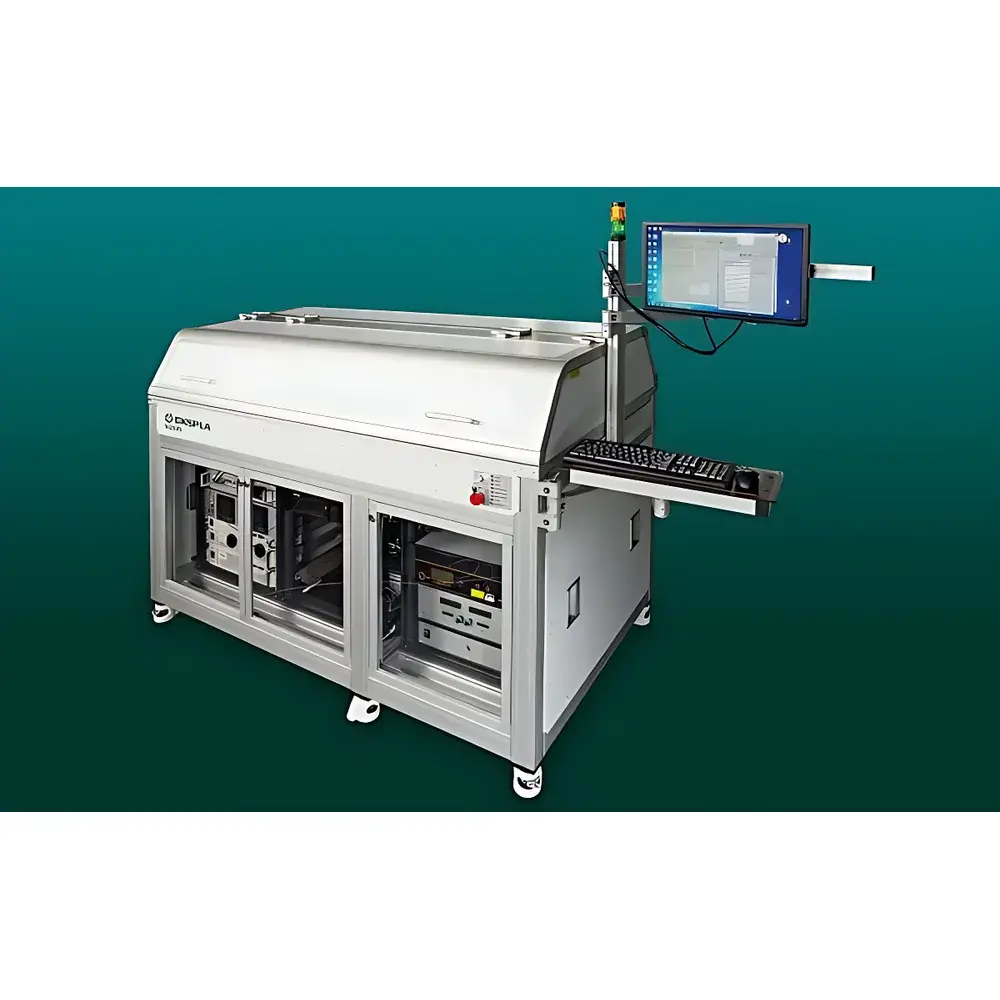
Ekspla ANL Series High-Energy, High-Repetition-Rate DPSS Nanosecond Laser System
| Brand | Ekspla |
|---|---|
| Output Pulse Energy | Up to 1 J at 1064 nm |
| Repetition Rate | Up to 1 kHz |
| Pulse Duration | 2–4 ns or 5 ns (selectable) |
| Beam Profile | Spatially uniform flat-top |
| Pumping | High-efficiency diode-pumped |
| Footprint | 1 × 2 m |
| Housing Options | Industrial-grade portable enclosure with integrated power supply and cooling |
| Harmonics | Optional SHG (532 nm) and THG (355 nm) modules |
| Diagnostics | Internal real-time system diagnostics |
| Maintenance | Low operational maintenance requirements |
Overview
The Ekspla ANL Series is a diode-pumped solid-state (DPSS) nanosecond laser system engineered for demanding industrial, scientific, and metrology applications requiring high pulse energy, precise temporal control, and spatial beam uniformity. Operating at the fundamental wavelength of 1064 nm, the ANL delivers up to 1 joule per pulse with repetition rates scalable from single-shot to 1 kHz—enabling high-throughput material processing, time-resolved spectroscopy, laser-induced breakdown spectroscopy (LIBS), and pump-probe experiments. Its nanosecond pulse architecture (2–4 ns or 5 ns, user-selectable) ensures sufficient peak power for nonlinear optical interactions while maintaining thermal stability and long-term pulse-to-pulse reproducibility. The spatially flat-top beam profile—achieved via optimized resonator design and homogenizing optics—provides uniform irradiance across the target area, critical for consistent ablation thresholds, precision micromachining, and calibration-grade optical pumping.
Key Features
- High-energy output: Up to 1 J per pulse at 1064 nm with <±1.5% pulse energy stability (rms, over 8 hours)
- Flexible repetition rate: Continuously adjustable from 1 Hz to 1 kHz, supporting both low-duty-cycle precision tasks and high-throughput production environments
- Nanosecond pulse control: Factory-configurable pulse duration options of 2–4 ns or 5 ns, optimized for specific absorption dynamics and plasma formation characteristics
- Flat-top spatial profile: Engineered beam homogeneity (>90% uniformity within 80% of beam diameter) minimizes edge effects in ablation and reduces post-processing variability
- Diode-pumped architecture: High-efficiency, air-cooled or water-cooled diode stacks ensure >15,000 hours mean time between failures (MTBF) and eliminate flashlamp-related degradation mechanisms
- Compact footprint: Integrated 1 × 2 m laser head design accommodates cleanroom and OEM integration without requiring external optical tables
- Industrial-grade packaging: Optional ruggedized housing includes sealed environmental protection (IP54), vibration-damped mounting, and fully integrated power conditioning and closed-loop chiller interface
Sample Compatibility & Compliance
The ANL Series is compatible with a broad range of optically transparent and opaque materials—including metals, ceramics, polymers, semiconductors, and biological tissues—without requiring vacuum or inert gas environments for standard operation. Its pulse parameters comply with ISO 11551 (laser beam parameter measurements) and IEC 60825-1:2014 (laser product safety classification). When equipped with optional harmonic generators, the system supports dual-wavelength LIBS and multi-photon excitation workflows compliant with ASTM E2926-22 (standard guide for LIBS analysis) and ISO/IEC 17025:2017 (general requirements for competence of testing laboratories). All firmware and hardware interfaces are designed to support GLP/GMP audit trails when integrated into validated manufacturing systems.
Software & Data Management
The ANL operates under Ekspla’s LaserControl Suite v4.x—a Windows-based platform supporting remote configuration, real-time pulse monitoring, and automated sequence scripting. Key software capabilities include synchronized trigger I/O (TTL, LVDS), analog feedback loop integration for energy stabilization, and timestamped event logging compliant with FDA 21 CFR Part 11 requirements (electronic signatures, audit trail, data integrity controls). Export formats include CSV, HDF5, and MATLAB-compatible binaries. For OEM integration, a comprehensive SDK provides C/C++, Python, and LabVIEW drivers with deterministic latency (<100 µs command response) and IEEE-488 (GPIB) and Ethernet TCP/IP communication protocols.
Applications
- Laser-induced breakdown spectroscopy (LIBS) for elemental mapping in mining, metallurgy, and nuclear forensics
- Precision thin-film ablation and lift-off in photovoltaic and display manufacturing
- Time-of-flight mass spectrometry (TOF-MS) ion source excitation
- Optical parametric oscillator (OPO) pumping for tunable mid-IR generation
- Calibration of high-speed photodetectors and streak cameras
- Shockwave generation and dynamic compression studies in condensed matter physics
- Nonlinear optical characterization including second-harmonic generation (SHG) microscopy reference sources
FAQ
What cooling options are supported for continuous 1 kHz operation?
The ANL supports either recirculating water cooling (with ≤20 °C inlet temperature and ≥3 L/min flow rate) or forced-air convection for lower-duty-cycle configurations. Industrial housing variants include integrated closed-loop chillers rated for ambient temperatures up to 40 °C.
Can the ANL be synchronized with external equipment such as delay generators or detectors?
Yes—dedicated TTL/LVDS sync outputs and inputs enable sub-nanosecond jitter synchronization with oscilloscopes, gated ICCDs, and pulse delay generators. Trigger latency is factory-calibrated and documented in the system certificate.
Is remote diagnostics and predictive maintenance available?
Internal diagnostics continuously monitor diode current, cavity temperature, Q-switch timing, and pulse energy feedback. Logged data can be exported for trend analysis; optional cloud-connected gateway enables secure remote health monitoring and firmware updates under ITAR-compliant protocols.
Does the system meet laser safety standards for Class 4 operation?
Yes—the ANL is certified as Class 4 per IEC 60825-1:2014. It includes interlocked beam enclosures, emergency stop circuitry, and integrated laser emission indicators. Full safety documentation (risk assessment, installation checklist, operator training syllabus) is provided with each unit.




