
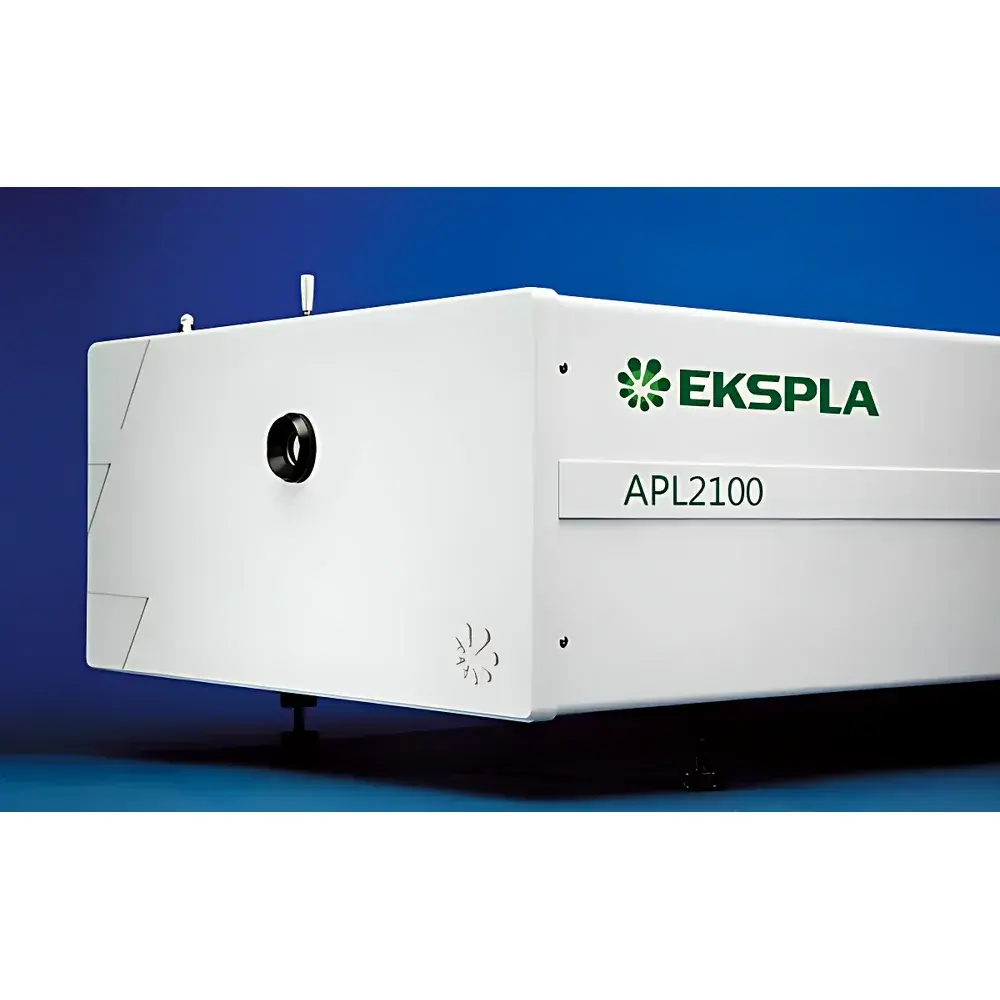
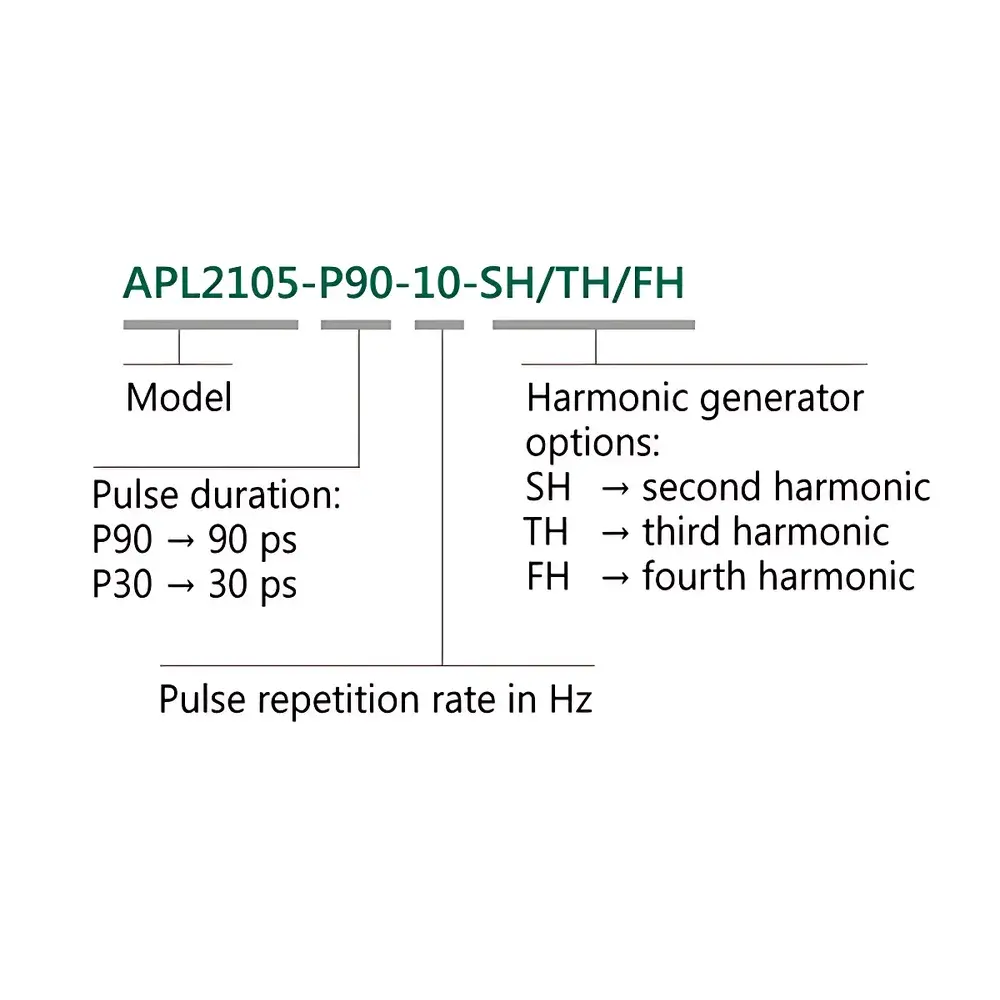
Ekspla APL2100 High-Energy Picosecond Amplifier
| Brand | Ekspla |
|---|---|
| Origin | Lithuania |
| Manufacturer Type | Original Equipment Manufacturer (OEM) |
| Product Category | Imported Instrument |
| Model | APL2100 |
| Core Technology | Diode-Pumped Regenerative Amplifier System |
| Pulse Energy | Up to 100 mJ (configurable) |
| Pulse Duration | <10 ps (FWHM) |
| Repetition Rate | 1–10 Hz (standard), up to 100 Hz (optional) |
| Output Wavelength | 1053 nm (fundamental), optional harmonic generation (2ω, 3ω, 4ω) |
| Beam Quality | M² < 1.3 |
| Timing Jitter | <10 ps RMS (sync output) |
| Cooling | Dual-stage water-to-water heat exchanger |
| Control Interface | CAN bus, USB 2.0 (RS232 optional) |
| Compliance | CE, RoHS, IEC 61000-6-3/6-4 |
Overview
The Ekspla APL2100 is a high-energy, diode-pumped regenerative amplifier engineered for demanding ultrafast laser applications requiring stable, high-contrast picosecond pulses. Operating at a fundamental wavelength of 1053 nm, the system integrates a robust Nd:glass gain medium with precision cavity design and active thermal management to deliver pulse energies up to 100 mJ at repetition rates from 1 to 10 Hz (extendable to 100 Hz in high-duty-cycle configurations). Its core architecture leverages chirped-pulse amplification (CPA) principles—where low-energy femtosecond seed pulses are temporally stretched, amplified in the regenerative cavity, and then recompressed—to preserve temporal fidelity while mitigating nonlinear effects and optical damage thresholds. Designed for integration into advanced optical parametric chirped-pulse amplification (OPCPA) pump chains, optical parametric generator/amplifier (OPG/OPA) systems, and time-resolved spectroscopy platforms, the APL2100 serves as a primary pump source where high peak power, low timing jitter, and exceptional pulse-to-pulse stability are non-negotiable.
Key Features
- Diode-pumped regenerative amplifier architecture eliminating flashlamp-induced thermal transients and enabling superior long-term amplitude stability (≤0.7% RMS over 8 hours)
- Active compensation of thermally induced birefringence via dual-rod polarization management, ensuring consistent beam pointing and polarization extinction ratio >100:1
- Ultra-low timing jitter (<10 ps RMS) on the synchronized output trigger, optimized for synchronization with streak cameras, pump-probe delay stages, and time-of-flight detectors
- Dual-stage water-to-water heat exchanger maintaining pump cavity temperature stability within ±0.1 °C—critical for maintaining gain uniformity and minimizing thermal lensing drift
- Modular harmonic generation unit (optional) supporting temperature-stabilized second-, third-, and fourth-harmonic generation with automated wavelength selection and real-time energy monitoring
- Fully remote operation via CAN bus or USB 2.0 interface; handheld control box provides tactile feedback and rapid parameter access without host PC dependency
Sample Compatibility & Compliance
The APL2100 is not a sample-contacting instrument but functions as a high-intensity optical pump source compatible with vacuum-compatible nonlinear crystals (e.g., BBO, LBO, KDP), gas-filled hollow-core fibers, and solid-state target chambers used in high-harmonic generation (HHG), laser-induced breakdown spectroscopy (LIBS), and plasma diagnostics. Its optical output meets Class 4 laser safety requirements per IEC 60825-1:2014 and is certified CE-marked for EMC compliance under IEC 61000-6-3 (emissions) and IEC 61000-6-4 (immunity). The system supports GLP/GMP-aligned operational logging when integrated with third-party data acquisition software that implements audit-trail functionality compliant with FDA 21 CFR Part 11.
Software & Data Management
Ekspla provides the APL2100 Control Suite—a Windows-based application supporting real-time monitoring of cavity alignment status, pump diode current/voltage, coolant flow rate and temperature, and harmonic conversion efficiency. All operational parameters—including repetition rate, pulse energy setpoint, harmonic selection, and sync delay—are programmable via ASCII command protocol over CAN or USB. Logged data (timestamped, with metadata tagging) exports natively to CSV and HDF5 formats for traceability in ISO/IEC 17025-accredited laboratories. Third-party integration with LabVIEW, MATLAB, and Python (via PySerial or CANopen libraries) is fully documented in the SDK.
Applications
- Primary pump source for OPCPA systems requiring >10 mJ, sub-10 ps pulses at 1–10 Hz for few-cycle pulse synthesis
- Driver for optical parametric amplifiers (OPAs) and generators (OPGs) in broadband IR and UV spectral generation
- Pump beam in time-resolved transient absorption, fluorescence upconversion, and coherent anti-Stokes Raman scattering (CARS) experiments
- High-fluence irradiation platform for laser-induced damage threshold (LIDT) testing of coatings and optics per ISO 21254 standards
- Seed source for multi-pass amplifiers targeting petawatt-class peak power systems
FAQ
What seed lasers are compatible with the APL2100?
The APL2100 accepts external seed sources with central wavelengths between 1030–1064 nm, pulse durations <500 fs, and repetition rates matching the amplifier’s operating frequency (1–10 Hz standard). Common integrations include Ti:sapphire oscillators with pulse pickers or fiber-based Yb-doped oscillators.
Is harmonic generation included by default?
No—the harmonic generation module (2ω/3ω/4ω) is an optional add-on. It features motorized crystal positioning, oven-controlled temperature stabilization (±0.05 °C), and integrated energy meters for each harmonic channel.
Can the APL2100 operate continuously at 100 Hz?
Yes, with the high-repetition-rate option package, which includes upgraded diode arrays, enhanced thermal management, and reinforced cavity mounts—enabling sustained operation at 100 Hz with pulse energy scaling to ~15 mJ.
Does the system support automated alignment routines?
While full auto-alignment is not embedded, the control suite provides guided alignment procedures with live camera feed overlay, cavity mode profiling tools, and step-by-step instructions compliant with ISO 10110-5 optical component verification protocols.
What documentation is provided for regulatory compliance in pharmaceutical labs?
Ekspla supplies a comprehensive Device Master Record (DMR)-aligned technical file, including risk analysis (ISO 14971), calibration certificates traceable to NIST standards, and firmware validation reports supporting 21 CFR Part 11 readiness when deployed with validated third-party DAQ software.






