
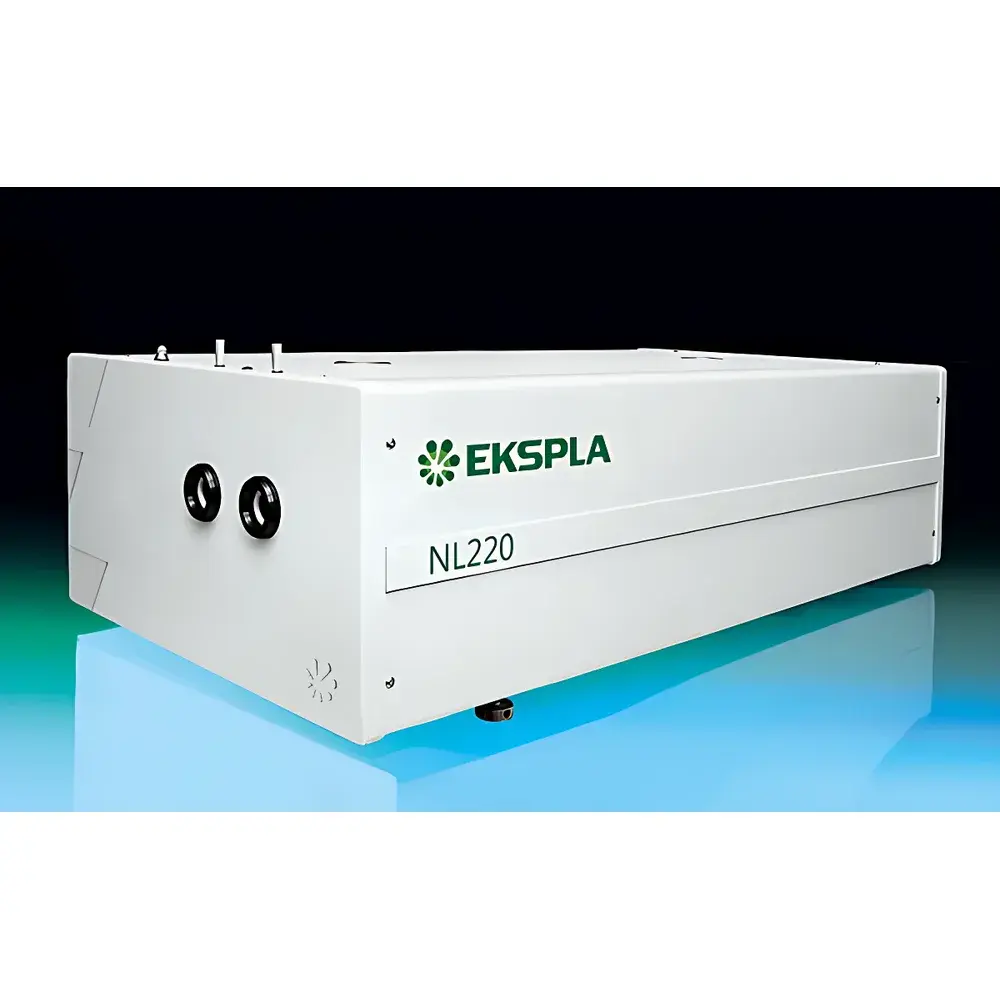
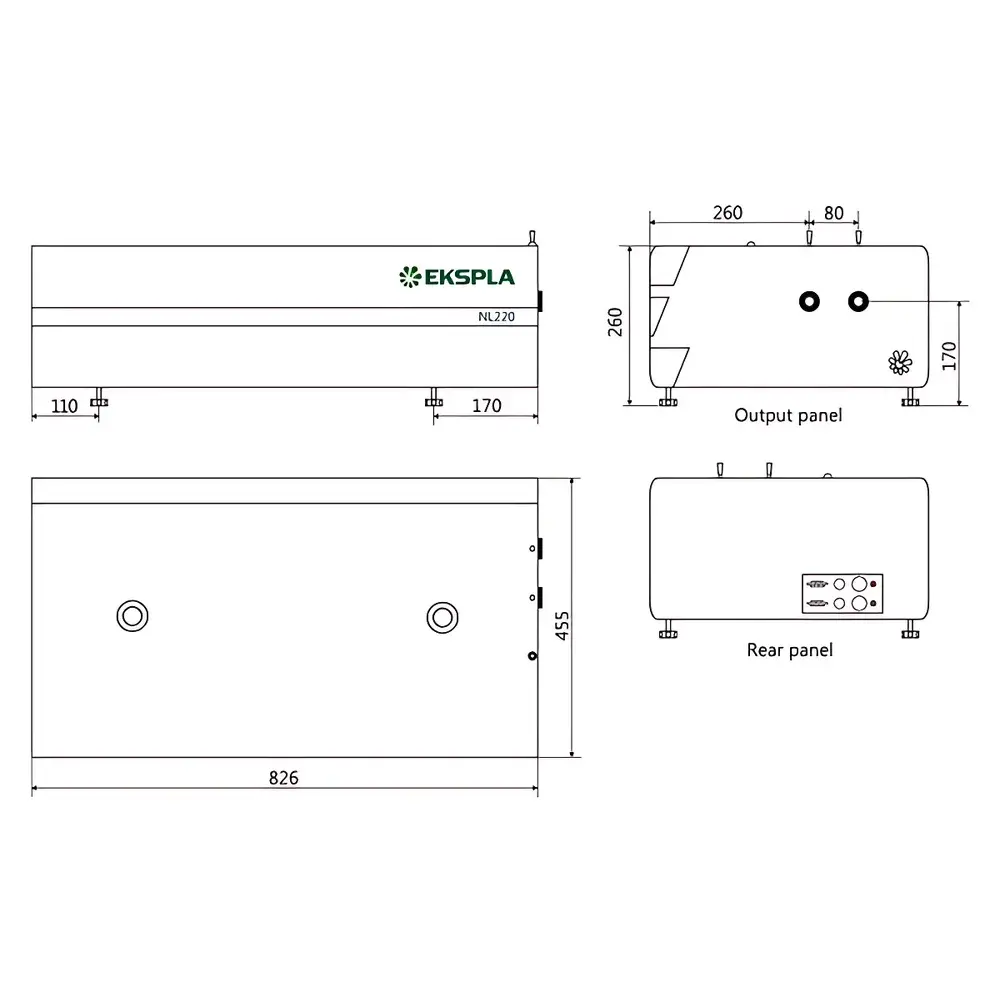
Ekspla NL220 High-Energy Kilohertz Nanosecond Diode-Pumped Solid-State Q-Switched Nd:YAG Laser
| Brand | Ekspla |
|---|---|
| Origin | Lithuania |
| Manufacturer Type | Original Equipment Manufacturer (OEM) |
| Product Category | Imported Instrument |
| Model | NL220 |
| Pulse Energy | Up to 30 mJ @ 1064 nm |
| Repetition Rate | Up to 1 kHz |
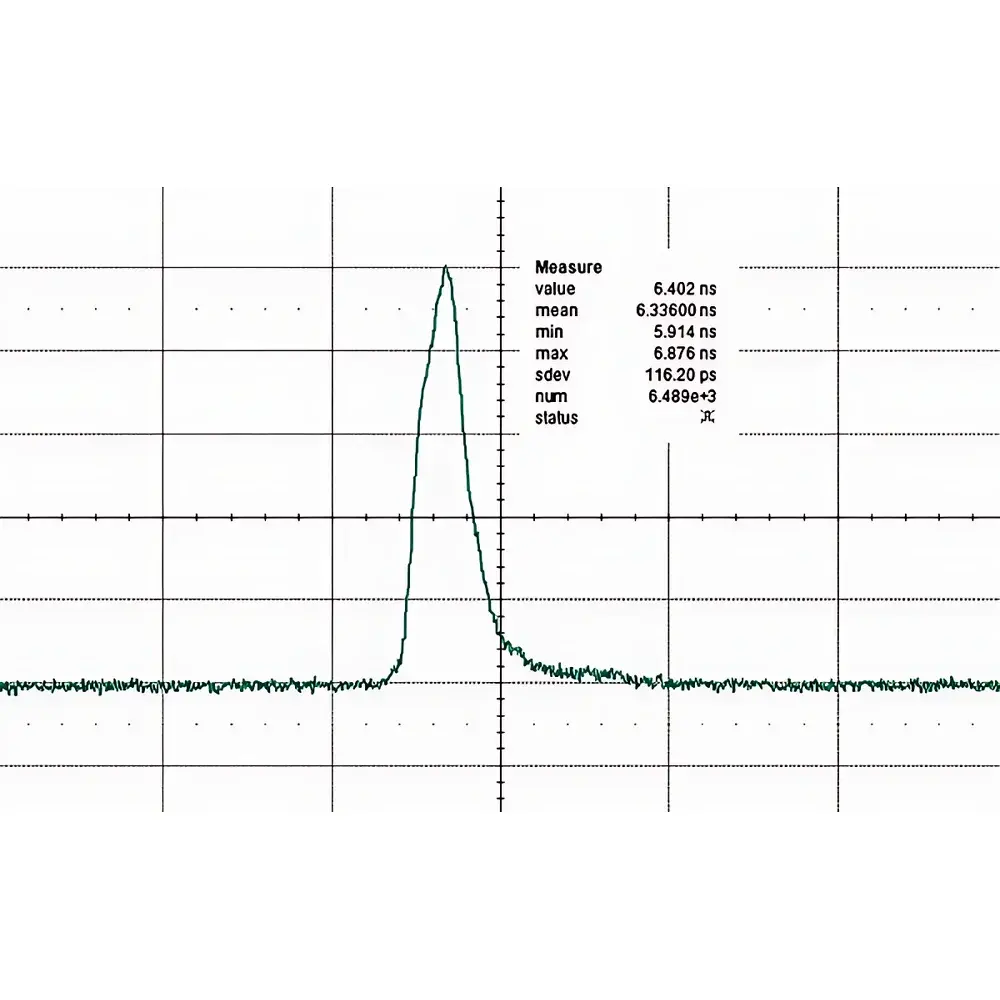
| Pulse Duration | <10 ns (typical) |
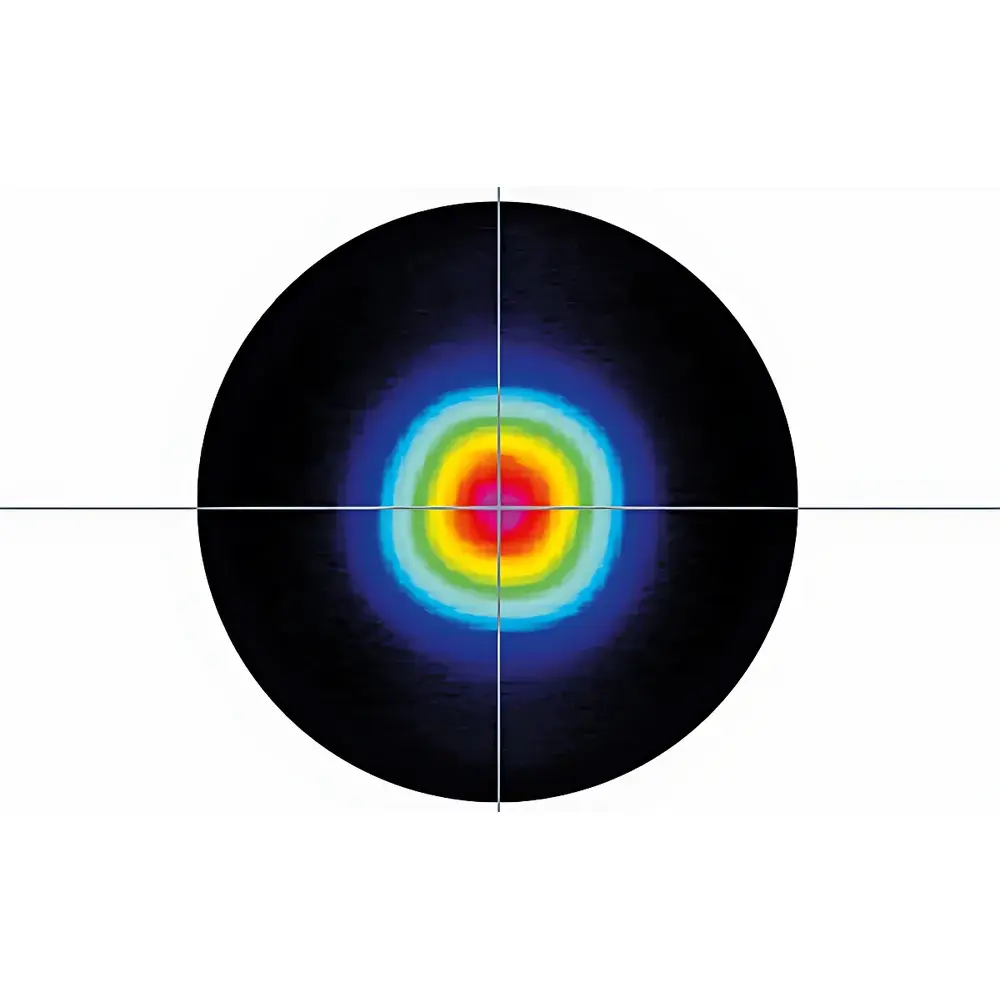
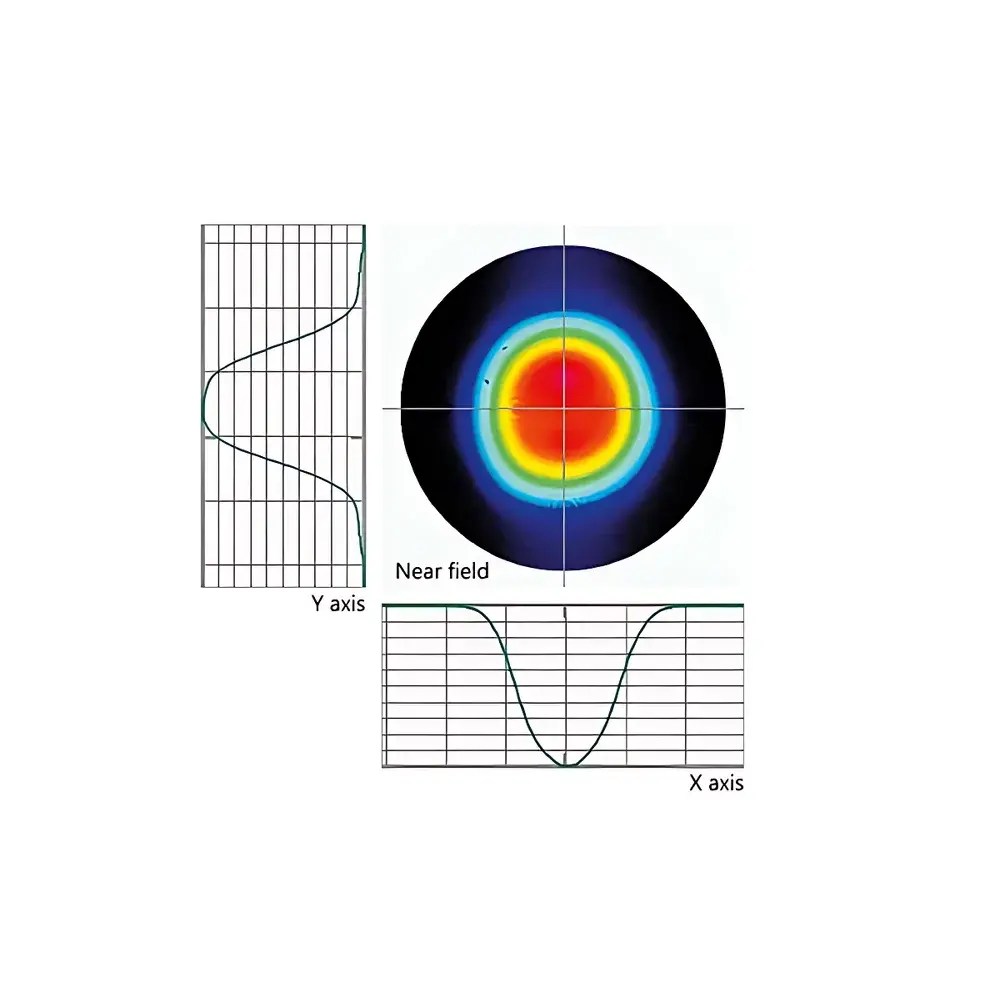
| Beam Profile | Near TEM₀₀ |
| Laser Type | Q-switched DPSS Nd:YAG |
Overview
The Ekspla NL220 is a high-performance, diode-pumped solid-state (DPSS), Q-switched Nd:YAG laser engineered for demanding scientific and industrial applications requiring stable, high-energy nanosecond pulses at kilohertz repetition rates. Operating at the fundamental wavelength of 1064 nm, the NL220 delivers up to 30 mJ per pulse with pulse durations typically below 10 ns—enabling precise material interaction, efficient nonlinear frequency conversion, and high signal-to-noise ratio in time-resolved diagnostics. Its robust monolithic resonator design, thermally stabilized pump module, and integrated electro-optic Q-switch ensure exceptional pulse-to-pulse stability (2 billion shots), making it suitable for continuous-duty laboratory environments and automated production-line integration.
Key Features
- High pulse energy output: up to 30 mJ at 1064 nm with optional harmonic generation modules (532 nm, 355 nm, 266 nm)
- Adjustable repetition rate from single-shot to 1 kHz, enabling flexible synchronization with external triggers (TTL-compatible, ≤5 ns jitter)
- Near-diffraction-limited beam quality (M² < 1.3) supporting tight focusing for ablation, LIBS, and nonlinear optics
- Integrated real-time pulse energy monitoring via calibrated photodiode and analog/digital output interface
- Passive and active cooling options: air-cooled configuration for benchtop use; water-cooled variant for sustained high-duty-cycle operation
- Compliance with IEC 60825-1:2014 Class 4 laser safety standards, including interlock-ready chassis and shutter control interface
Sample Compatibility & Compliance
The NL220 is compatible with a broad range of optical components and experimental configurations, including vacuum chambers, cryostats, and multi-axis translation stages. Its low-amplitude noise (<0.7% RMS) and stable pointing (<5 µrad/°C) ensure reproducible coupling into fiber launch systems, optical parametric amplifiers (OPAs), and time-of-flight mass spectrometers. The system meets essential regulatory requirements for research-grade instrumentation: CE marking under the EU Machinery Directive and Electromagnetic Compatibility (EMC) Directive; RoHS 2011/65/EU compliance; and full traceability of calibration certificates per ISO/IEC 17025-accredited procedures. For GLP/GMP environments, optional firmware enables audit-trail logging of operational parameters (pulse count, energy history, temperature logs) aligned with FDA 21 CFR Part 11 data integrity principles.
Software & Data Management
Control and monitoring are facilitated via Ekspla’s proprietary LaserStudio software (Windows-based), offering GUI-driven parameter configuration, real-time oscilloscope-style pulse visualization, and automated sequence scripting. Communication protocols include USB 2.0, RS-232, and Ethernet (TCP/IP), supporting integration into LabVIEW, MATLAB, and Python-based automation frameworks. All energy measurements are referenced to NIST-traceable calibration standards, and raw pulse data (timestamped energy, temperature, repetition rate) can be exported in CSV or HDF5 format for post-acquisition analysis. Optional remote diagnostics allow secure firmware updates and performance benchmarking through encrypted cloud-assisted service channels.
Applications
- Laser-Induced Breakdown Spectroscopy (LIBS) for elemental analysis in metallurgy, geology, and environmental monitoring
- Pump-probe spectroscopy and time-resolved fluorescence decay studies in photochemistry and condensed matter physics
- Thin-film ablation, micromachining, and selective laser scribing in semiconductor and display manufacturing
- Optical parametric oscillator (OPO) and amplifier (OPA) pumping for tunable mid-IR generation
- Calibration source for radiometric and photonic sensor validation (e.g., streak cameras, fast photodiodes)
- Nonlinear microscopy techniques including second-harmonic generation (SHG) and coherent anti-Stokes Raman scattering (CARS)
FAQ
What harmonic wavelengths are supported by the NL220 series?
The NL220 supports standard harmonic generation to 532 nm (second harmonic), 355 nm (third harmonic), and 266 nm (fourth harmonic) via integrated or external nonlinear crystals. Harmonic modules are field-installable and maintain beam quality and energy stability within specified tolerances.
Is the NL220 compatible with ultra-high vacuum (UHV) environments?
While the base unit is designed for ambient laboratory operation, custom UHV-compatible variants—including feedthroughs for trigger signals, water cooling lines, and sealed optical mounts—are available upon request and subject to OEM engineering review.
Can pulse energy be modulated dynamically during operation?
Yes—via analog voltage input (0–5 V) or digital command set, pulse energy can be adjusted in real time across the full range (10%–100%) without altering repetition rate or beam profile.
What maintenance intervals are recommended for optimal performance?
Routine inspection of cooling interfaces and optical alignment is advised every 6 months; diode pump modules are rated for >2 billion shots and require no scheduled replacement under nominal operating conditions.
Does the NL220 support external cavity dumping or cavity length tuning?
No—the NL220 utilizes a fixed-resonator, passively stabilized architecture optimized for pulse energy and temporal stability; cavity-length tuning is not implemented to preserve mechanical and thermal robustness.



