
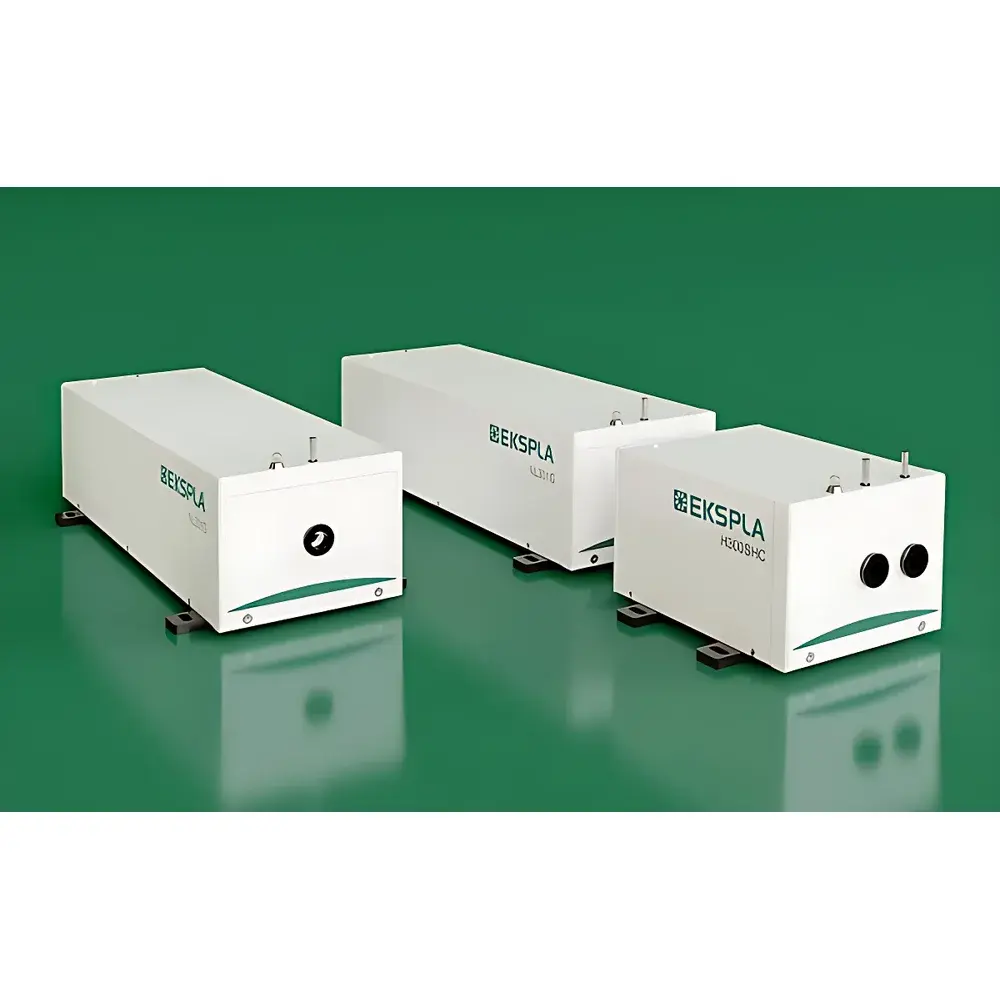
Ekspla NL300 Series Electro-Optically Q-Switched High-Energy Nd:YAG Laser
| Brand | Ekspla |
|---|---|
| Model | NL300 |
| Pulse Energy | up to 800 mJ |
| Pulse Duration | 3–6 ns |
| Repetition Rate | 10–30 Hz |
| RMS Pulse Energy Stability | <1% |
| Harmonics Generation | 2nd–5th (thermo-stabilized modules) |
| Cooling Options | water-to-water or water-to-air |
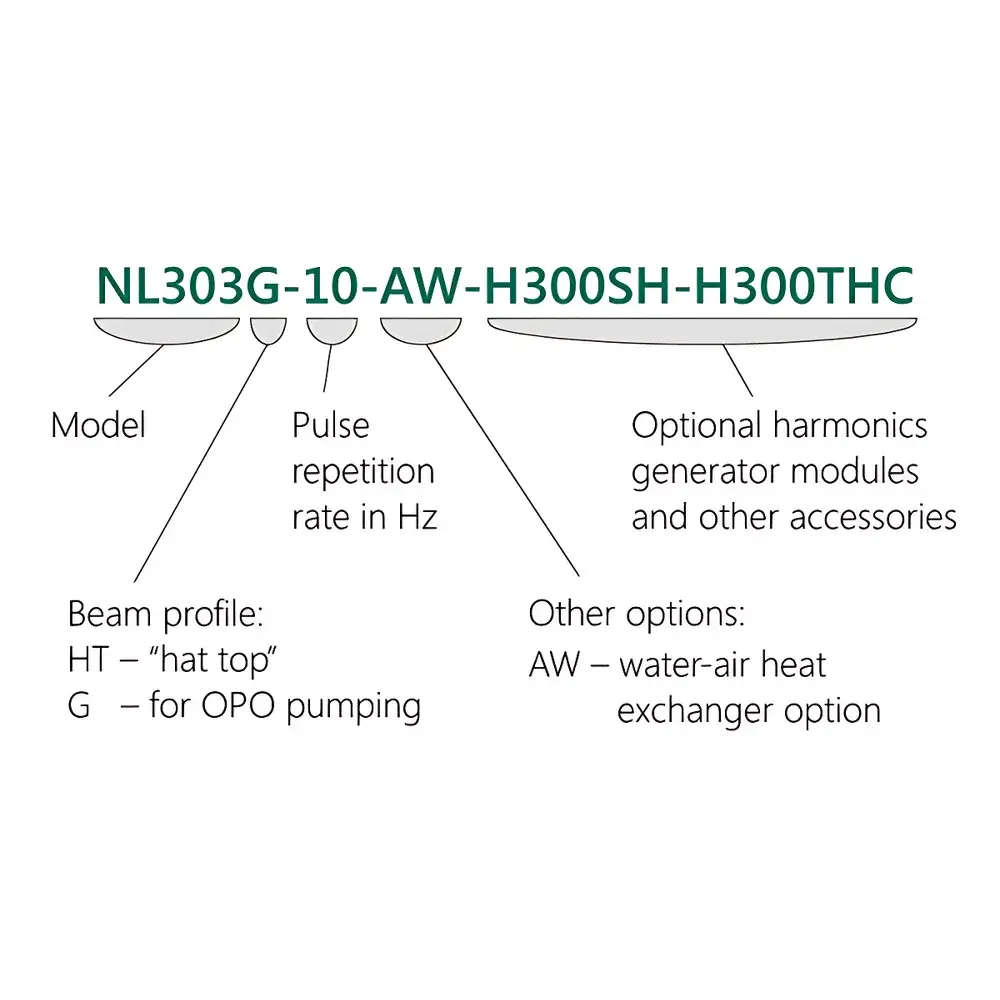
| Beam Profile Optimization | NL30×G (OPO-pumping grade), NL30×HT (high-energy extraction) |
| Control Interface | RS232/USB with LabVIEW™ drivers, keypad remote |
Overview
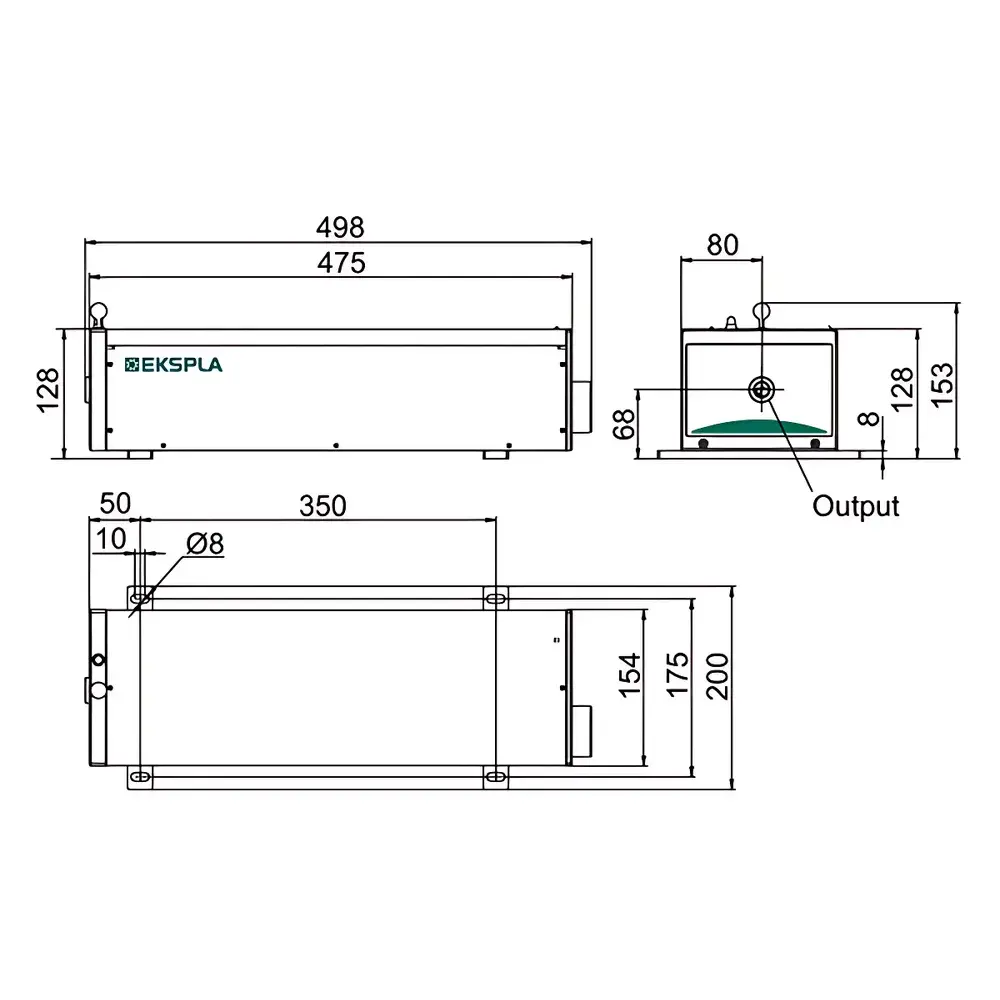
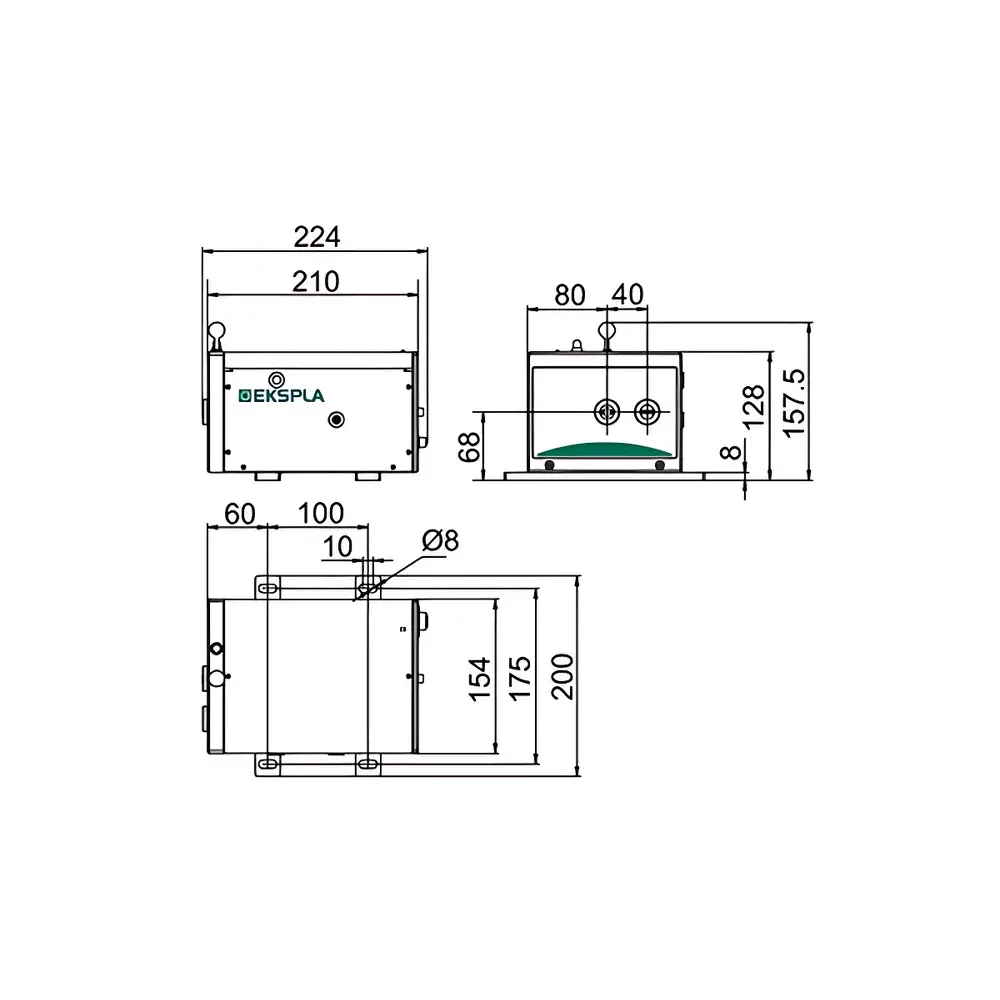
The Ekspla NL300 Series is a high-performance, electro-optically Q-switched solid-state laser system based on flashlamp-pumped Nd:YAG gain media. Engineered for precision and reliability in demanding industrial and scientific environments, the NL300 delivers nanosecond-scale pulses with exceptional temporal fidelity and energy stability. Its core architecture employs a rugged, hermetically sealed laser cavity—minimizing sensitivity to environmental fluctuations and ensuring long-term alignment integrity. The system operates at fundamental 1064 nm wavelength and supports harmonic generation up to the 5th order (213 nm), enabled by thermo-stabilized nonlinear crystal modules. Pulse shaping is achieved via electro-optic (EO) Q-switching, offering superior timing jitter control (<1 ns) and deterministic pulse initiation compared to passive or acousto-optic alternatives. Designed for integration into complex optical setups—including OPO pump sources, ultrafast amplifier seeds, and time-resolved spectroscopy platforms—the NL300 balances compact mechanical footprint (laser head length ≈ 480 mm) with scalable output performance across its model variants (NL30×G for beam homogeneity; NL30×HT for peak energy extraction).
Key Features
- Rugged, sealed laser cavity engineered for operational longevity and minimal maintenance-induced misalignment
- Pulse energy up to 800 mJ at 1064 nm (NL30×HT variant, 10 Hz)
- Exceptional pulse-to-pulse stability: <1% RMS over 8-hour continuous operation
- Adjustable repetition rate from 10 to 30 Hz, software-locked or front-panel selectable
- Narrow pulse width of 3–6 ns (FWHM), verified with fast photodiode + oscilloscope calibration traceability
- Thermo-stabilized harmonic generator modules for 532 nm (2nd), 355 nm (3rd), 266 nm (4th), and 213 nm (5th) outputs—each independently temperature-controlled to ±0.1°C
- Integrated attenuators for fundamental and/or harmonic wavelengths, enabling continuous energy adjustment without perturbing pulse duration, divergence, or spatial profile
- Modular cooling architecture: configurable water-to-water or water-to-air heat exchange—eliminating dependency on facility tap water while maintaining thermal load capacity ≤ 3.2 kW
- Flashlamp replacement performed in situ—no disassembly of pump chamber or realignment procedures required
- Dual-control interface: tactile keypad with OLED status display + RS232/USB port supporting SCPI-compliant command set and native LabVIEW™ drivers (included)
Sample Compatibility & Compliance
The NL300 series is designed for compatibility with standard optical tables, kinematic mounts, and OEM integration frameworks (e.g., ISO 30/40 mounting interfaces). Its beam specifications—including M² < 2.5 (NL30×G), divergence < 1.2 mrad (full angle), and near-Gaussian spatial profile—meet requirements for efficient coupling into nonlinear crystals, fiber launch systems, and scanning optics. Harmonic modules comply with IEC 60825-1:2014 Class 4 laser safety standards when properly interlocked. The power supply and laser head conform to CE marking directives (EMC 2014/30/EU, LVD 2014/35/EU) and RoHS 2011/65/EU material restrictions. For regulated environments (e.g., pharmaceutical laser processing or metrology labs), full audit trails are supported via USB logging of all parameter changes, including timestamped settings for pulse energy, rep rate, and harmonic selection—enabling alignment with GLP/GMP documentation practices.
Software & Data Management
Control firmware supports both local and remote configuration through a dual-path architecture. The embedded keypad provides immediate access to critical parameters (rep rate, Q-switch delay, harmonic selection) with real-time feedback on lamp shot count, coolant temperature, and interlock status. For automated workflows, the RS232/USB interface implements a documented SCPI command set compatible with Python, MATLAB, and LabVIEW™ environments. Included LabVIEW™ drivers feature VI-based parameter trees, error-handling routines, and waveform logging capabilities—supporting synchronized acquisition with external detectors (e.g., streak cameras or gated PMTs). All user-modified settings are stored in non-volatile memory with version-stamped backup files (.csv export). Firmware updates are performed via signed binary packages validated against SHA-256 checksums—ensuring traceability per ISO/IEC 17025 Clause 5.9.2.
Applications
- OPO pumping: NL30×G models provide diffraction-limited beam uniformity essential for efficient, low-threshold optical parametric oscillation across UV–IR spectral ranges
- Ti:sapphire and dye laser seeding: precise pulse timing and low jitter enable stable mode-locking initiation and cavity dumping synchronization
- Laser-induced breakdown spectroscopy (LIBS): high pulse energy and short duration maximize plasma ablation efficiency and signal-to-noise ratio in elemental analysis
- Time-of-flight mass spectrometry (TOF-MS): sub-nanosecond jitter enables accurate ion flight path calibration and mass resolution enhancement
- Remote sensing (LIDAR/DIAL): harmonics-enabled multi-wavelength operation supports differential absorption measurements for atmospheric gas profiling
- Thin-film ablation and micromachining: controllable pulse energy and beam quality allow reproducible feature sizing in polymer, ceramic, and semiconductor substrates
FAQ
What is the maximum achievable pulse energy at 532 nm?
Up to 420 mJ (typical, NL30×HT at 10 Hz), dependent on crystal temperature stabilization and input 1064 nm energy.
Can the NL300 operate continuously for 24 hours?
Yes—thermal management architecture and lamp lifetime (≥ 10⁷ shots) support unattended operation under nominal load; recommended duty cycle ≤ 85% for extended service life.
Is FDA 21 CFR Part 11 compliance supported?
While the base system does not include electronic signatures or role-based access, full audit log export (.csv) and parameter change timestamps enable implementation of Part 11-compliant SOPs when integrated with validated laboratory information systems.
How is beam pointing stability maintained during thermal cycling?
Through monolithic cavity design, low-CTE Invar structural elements, and active cavity temperature monitoring (±0.2°C resolution) feeding into closed-loop thermal compensation algorithms.
Are harmonic modules field-replaceable without realignment?
Yes—harmonic generators utilize kinematic mounts with repeatability < 5 µrad; alignment verification is performed at factory and confirmed via built-in beam profiler diagnostics.





