
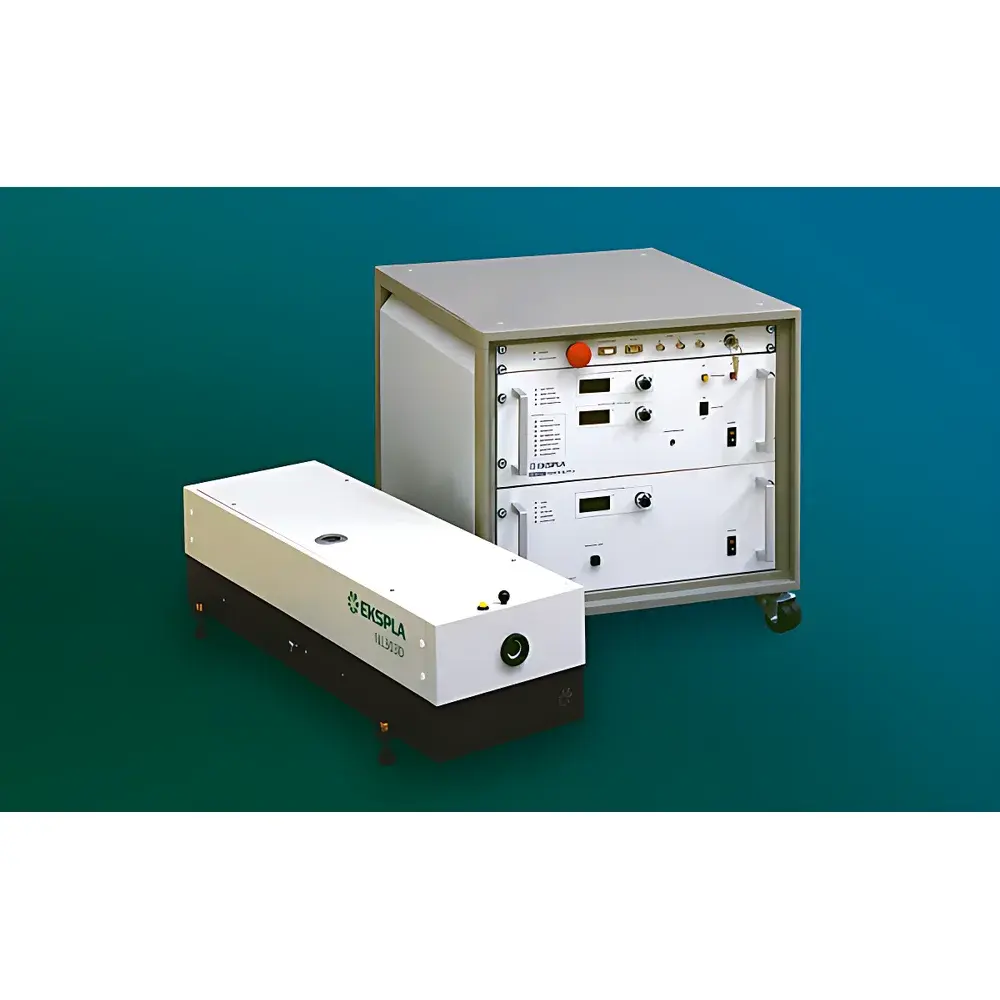
Ekspla NL300D Dual-Pulse Nanosecond PIV Laser
| Brand | Ekspla |
|---|---|
| Origin | Lithuania |
| Manufacturer Type | Original Equipment Manufacturer (OEM) |
| Product Category | Imported Scientific Laser System |
| Model | NL300D |
| Laser Medium | Diode-Pumped Solid-State (DPSS) |
| Wavelength Options | 1064 nm / 532 nm / 355 nm / 266 nm |
| Pulse Energy | up to 2 × 720 mJ at 1064 nm |
| Pulse Duration | <8 ns (FWHM) |
| Pulse Separation | Adjustable from 100 ns to 10 s |
| Repetition Rate | Up to 20 Hz (dual-pulse mode) |
| Beam Quality | M² < 2.5 |
| Cooling | Water-cooled |
| Compliance | CE, RoHS, IEC 60825-1:2014 Class 4 Laser Product |
Overview
The Ekspla NL300D is a high-energy, dual-pulse, nanosecond diode-pumped solid-state (DPSS) laser system engineered specifically for Particle Image Velocimetry (PIV) applications in fluid dynamics research and industrial flow diagnostics. Operating on the principle of time-resolved laser sheet illumination, the NL300D delivers precisely timed, collinear or spatially separated laser pulses—enabling accurate displacement measurement of seeded particles between successive frames. Its core architecture leverages Q-switched Nd:YAG technology with harmonic generation stages, supporting fundamental (1064 nm), second-harmonic (532 nm), third-harmonic (355 nm), and fourth-harmonic (266 nm) outputs. The system’s nanosecond pulse width (<8 ns FWHM) ensures minimal motion blur during high-speed flow imaging, while its adjustable inter-pulse delay (100 ns – 10 s) supports both microscale turbulent studies and macroscopic transient flow analysis. Designed and manufactured in Vilnius, Lithuania, the NL300D meets stringent international laser safety standards (IEC 60825-1:2014) and is classified as a Class 4 laser product—requiring appropriate enclosure and interlock integration in laboratory or test-cell deployments.
Key Features
- True dual-pulse operation with independent energy control per pulse—enabling asymmetric illumination schemes for optimized signal-to-noise ratio in challenging seeding conditions.
- Wavelength agility via motorized harmonic separator: seamless switching among 1064 nm, 535 nm, 355 nm, and 266 nm without realignment—critical for matching particle scattering efficiency and camera quantum efficiency across experimental configurations.
- High pulse energy stability: ≤±1.5% RMS energy fluctuation over 10⁴ shots at 1064 nm, ensuring measurement repeatability essential for quantitative PIV uncertainty budgets.
- Integrated digital delay generator with sub-nanosecond jitter (<50 ps RMS), synchronized to external triggers (TTL, LVDS) or internal master clock—supporting multi-camera, multi-laser, or stereo-PIV synchronization.
- Water-cooled thermal management architecture enabling continuous operation at maximum repetition rate (20 Hz) without thermal lensing degradation or beam pointing drift.
- Rugged OEM-grade mechanical housing (IP54-rated) with standardized mounting interfaces (M6 and Ø6 mm kinematic rails) for integration into wind tunnels, combustion chambers, or optical tables.
Sample Compatibility & Compliance
The NL300D is compatible with standard PIV seeding media—including TiO₂, Al₂O₃, SiO₂, and oil-based droplets—with optimal performance observed under 532 nm excitation for micron-scale particles (0.5–5 µm). Its 266 nm output enables resonance-enhanced imaging in UV-absorbing flows (e.g., flame front tracking, NO-LIF coupling). All optical outputs comply with ISO 11146-1:2019 for beam parameter measurement and are certified to EN 61000-6-3:2011 (EMC emission limits) and EN 61000-6-2:2016 (immunity). The system supports full traceability documentation required for GLP-compliant laboratories and aligns with ASTM F3077-22 guidelines for laser-based flow instrumentation validation.
Software & Data Management
The NL300D operates via Ekspla’s proprietary Laser Control Suite (v4.2+), a Windows-based application offering GUI-driven pulse sequencing, energy calibration logging, and firmware-upgradable parameter sets. It provides native API support (DLL, LabVIEW VI, Python bindings) for integration with commercial PIV software platforms including Dantec Dynamics DynamicStudio, LaVision DaVis, and OpenPIV-compatible acquisition frameworks. Audit trails—including user login timestamps, configuration changes, and pulse counter logs—are stored in encrypted SQLite databases compliant with FDA 21 CFR Part 11 requirements when deployed in regulated environments.
Applications
- Aerodynamic characterization in low- and high-speed wind tunnels (Mach 0.1–2.5)
- Combustion flowfield mapping in gas turbine combustors and scramjet test rigs
- Biomedical fluid mechanics: pulsatile blood flow simulation in vascular phantoms
- Environmental fluid dynamics: sediment transport in fluvial channels and coastal modeling tanks
- Industrial process optimization: mixing efficiency assessment in stirred-tank reactors and extrusion dies
- Plasma–fluid interaction studies using simultaneous PIV and Schlieren or OH-LIF imaging
FAQ
What is the minimum inter-pulse separation achievable in dual-pulse mode?
The NL300D supports inter-pulse delays down to 100 ns with ≤50 ps timing jitter—sufficient for resolving velocities exceeding 100 m/s in high-resolution PIV setups.
Can the NL300D be operated in single-pulse mode for non-PIV applications?
Yes—via software-selectable trigger modes, the system functions as a high-energy Q-switched source for LIBS, LIF, or ablation studies without modification.
Is remote monitoring and control supported over Ethernet or USB?
Standard communication includes USB 2.0 and RS-232; optional Gigabit Ethernet interface (with TCP/IP protocol stack) enables remote diagnostics, firmware updates, and integration into centralized facility control systems.
Does the system include beam delivery optics or laser sheet formers?
No—the NL300D is supplied as a laser head + power supply + controller; beam shaping optics (cylindrical lenses, Powell lenses, or slit generators) are selected separately based on working distance and sheet thickness requirements.
What maintenance intervals are recommended for long-term operational stability?
Laser crystal and harmonic crystal lifetimes exceed 10⁹ shots under nominal operating conditions; annual preventive maintenance—including cooling loop inspection, alignment verification, and energy calibration—is advised per Ekspla Service Bulletin SB-NL300D-2023.




